
 close
close


 LOGIN
LOGINYou are viewing 1 of your 1 free articles. For unlimited access take a risk-free trial
Carbohydrate fueling: recreational vs. elite athletes
SPB looks at new research on carbohydrate feeding for endurance exercise performance. Are the traditional guidelines really optimal for recreational athletes?


One of the most fundamental cornerstones of sports nutrition is the concept of carbohydrate fueling for enhanced endurance performance, especially during longer workouts or races. But why is carbohydrate so important for endurance athletes? The reason is fairly straightforward: carbohydrate can be considered as your premium grade fuel for exercise. Stored in the muscles as ‘glycogen’, carbohydrate can be broken down very quickly during exercise to provide large amounts of energy for the working muscles to fuel that exercise.
Contrast this with fat, the other main source of energy during exercise. Although fat can also be stored in the body and is actually a more concentrated source of energy during exercise, there’s a major drawback; it can’t be broken down to release energy as rapidly as carbohydrate. Burning fat for energy requires more oxygen per unit of chemical energy produced in the muscles, and more intermediate steps to release that energy. Since oxygen availability to the working muscles is strictly limited (determined by your aerobic capacity), fat cannot be burned fast enough to sustain the very high exercise intensities required in endurance racing and competition. Yes, it can contribute greatly at lower intensity levels but it’s carbohydrate burning that does the lion’s share of the lifting when the hammer is down!
Limits to carbohydrate storage
Despite the high-intensity benefits that carbohydrate fueling during exercise can deliver, there is a major downside – storage. At best, your muscles can only store around 2.5 hours’ worth of glycogen and even mild glycogen depletion is known to impair performance(1,2). Contrast this with fat storage, where even the leanest athlete has days or week’s worth of (lower-intensity) energy provision from their fat stores! That’s where carbohydrate fueling in the form of drinks and gels come in; consuming rapidly-absorbed carbohydrate before and during exercise can help slow down the rate at which your body’s stores of muscle glycogen are depleted. This in turn helps to delay the onset of fatigue, prolongs the time to exhaustion, and by doing so, improves performance(3,4).
How much, how often?
If carbohydrate fueling (or topping up) can help delay muscle glycogen depletion and boost endurance performance, the obvious question is how much carbohydrate do you need to be consuming in order to make the biggest performance difference? Regular readers will know that over the past three decades or more of research, a clear scientific consensus has emerged. For carbohydrate drinks and gels drinks based on glucose/maltodextrin, the optimum intake has been accepted to be around 60g per hour(5-8). For drinks that are based on a combination of glucose/maltodextrin and fructose (sometime dubbed ‘2:1’ or ‘multiple transporter’ drinks), this figure rises to around 80g per hour(9-11).
For athletes who want to follow these guidelines, it’s a fairly simple process to do some quick sums on the carbohydrate contents of the products you consume and tailor your intake accordingly so that you obtain the recommended 60/80g per hour. Indeed, many manufacturers will provide the actual recommended intakes on their product packaging – for example, three glucose gels per hour if each gel contains 20 grams of carbohydrate.
Is ample too much?
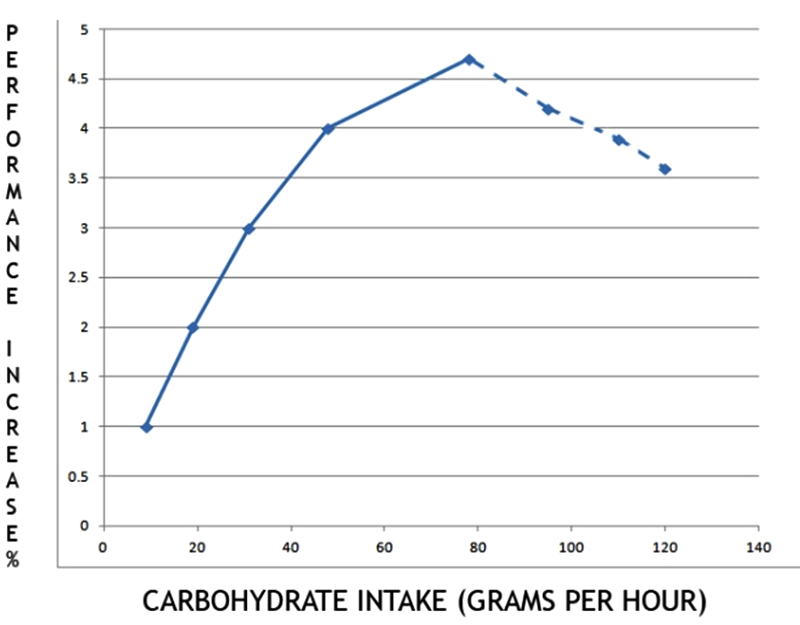
Another option is the ‘ample approach’, where you aim to consume large amounts of carbohydrate regardless so that even if you exceed the recommended guidelines, you know that you’re at least getting the ‘sufficient amount’ – a kind of sledgehammer strategy. However, while this strategy might sound simple and appealing, some research has suggested it could be counterproductive. In a 2013 study, US scientists studied highly-trained 51 cyclists and triathletes who completed a number of cycling trials(12). Each trial consisted of a hard 2-hour ride at a constant intensity, immediately followed by a computer-simulated 20km time-trial, which subjects were asked to complete as quickly as possible. During the trials, the participants drank identical-tasting 2:1 glucose-fructose carbohydrate drinks, but which supplied different amounts of carbohydrate per hour: 10, 20, 30, 40, 50, 60, 70, 80, 90, 100, 110, and 120g.
As the hourly carbohydrate intake rose, so did performance (as you’d expect). However this upwards performance trend only occurred up to an intake of 78g of carbohydrate per hour (see figure 1). After that, progressively higher intakes resulted in less performance gain than that observed at 78g per hour - see figure 1. In plain English, these results suggested that using a sledgehammer approach and consuming more carbohydrate than the recommended guidelines could actually harm performance and lead to slower times.
Figure 1: Change in performance gains with varying carbohydrate (glucose/fructose) intake
Recreational athletes and optimum carbohydrate intake
The study above showed that while ingesting higher amounts of carbohydrate drinks or gels helps improve performance up to a point, beyond that point, it might actually worsen performance. This clearly establishes the principle that more is not always better – something that many athletes and even their elite coaches may not fully appreciate. However, there is another dimension to this concept, which involves the training status of an athlete.
Many of the studies involving optimum carbohydrate intake during endurance exercise have been conducted with very well-trained or elite endurance athletes. These athletes tend to be very well practiced when it comes to carbohydrate feeding during training or racing. That matters because of a concept known as ‘gut training’. Research has clearly demonstrated that the guts of athletes who are habitual carbohydrate drink and gel users can be trained over a period of time to cope with higher intakes without suffering from gastrointestinal (GI) distress(13,14). In short, the gut of a highly trained and elite cyclist is not the same as that of a weekend warrior attempting their first 100-miler! That in turn begs the question of whether the 60g-80g (or even 90g) recommended hourly intake of carbohydrate is always appropriate for recreational endurance athletes.
New research
This is a really important question to answer because if recreational athletes are ingesting the traditionally recommended (60-90 grams) amount of carbohydrate per hour but are struggling to absorb it, their performance may be not benefit, or even be worsened rather than improved. The good news is that for more clarity on this topic, we can turn to brand new research published earlier this month, which has specifically investigated carbohydrate supplementation strategies for recreational athletes rather than focusing on highly trained or elite athletes(15).
Published in the Scandinavian Journal of Medicine & Science in Sports, this study sought to answer two key questions:
· How does carbohydrate supplementation help improve the performance of recreational endurance athletes at moderate vs. heavy exercise intensities?
· Is the upper limit of carbohydrate ingestion the same for recreational athletes as for elite athletes – ie are the traditional guidelines appropriate for recreational athletes?
To do this, 12 recreationally-trained athletes were recruited for the study. In the first stage of the study, the athletes underwent testing using a ‘step-ramp-step test’ to establish two key physiological measures. A step-ramp-step (SRS) protocol differs from a standard ramp test in that instead gradually and linearly increasing test difficulty until the athlete reaches exhaustion, the SRS protocol adds specific ‘step’ phases to look at how the body responds to changing oxygen demands – ie the lag time between starting an activity and the aerobic system catching up to the energy requirement. The two key baseline measures were:
· Gas exchange threshold (GET): The point where fatiguing lactate begins to accumulate in the blood, but can still be easily cleared – ie allowing the athlete to comfortably maintain that pace.
· Maximal metabolic steady state (MMSS): The highest exercise intensity at which an athlete can maintain a stable physiological state before fatigue due to lactate accumulation becomes exponential.
These measures were then used to set the individualized exercise intensities in the experimental stages that followed.
Related Files
What they did
Once the baseline measures had been taken, all the participants completed nine visits each on nine separate occasions. During these visits to the lab, each participant undertook three types of exercise trial using three different constant power outputs (ie each type of exercise trial/power output was repeated three times). The three types of exercise trials were as follows:
· Moderate intensity: where the participants cycled for 120 minutes at 90% of GET. This represents moderate-intensity, steady-state exercise where fat burning provides a significant proportion of the energy. This was followed by a flat-out 4km time trial.
· Hard intensity: where the participants cycled for 90 minutes with power set at an extra 20% of the difference between GET and MMSS. This equates to a quite challenging/hard tempo pace. As above, this was followed by a flat-out 4km time trial.
·
· Very hard intensity: where the participants cycled for 60 minutes with power set at an extra 80% of the difference between GET and MMSS (ie very near to maximum sustainable output) followed by a 4km time trial. This equates to a very high-intensity endurance effort.
In each of the three repeats of the three types of exercise trials, a different carbohydrate intake regime was used. These were as follows:
· Placebo (PLA): A flavored drink without any carbohydrate in.
· Low-carbohydrate drink: A delivering 40 grams per hour of glucose/fructose carbohydrate blend that tasted identical to the placebo.
· High-carbohydrate drink: as above but delivering 90 grams per hour.
All of these trials and drink combinations were completed in a completely randomized order to minimize any ‘learning’ or expectation effects. The key performance metric the researchers wanted to track was how the participants performed in each 4km time trial (ie how much energy they had left in the tank to sprint or finish a race after the primary exercise block), how the different carbohydrate intakes affected that performance, and what effect the previous primary exercise block had on the benefits or otherwise of that carbohydrate intake.
What they found
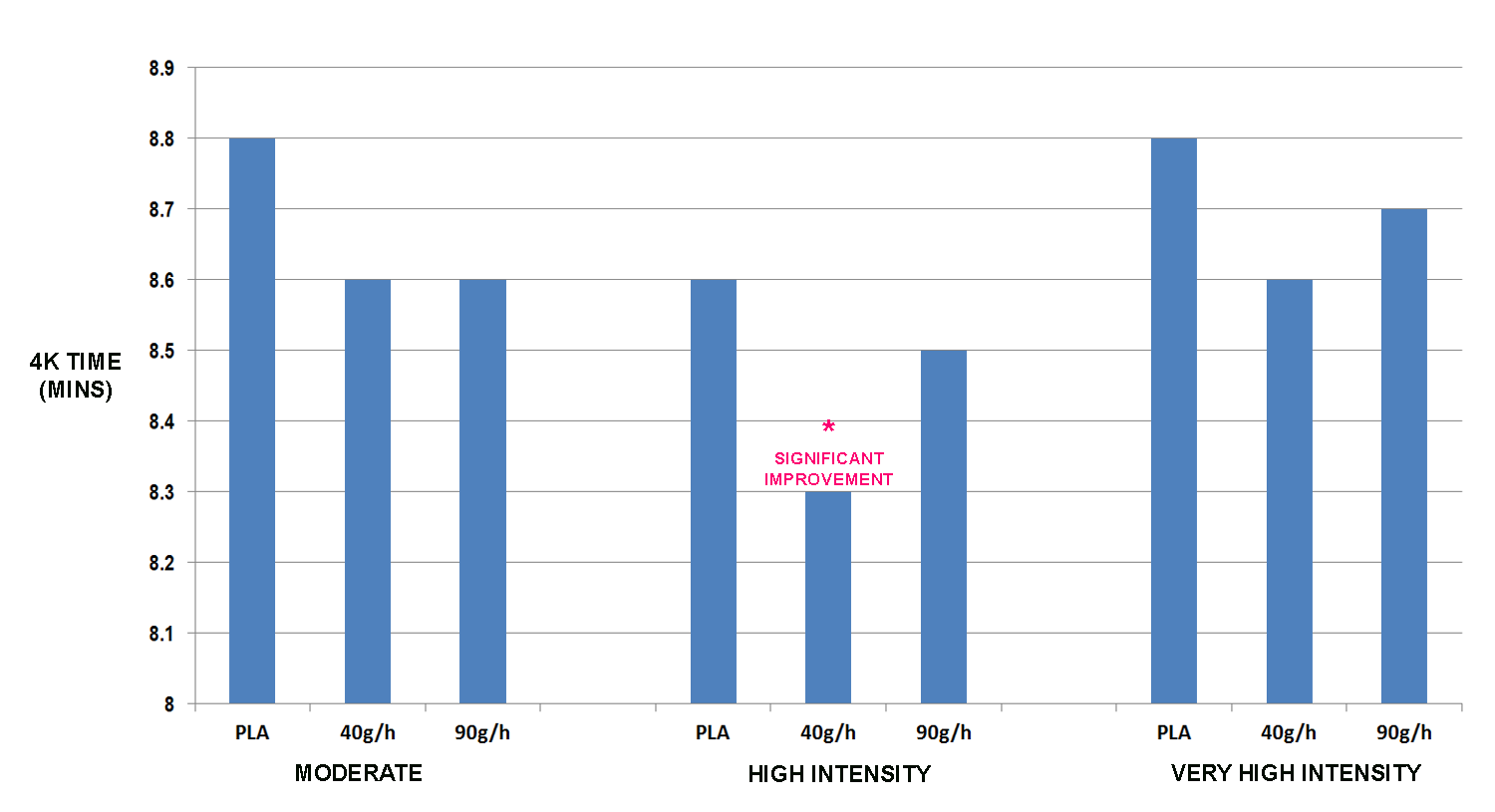
The results were fascinating and showed a) that for recreational athletes, more carbs aren’t always better and b) how much benefit you can expect from ingesting carbohydrate during exercise depends on the intensity of the preceding exercise. Getting down to specifics (see figure 2):
· Moderate-intensity exercise - after 120 minutes of moderate-intensity exercise, there was no significant difference in 4 km time trial performance between the placebo, recommended dose, or high dose carbohydrate drinks.
· Hard-intensity exercise – When the athletes had been cycling for 90 minutes at a hard intensity (tempo) pace, the benefits of carbohydrate ingestion began to show its hand with the 40g/hour dose improving time trial performance by 18 seconds (reducing it from 8.6 minutes to 8.3 minutes). Importantly however, the higher (90g/hour) carbohydrate dose produced ZERO benefit whatsoever over the placebo drink.
· Very-high intensity exercise - After 60 minutes of very high-intensity cycling, carbohydrate supplementation again showed no significant benefit across any group. While there was a slight trend to faster times with carbohydrate, especially at 40g/hour, this wasn’t strong enough to be considered statistically significant (ie it could have happened through chance).
Figure 2: 4km performances across different exercise intensities/carbohydrate intakes
Summary and practical advice for recreational athletes
This new research adds further weight to the argument that recreational endurance athletes are NOT the same as elite athletes, and are therefore unlikely to benefit in the same way from the same traditional nutritional strategies used by elite athletes. In this study, it was the lower carbohydrate intake (40 grams per hour) consumed during the high-intensity exercise that resulted in significant performance gains. But why did carbohydrate supplementation at both doses fail to benefit these recreational athletes when taken during the lower (moderate) and very high intensity exercise bouts?
In the former case, this is likely because two hours of easy exercise was probably not sufficient to deplete carbohydrate stores enough for carbohydrate external supplementation to make a meaningful difference in the 4km time trial because fat oxidation had provided much of the energy requirement. In the later case, the 60 minutes of very high exercise intensity exercise may have imposed too much physiological stress for the athletes to absorb and benefit from additional carbohydrate. Also, 60 minutes may not have been a long enough timescale in which to deplete muscle glycogen sufficiently so that performance was negatively impacted.
Another question is why the 90 grams per hour protocol of carbohydrate supplementation seemed ineffective at enhancing performance in the tempo trial? This is where the highly-trained guts of the pros differ to those of recreational athletes; elite athletes are much more efficient at transporting carbohydrate from the intestine to the bloodstream and thus benefit from higher doses up to 90 grams per hour. In recreationally trained athletes however, this high dose likely exceeds the gut’s absorption capacity, leading to no extra metabolic advantage or even negative effects such as gastrointestinal discomfort. Remember too that even at moderate or tempo pace, elite endurance athletes (because of their extraordinary fitness levels) are burning far more calories per hour than recreational athletes, which is yet another reason why elites benefit more from high carbohydrate intakes.
In terms of take-home messages, the first is that recreational athletes do not have the same nutritional requirements as the elites. Unless you are an elite athlete training or competing at very high power outputs over a long period of time, trying to cram in 80 or even 90 grams per hour of carbohydrate is almost certainly unnecessary, and may even be counterproductive due to the risk of gastic distress. A better option therefore is to aim for 40 grams per hour of carbohydrate intake, possibly up to 60 grams per hour max if you are at the very fit end of the recreational spectrum.
Interestingly, it was just at the end of last year when we highlighted recent research on recreational runners and cyclists competing in marathons and long-distance cycling events; the average intake in these athletes was around 40 grams per hour – exactly in line with this brand new research. Is it the case that recreational athletes instinctively gravitate to what works best in practice?
Another take home message is that at low or very high intensities, you are unlikely to benefit as much from carbohydrate supplementation for the reasons given above. If you regularly train for two hours at slow-moderate intensity once per week, it’s unlikely you’ll benefit from carbohydrate supplementation. In fact, taking none might be better because it will enhance your body’s ability to train the fat-burning pathways more efficiently. In warm conditions however, don’t forget to take fluid and electrolytes! Finally, recreational athletes should not feel pressured to follow an ‘elite’s’ nutritional plan for training or competition. More carbohydrate is not always better for a recreationally-trained gut less equipped to absorb it – and may actually be worse!
References
1. Acta Physiol Scand 1967; 71:129-139
2. Oxford Textbook of Sports Medicine, 2nd edn. New York: Oxford University Press 1998
3.J Appl Physiol. 1994; ss76(3):1014-9
4. J Appl Physiol 2004; 96: 1285–1291
5. Med Sci Sports Ex 1993; 25:42-51
6. Int J Sports Med 1994; 15:122-125
7. Med Sci Sports Ex 1996; 28: i-vii
8. J Athletic Training 2000; 35:212-214
9. Med Sci Sports Exerc. 2008 Feb;40(2):275-81;
10. Appl Physiol Nutr Metab. 2012 Jun;37(3):425-36;
11. Int J Sport Nutr Exerc Metab. 2010 Apr;20(2):122-31
12. Med Sci Sports Exerc. 2013 Feb;45(2):336-41
13. Appl Physiol Nutr Metab. 2017;42(5):547–557
14. Scand J Med Sci Sports. 2018;28(2):630–640
15. Scand J Med Sci Sports. 2026 May;36(5):e70288

Andrew Hamilton

Latest Issue

Subscribe Today
Newsletter Sign Up
Testimonials
Dr. Alexandra Fandetti-Robin, Back & Body Chiropractic
Elspeth Cowell MSCh DpodM SRCh HCPC reg
William Hunter, Nuffield Health
Editor's Picks
Subscribe Today


Newsletter Sign Up

Coaches Testimonials
Dr. Alexandra Fandetti-Robin, Back & Body Chiropractic
Elspeth Cowell MSCh DpodM SRCh HCPC reg
William Hunter, Nuffield Health
Subscribe Today
Latest Issue

Keep up with latest sports science research and apply it to maximize performance
Today you have the chance to join a group of athletes, and sports coaches/trainers who all have something special in common...
They use the latest research to improve performance for themselves and their clients - both athletes and sports teams - with help from global specialists in the fields of sports science, sports medicine and sports psychology.
They do this by reading Sports Performance Bulletin, an easy-to-digest but serious-minded journal dedicated to high performance sports. SPB offers a wealth of information and insight into the latest research, in an easily-accessible and understood format, along with a wealth of practical recommendations.
*includes 3 coaching manuals
Get Inspired
All the latest techniques and approaches


Sports Performance Bulletin helps dedicated endurance athletes improve their performance. Sense-checking the latest sports science research, and sourcing evidence and case studies to support findings, Sports Performance Bulletin turns proven insights into easily digestible practical advice. Supporting athletes, coaches and professionals who wish to ensure their guidance and programmes are kept right up to date and based on credible science.
