
 close
close


 LOGIN
LOGINYou are viewing 1 of your 1 free articles. For unlimited access take a risk-free trial
Muscle cramp conundrum: what really works for prevention?
As any athlete who’s suffered will testify, muscle cramping can be a disaster for endurance performance. SPB unpicks the recent research to find out which cramping prevention strategies work best


As summer has arrived and temperatures rise, athletes in warmer climates may be thinking about how best to manage the challenges that hot weather brings. This is especially true for endurance athletes undertaking long-duration events where heat has time to take its toll. One of the biggest of these challenges is to prevent overheating and the performance-sapping effects of a rise in core temperature – something that can be achieved with various cooling strategies. Another is to ensure adequate hydration since even moderate water losses as a result of sweating can lead to a significant drop in performance (see this article). But while cooling and hydration strategies can mitigate much of the downsides of heat, there’s another aspect that can be more challenging – muscle cramps.
What causes muscle cramps?
Despite being a very common condition in athletes, the exact causes of cramps have remained something of a mystery. What is known is that cramping occurs when the mechanisms controlling the electrical stimulation of muscle fibres (contraction - motor unit firing) and subsequent deactivation (relaxation) become impaired in any way. Physiological factors that have been investigated as possible contributors to this impairment of electrical control include.
● Inadequate hydration and insufficient levels of the electrolyte minerals in muscles;
● Poorly-trained muscles that are inflexible and/or insufficiently conditioned for the exercise being undertaken (muscle cramps are much more likely to occur in muscles that are unused to vigorous training).
● Inadequate rest and recovery; we know that muscles are much more likely to cramp when fatigued.
However, most authorities agree that ‘true cramps’ – those we normally associate with vigorous exercise, fatigue and dehydration/electrolyte imbalances etc - are caused by hyperexcitability of the nerves that stimulate the muscles, which also explains why much attention on preventing cramps has been focussed at minimising this excitability through optimum nutrition and conditioning protocols.
Cramp confusion
Studies on athletes investigating the causes of cramps have often produced mixed results. For example, research on ultra-distance marathon runners compared data from those who suffered exercise-induce cramps and those who didn’t to see how the runners’ electrolyte and fluid balance affected the risk(1). It found no difference in blood electrolyte concentrations and no alteration in hydration status in runners with ‘exercise associated muscle cramping’ (EAMC).
Despite the lack of rock-solid evidence however, most scientific authorities agree that any cramp-prevention strategy should at the very least aim to maintain adequate hydration – because all electrical signalling activity in the muscles takes place in an aqueous (water) environment and even small shortfalls in hydration levels could lead to impaired electrical signalling and an increased risk of cramping(2).
In addition, replenishing energy (carbohydrate) is important because even small drops in the level of stored muscle carbohydrate (glycogen) can lead to increased fatigue, which may in turn increase the risk of muscle cramps. Another area where most scientists agree is the value of stretching; good evidence suggests that a regular stretching program targeted at muscles prone to cramping can reduce the incidence of exercise associated muscle cramps as well as stopping cramp once it’s started(3,4). Passive static stretches held for 15-30 seconds at time seem to be most effective but the mechanism for this benefit is unclear.
The neurological dimension
It was almost exactly ten years ago that SPB reported on groundbreaking research showing the importance of the neurological system in the aetiology of muscle cramping. This backdrop to this story began when two avid sea kayakers sustained a serious episode of muscle cramps while winter paddling. However, it just so happened that one of these kayakers was a Nobel laureate in chemistry with a specialist interest in ion channel activation in the nervous system, while the other was a professor of neurophysiology at Harvard Medical School. To cut a long story short, they decided to dig deep into the mechanism of exercise-induced muscle cramps, and having eliminated electrolyte imbalances as a cause, decided to focus instead on the neurological dimension.
What they discovered was that muscles need to be ‘innervated’ to cramp effectively, implying the nervous system (not muscles) as a key element of muscle cramps. This discovery also raised the intriguing possibility that a ‘nerve block’ might be able to prevent cramps. The nerve block they had in mind was very novel - a strong sensory stimulus input into the brainstem and spinal cord in order to ‘shock’ the nervous system. Such a shock is able to activate proteins called ‘TRP ion channels’, which helps to tone down any overexcitability in the motor neurons that supply the muscles and which can lead to cramps.
They hypothized that a good way of delivering this strong sensory stimulus or ‘shock’ would be to use mix of ginger, cinnamon and capsicum from spicy pepper plants; by applying a strong sensory input and stimulating receptors in the mouth and oesophagus, the theory was that the pungent taste would overload nerve receptors, thus activating the TRP ion channels and producing a kind of numbing effect.
To confirm this, a number of carefully controlled scientific study was conducted, which showed that a) this spice combination was very effective at activating the TRP ion channels and secondly, was highly effective in preventing muscle cramping when taken before electric muscle stimulation (to induce muscle cramping)(5). Compared with findings in untreated participants, muscle cramp intensity and frequency was reduced 3-fold. Even better, this preventative effect was evident within minutes of taking the spice combination and lasted up to 8 hours.
No cure all
The study above provided solid evidence for a powerful neurological element in muscle cramping. However, a follow-up study the following year by German researchers was somewhat less convincing. They used TRP activators to see if/how cramp threshold frequency (the level of electrical stimulation needed to produce muscle cramping), and cramp intensity (the amount of cramping as measured by electrical activity in the muscles) reduced following electrical stimulation on muscles in 22 healthy young volunteers(6). What the findings showed was that ingesting TRP activators resulted in a slightly higher resistance to muscle cramping (around 50% higher) after 15 minutes or so, but that this effect was more short-lived than in the study above, and had disappeared within about four hours. Meanwhile, when cramp did occur, there was no difference in cramp intensity or perceived pain between the TRP activated group and the controls.
Recent thinking
Following this initial flurry of research into the neurological basis for muscle cramps, very little further research in this area was carried out subsequently, which means that scientists have remained rather unclear about definitive cramping mechanisms – and importantly how to prevent it. But has there been any further progress in determining how athletes can best prevent muscle cramping during exercise? Some researchers have revisited the original approach to this question – by tracking athletes in the real world undertaking a lengthy endurance event, seeing which athletes got cramp and which didn’t, then looking to see what factors might have explained the difference.
In 2022, a team of Spanish researchers compared measures of dehydration, blood electrolytes, and markers of muscle damage between runners who suffered exercise-associated muscle cramps (EAMC) and runners who did not suffer EAMC in a road marathon(7). They also looked at race pacing and training background. Ninety eight runners participated in the study. Before and after the race, a 3-minute cardio test was carried out to assess the runner’s second lactate threshold (VT2 – where lactate begins to rapidly accumulate) and maximum oxygen uptake. Blood and urine samples were collected and body mass was measured. Of the runners, 88 finished the marathon, and of these 20 (24%) of them developed EAMC during or immediately after the race.
Crampers vs. non-crampers
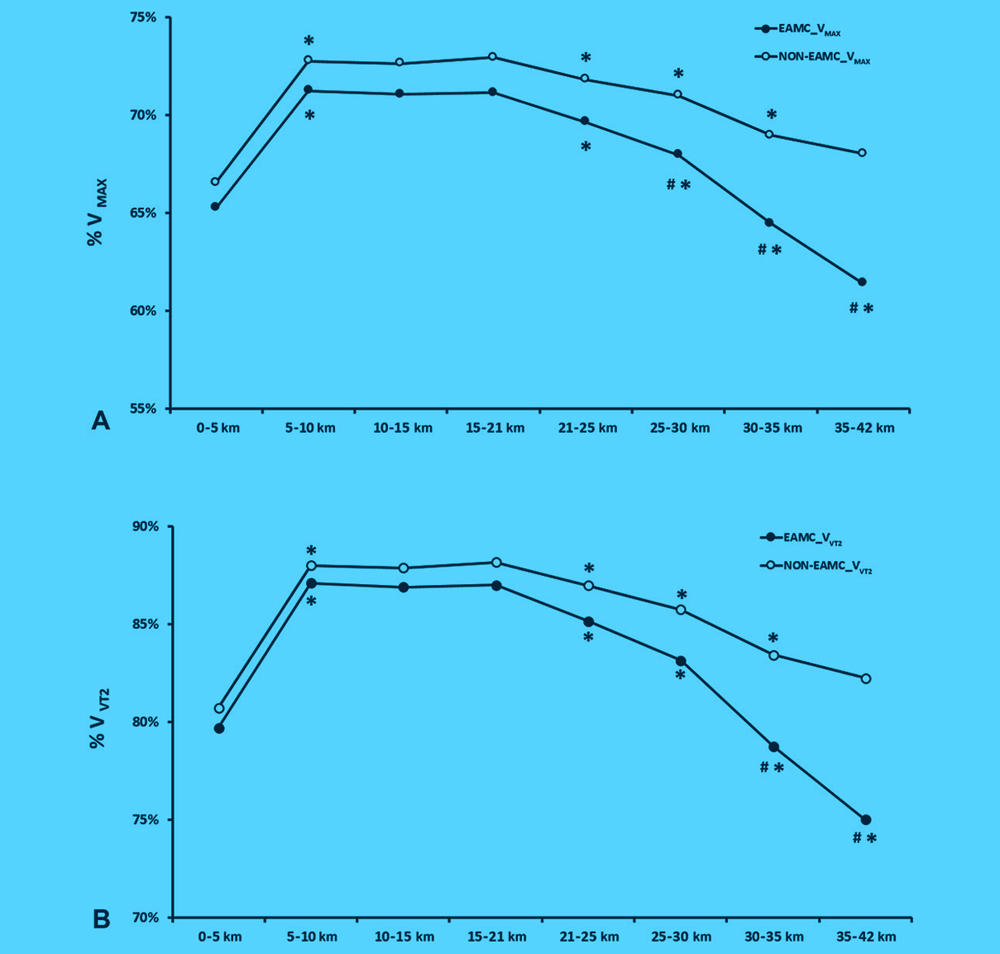
An analysis showed that body mass change (ie fluid loss), post-race urine concentration, and blood levels of sodium and potassium were NOT different between crampers and non-crampers. However, the runners who suffered EAMC showed significantly greater levels of muscle damage, both immediately after the race and at 24 hours later. The relative pace of the crampers and non-crampers differed slightly, but only from the 25km mark onwards, where the crampers slowed more (see figure 1). This was not down to the non-crampers being fitter or more experienced as the number of years running, number of previous marathons, average weekly training days, running volume and training hours were NOT different between crampers and non-crampers!
What was very interesting however was that the percentage of runners who included strength conditioning in their race training differed between the campers and non-crampers; 48% of the non-crampers had regularly strength trained vs. just 25% of the crampers. This, along with the muscle damage findings hints that building muscle strength and resilience with strength training could help muscles to become more resistant to cramping. In summary, hydration, electrolyte losses and the runners’ backgrounds seemed to have no impact on cramping risk, but the levels of muscle damage sustained and their strength training background did!
Figure 1: Pacing of the crampers vs. non-crampers
Ironman triathletes: 3 decades of data
For another insight into what might affect muscle cramping risk in real athletes competing in real-world conditions, we can turn to very recent research published by US scientists from Washington State University earlier this year(8). In this study, the researchers looked back (retrospectively) to explore the associations and trends in athletes experiencing exercise-associated muscle cramps (EAMC) in ultra-endurance competitions (where cramping can be a particular challenge). Although this was a retrospective study, and therefore considered less rigorous than a prospective (looking forward) study, the researchers looked at a huge number (10,553) of medical records. That matters because big numbers make it easier to accurately spot trends and patterns, even when looking backwards.
These medical records were sourced from medical tent data collected from three decades of annual IRONMAN World Championship events among 49,530 race participants, spanning 1989 to 2019. The main goal was to compare triathletes with and without EAMC to see which athlete characteristics most predicted cramps, and whether cramping was linked to any additional medical conditions. What they found was as follows:
· EAMC occurred in just under 6% of the 49,530 race participants.
· The incidence of EAMC did not differ between male and female triathletes.
· Athletes who suffered cramping had a greater weight loss (ie were more dehydrated) than non-crampers.
· There was no difference in blood levels of sodium and potassium between crampers and non-crampers. In other words, electrolyte imbalances were NOT associated with cramping.
A further analysis revealed that dehydration, exhaustion, hypotension, abdominal pain, headaches, and a previous treatment for cramping were strongly associated with muscle cramping. When summing up, the researchers concluded that their findings supported previous research showing that electrolyte abnormalities are not associated with cramping. But unlike some other studies, they found that dehydration IS associated with muscle cramping.
Practical implications for athletes
There’s still a lot that scientists don’t understand about exactly why and how muscle cramping occurs and how to prevent it. But we can draw together the findings outlined above and make some ‘best practice recommendations based on our current understanding. The first thing to say is that one finding that is universally agreed upon is that electrolyte imbalances seems to have little impact on the risk of muscle cramping during exercise. So if you regularly suffer from cramping during exercise, taking salt tablets, electrolyte drinks or other similar products are unlikely to help. However, that doesn’t mean your intake of electrolyte minerals (sodium, potassium and magnesium) doesn’t matter at all. For example, low levels of potassium or sodium are known to be associated with an increased risk of heart arrhythmias(9).
Hydration is a different matter. The evidence for dehydration increasing the risk of cramping is mixed, with some studies finding it does increase risk and other finding it doesn’t. Quite apart from cramping however, given that keeping adequately hydrated is known to help performance, and since dehydration levels of over 2% of body mass can harm performance, it makes sense to err on the side of caution and ensure you keep well hydrated during long-duration events in warm or hot conditions. Basically, there’s no downside and possibly a cramp-prevention upside.
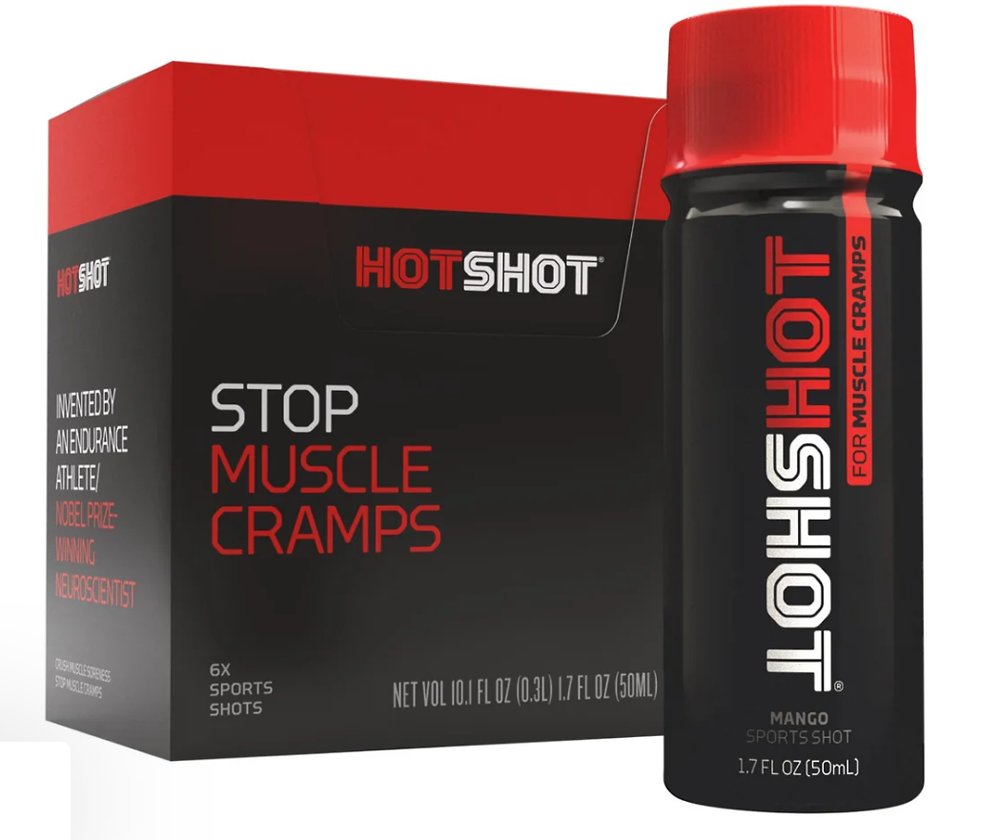
When it comes to using spices such as capsicum pepper to induce a ‘neural shock’, thereby desensitizing muscles to cramp-producing electric stimuli, there’s some good data this is effective but ideally more research is needed before we can be fully confident. That said, there’s little harm in trying it for yourself by taking some hot pepper product before training or competition. If you live in the US, the good news is that you can buy a ready-made drink product called ‘HOTSHOT’, which contains hot pepper and spices, using this principle as an anti-muscle cramping aid (see figure 2).
Figure 2: HOTSHOT pre-exercise anti-cramping drink
Finally, another strategy that might offer significant benefits is to try and build pre-race muscle resilience to muscle damage. In the study on ultra-marathoners, adding in strength training to a running program led to a 50% reduction in cramping risk. More research on this topic is needed, but apart from a small time investment, there are no downsides to this approach. Not only could it help reduce the incidence of cramping, but strength training is known to boost muscle economy. This means that muscles work more efficiently at sub-maximal pace, reducing oxygen demand and fatigue, helping improve endurance performance. On top of that, a well designed strength program can also help lower injury risk, which means that you could be getting a triple-whammy of benefits!
References
1. Br J Sports Med. 2004 Aug;38(4):488-92
2. Int J Sport Nutr Exerc Metab. 2005 Dec;15(6):641-52
3. J Sports Sci 1997 Jun;15(3):277-85
4. Clin Sports Med 2008 Jan;27(1):183-94, ix-x
5,. Neurology April 6, 2015 vol. 84 no. 14 Supplement S17.003
6. Eur J Appl Physiol. 2017 Aug;117(8):1641-1647
7. J Strength Cond Res. 2022 Jun 1;36(6):1629-1635
8. Clin J Sport Med. 2026 Jan 1;36(1):30-35. doi: 10.1097/JSM.0000000000001276
9. Front. Physiol. 9:1500. doi: 10.3389/fphys.2018.01500 Cardiovasc J Afr. 2022;33(2):98-100

Andrew Hamilton

Latest Issue
Subscribe Today
Newsletter Sign Up
Testimonials
Dr. Alexandra Fandetti-Robin, Back & Body Chiropractic
Elspeth Cowell MSCh DpodM SRCh HCPC reg
William Hunter, Nuffield Health
Editor's Picks
Subscribe Today
Newsletter Sign Up
Coaches Testimonials
Dr. Alexandra Fandetti-Robin, Back & Body Chiropractic
Elspeth Cowell MSCh DpodM SRCh HCPC reg
William Hunter, Nuffield Health
Subscribe Today
Latest Issue
Keep up with latest sports science research and apply it to maximize performance
Today you have the chance to join a group of athletes, and sports coaches/trainers who all have something special in common...
They use the latest research to improve performance for themselves and their clients - both athletes and sports teams - with help from global specialists in the fields of sports science, sports medicine and sports psychology.
They do this by reading Sports Performance Bulletin, an easy-to-digest but serious-minded journal dedicated to high performance sports. SPB offers a wealth of information and insight into the latest research, in an easily-accessible and understood format, along with a wealth of practical recommendations.
*includes 3 coaching manuals
Get Inspired
All the latest techniques and approaches


Sports Performance Bulletin helps dedicated endurance athletes improve their performance. Sense-checking the latest sports science research, and sourcing evidence and case studies to support findings, Sports Performance Bulletin turns proven insights into easily digestible practical advice. Supporting athletes, coaches and professionals who wish to ensure their guidance and programmes are kept right up to date and based on credible science.
