
 close
close


 LOGIN
LOGINYou are viewing 1 of your 1 free articles. For unlimited access take a risk-free trial
Carbohydrates for performance: glycemic ups and downs
Does the energy release rate of your dietary carbohydrates affect performance? Andrew Sheaff looks at new research



For the last 50 years, carbohydrates have been recognized for their importance in endurance performance. As the interest in carbohydrate fueling expanded, researchers became more and more interested in how carbohydrate consumption influences blood sugar response. That’s because not all carbohydrate consumption increases blood glucose levels with equal speed, with some foods increasing blood sugar levels much more dramatically than others, despite the ingesting the same amount of carbohydrate.
Glycemic load matters
The rate at which glucose enters the blood after eating is related to what’s known as the ‘glycemic load’ of a meal. High glycemic loads raise blood sugar quickly, and this can quickly reduce fat oxidation, as there is no need to burn fat when there is plenty of glucose around. This is potentially problematic as fat can be a very important fuel, especially during long duration exercise. In addition, when blood sugar goes up quickly it often comes down quickly, and unstable blood sugar levels can make functioning and performing at a high level problematic.
For these reasons, many athletes are guided to emphasize lower glycemic foods to avoid these effects. However, it’s not clear the extent to which blood glucose variations are relevant to athletes, and how relevant they are over 24-hour periods. In the past, technology has made it very difficult to measure blood glucose continuously outside of a laboratory setting, which proved to be a major obstacle in studying this issue.
However, with the emergence and commercialization of minimally-invasive continuous blood glucose monitors, it’s now much easier and much less expensive to measure blood glucose levels in real time. This makes it possible to answer whether a difference in glycemic load can lead to meaningful differences in blood glucose levels over extended periods of time, and whether differences in diet actually lead to difference in performance.
New research
A group of European researchers has investigated the impact of high- and low-glycemic diets on glycemic control in trained ultra-endurance athletes(1). The primary goal of the study was to investigate the consumption of both a low-glycemic and a high-glycemic diet during training. This study was performed as a crossover design, where all subjects served as their own control, performing both versions of the study (which leads to more robust evidence).
The runners performed each diet (high-glycemic and low-glycemic) for 28 days, followed by a 14-day return to a habitual eating patterns between the two diets. The diet order was randomized for each subject. Based upon a habitual diet log completed before the study, subjects were provided with high-glycemic or low-glycemic substitutions for the foods they were already eating. This enhanced the athletes’ compliance without compromising the diet effectiveness. In addition, subjects were recommended to use carbohydrate supplements during training and throughout the day. When in the high-glycemic trial, subjects were provided with maltodextrin, a high-glycemic carbohydrate, and when in the low-glycemic arm isomaltulose, a low-glycemic carbohydrate.
At the beginning and end of each leg of the study, the athletes performed exercise testing and blood glucose responses were measured. After an overnight fast, the subjects also performed a 3-hour run. The run was performed at an average of 71% of heart rate max. Following the run, they refueled with either maltodextrin or isomaltulose, depending on which diet they had been following. Refueling was performed at a rate of 0.75 grams of carbohydrate per kilogram of bodyweight per hour over a 3.5-hour period. Following the re-feeding, the subjects performed another treadmill test to exhaustion at 74% of their maximal aerobic capacity (V02max) speed (calculated during initial testing exercise prior to the dietary interventions.
Throughout the 28-day period, subjects wore a continuous glucose monitor to keep track of blood glucose levels. A variety of measures were calculated from these data, including maximal, minimal, and average glucose values, the standard deviation (spread) of glucose levels, as well as time spent in, above, and below targeted ranges. These measurements provided a comprehensive understanding of blood glucose dynamics. During the trial days, carbohydrate and fax oxidation were measured directly during the first hour of the endurance run capacity test.
What they found
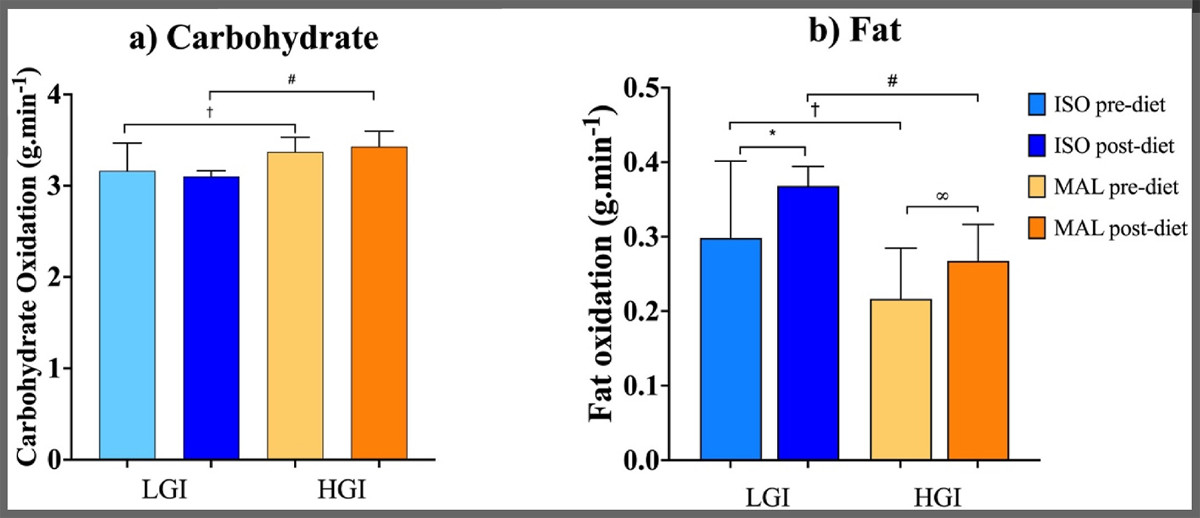
While glucose responses across the study were similar between high and low glycemic index diets, several differences emerged. The high-glycemic trial saw slightly lower minimum blood sugar values, and blood sugar levels were more variable compared to the low glycemic arm (which was more stable). Fat oxidation was higher during the 3-hour run in the low-glycemic arm of the study, and carbohydrate oxidation was lower, potentially implying a carbohydrate sparing effect (see figure 1). Following the recovery from the 3-hour run, blood sugar was spiked higher in the high glycemic group and was followed by a greater dip afterwards. However, there was no
measurable distinction in performance since the total distance covered and the mean heart rates were not significantly different between the two diets. Likewise, performance was similar in the run to exhaustion, with only the high-glycemic arm of the diet showing a slight lowering of heart rate despite no changes in performance.
Figure 1: Fuel oxidation data during the indoor treadmill run to exhaustion
Practical applications for athletes
It appears that low glycemic load diets can reduce blood glucose variability and potentially enhance fat oxidation, but it’s not immediately obvious how impactful these differences are. From a purely performance perspective, it appears that low- and high-glycemic diets do not have a differential impact on performance. That being said, there was a lot of variability in the data, and just because there weren’t differences in performances measures at a group level, it doesn’t mean there won’t be meaningful differences at an individual level.
Fortunately, the cost of continuous glucose monitors makes them accessible for those that are interested, and depending on where you live, they are easily accessible as well. If you’re interested in the impact of different dietary strategies on your blood glucose levels, you can test it out for yourself. And if you’re interested in improving blood glucose stability, as well as enhancing fat oxidation, this study provides evidence that these ae achievable outcomes with a shift in carbohydrate choice patterns.
It’s important to note though that the subjects changed the glycemic load of the diet, not the carbohydrate content of the diet. Both groups consumed approximately 58% of their calories from carbohydrates, but the food choices they made, and the carbohydrate supplements they used, were different. Therefore, if you choose to manipulate the glycemic load of your diet, you need to emphasize changing the types of carbohydrates consumed (glycemic index) and not the total carbohydrate content to realize the potential benefits. The best way to achieve this is to substitute a carbohydrate for another with a high/lower glycemic index (GI) value as required. An excellent and validated tool to help you do this is to use the searchable database maintained by the University of Sydney’s Glycemic Index Research Service where can look up specific carbohydrates and their GI numbers directly.
References
1. Eur J Sport Sci. 2025 Dec;25(12):e70092. doi: 10.1002/ejsc.70092.
Related Files

Latest Issue

Subscribe Today

Newsletter Sign Up
Testimonials
Dr. Alexandra Fandetti-Robin, Back & Body Chiropractic
Elspeth Cowell MSCh DpodM SRCh HCPC reg
William Hunter, Nuffield Health
Editor's Picks
Subscribe Today




Newsletter Sign Up

Coaches Testimonials
Dr. Alexandra Fandetti-Robin, Back & Body Chiropractic
Elspeth Cowell MSCh DpodM SRCh HCPC reg
William Hunter, Nuffield Health
Subscribe Today
Latest Issue


Keep up with latest sports science research and apply it to maximize performance
Today you have the chance to join a group of athletes, and sports coaches/trainers who all have something special in common...
They use the latest research to improve performance for themselves and their clients - both athletes and sports teams - with help from global specialists in the fields of sports science, sports medicine and sports psychology.
They do this by reading Sports Performance Bulletin, an easy-to-digest but serious-minded journal dedicated to high performance sports. SPB offers a wealth of information and insight into the latest research, in an easily-accessible and understood format, along with a wealth of practical recommendations.
*includes 3 coaching manuals
Get Inspired
All the latest techniques and approaches


Sports Performance Bulletin helps dedicated endurance athletes improve their performance. Sense-checking the latest sports science research, and sourcing evidence and case studies to support findings, Sports Performance Bulletin turns proven insights into easily digestible practical advice. Supporting athletes, coaches and professionals who wish to ensure their guidance and programmes are kept right up to date and based on credible science.
