
 close


 LOGIN
Creatine for athletes: getting the complete picture
SPB looks at new and authoritative research showing exactly what athletes can and can’t expect when using supplemental creatine to support a resistance training program


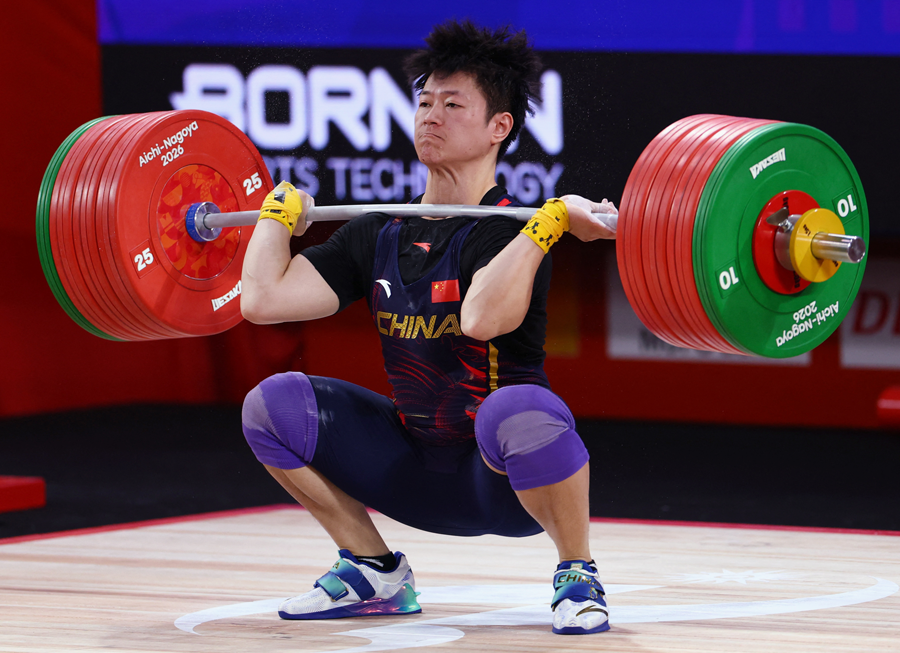
There’s a well-known saying that ‘a fool and his money are easily parted’. Unfortunately, that can all too easily be the case with sports supplements because when all the hype is stripped away and sports supplements are subjected to rigorous scientific testing, there are actually very few that have consistently been shown to safely and legally improve performance. There is good news however, for both endurance and strength athletes; caffeine is a great example of a safe and legal supplement that has been repeatedly proven to enhance endurance performance in a large number of real world scenarios. Meanwhile, for athletes whose sports require strength, power and speed, another supplement that does exactly what it says on the tin – and that is creatine.
Creatine facts
Because creatine is proven and effective for enhancing high-intensity and strength performance, it is (along with caffeine) one of the most widely studied ever sports supplements. Rather than revisit and regurgitate all the previous research on this topic, you can read everything you need to know in these SPB articles. The good news is that some review studies have gathered together and summarized all the prior research into creatine and athletic performance, and have presented conclusive evidence that creatine supplementation can benefit both high-intensity (strength/power/anaerobic) and lower intensity (endurance) performance, as well as boosting strength and muscle mass across a wide range of athletes(1-4).
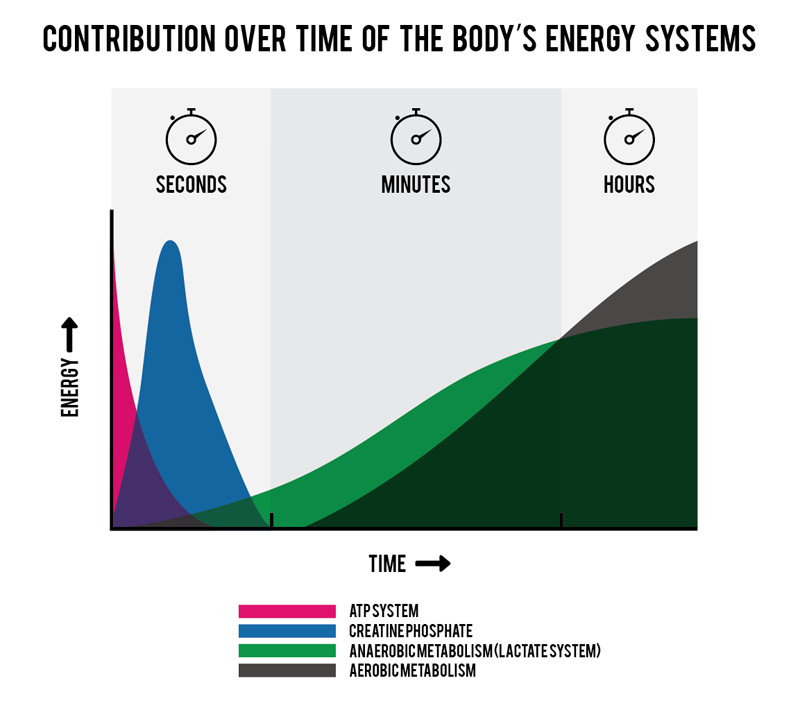
As the articles alluded to above explain, creatine exerts its effects principally by enhancing the phosphocreatine energy system, which can power very high-intensity muscle activity for short periods of time (no longer than 60 seconds – see figure 1). This allows athletes to generate a higher-intensity/higher load when strength training, producing a larger training stimulus and therefore greater gains. A secondary effect is that creatine helps to draw water into muscle cells, and the resulting increase in cell volume is believed to support growth signals inside the muscle(5). In addition, SPB contributor Andrew Sheaff also highlighted some recent research from December 2025 on how athletes can best use creatine to optimize its positive impact on their performance (see this article)(6). One of the key findings to emerge was that creatine may also positively impact recovery via reduced muscle protein breakdown rates – ie that part of the reason creatine is effective may be that it limits the amount of muscle protein breakdown following training. The research also hinted that - related to this - creatine may be able to speed up recovery following injury, surgery and/or immobilization, although this has only been clearly shown in animal models.
Figure 1: Schematic representation of contribution over time of the body’s energy systems
Questions remaining
Despite everything we know about creatine for athletic use, and the fact that has been widely used by athletes and gym-goers for over 20 years, there are still some questions that remain unanswered. In particular, despite the known mechanisms (outlined above) by which creatine is known to exert its effects, much of the previous into creatine use has been limited by the statistical analysis used by the researchers. Specifically, most previous studies have looked at only one outcome at a time (for example, creatine and lean mass alone) instead of looking at the bigger picture of what the overall effect of supplementing creatine is in athletes undergoing training. To build a more complete picture, research is needed with a statistical approach that enables researchers to look at several outcomes together (eg lean muscle mass, body fat %, upper and lower body strength etc) among a broad range of participants and undertaking a wide range of resistance programs. Fortunately, this is exactly what a team of Chinese scientists from the
New research
In a brand new study published last month in the Journal of the International Society of Sports Nutrition, the researchers carried out a meta-analysis (a study combining the results of many previous studies on a topic to obtain more robust evidence) to investigate exactly what happens when supplemental creatine is combined regular resistance training (weight training) compared with resistance training alone (ie no creatine)(7). In particular, they wanted to better understand:
· The effects of resistance training combined with creatine supplementation on muscle strength (both upper- and lower-body strength) and on body composition (lean muscle mass, fat mass, body-fat percentage, and overall body mass).
· Whether these effects were moderated by the participants’ characteristics - ie age, gender, and training experience.
· How the resistance training/supplementation protocols used - ie the length of a training program, training frequency, creatine dosing strategy and the daily dose consumed - affected the outcomes.
What they did
To do this, the researchers trawled through all the relevant previous research on creatine and resistance training that met all the following criteria:
· Participants who were adults over 18 years.
· Studies where there was a resistance training intervention combined with creatine supplementation AND a resistance training intervention with a placebo given (eg maltodextrin, dextrose, glucose etc).
· Studies where the outcome(s) measured included at least one or more of the following: upper-body strength, lower-body strength, body mass, fat mass, body-fat percentage or lean muscle mass.
· Studies that were designed using randomized controlled trials with a control group.
When all the sifting was done, 63 trials involving a total of 1,489 participants were identified and included in the analysis. The researchers then carried out a ‘3-level random-effects meta-analysis’ of all the pooled data from those 63 trials. This differs from a standard meta-analysis because it goes a step further by accounting for related data points – for example a single study reporting multiple outcomes or testing multiple experimental groups – and ensures those connected results do not unfairly distort the overall conclusions.
What they found
Once the analysis was complete, it was clear that overall, there were consistent advantages for the combination of resistance training plus creatine compared to resistance training alone (see figure 2). Key findings included:
· Upper-body strength improved by a moderate amount (effect size roughly 0.54), and lower-body strength improved by a similar amount (roughly 0.55) – NB, see box 1 for explanation of effect sizes.
· Lean muscle mass increased more with creatine than without it (effect size about 0.30).
· Total body weight rose slightly (effect size 0.12), while body-fat percentage fell by a small but detectable margin (effect size –0.14).
· Fat mass itself did not change in a statistically meaningful way; therefore, the extra weight gained in these studies was principally down to gains in lean tissue rather than by fat mass gains. (It also follows that the slight drop in body-fat percentage resulted from gains in lean muscle mass).
· Age seemed to play a role in the magnitude of creatine supplementation benefits observed, with under 45s and over 60s faring better than 45-59s. However, the researchers caution that this may just be an anomaly as the middle-aged groups were somewhat under-represented in the overall sample of 1,489 participants.
· Biological sex, prior training experience, program length, training frequency, daily creatine dose and whether a ‘loading phase’ was used had NO effect on the magnitudes of the gains experienced.
Figure 2: Results of the 3-level statistical analysis on creatine and resistance training
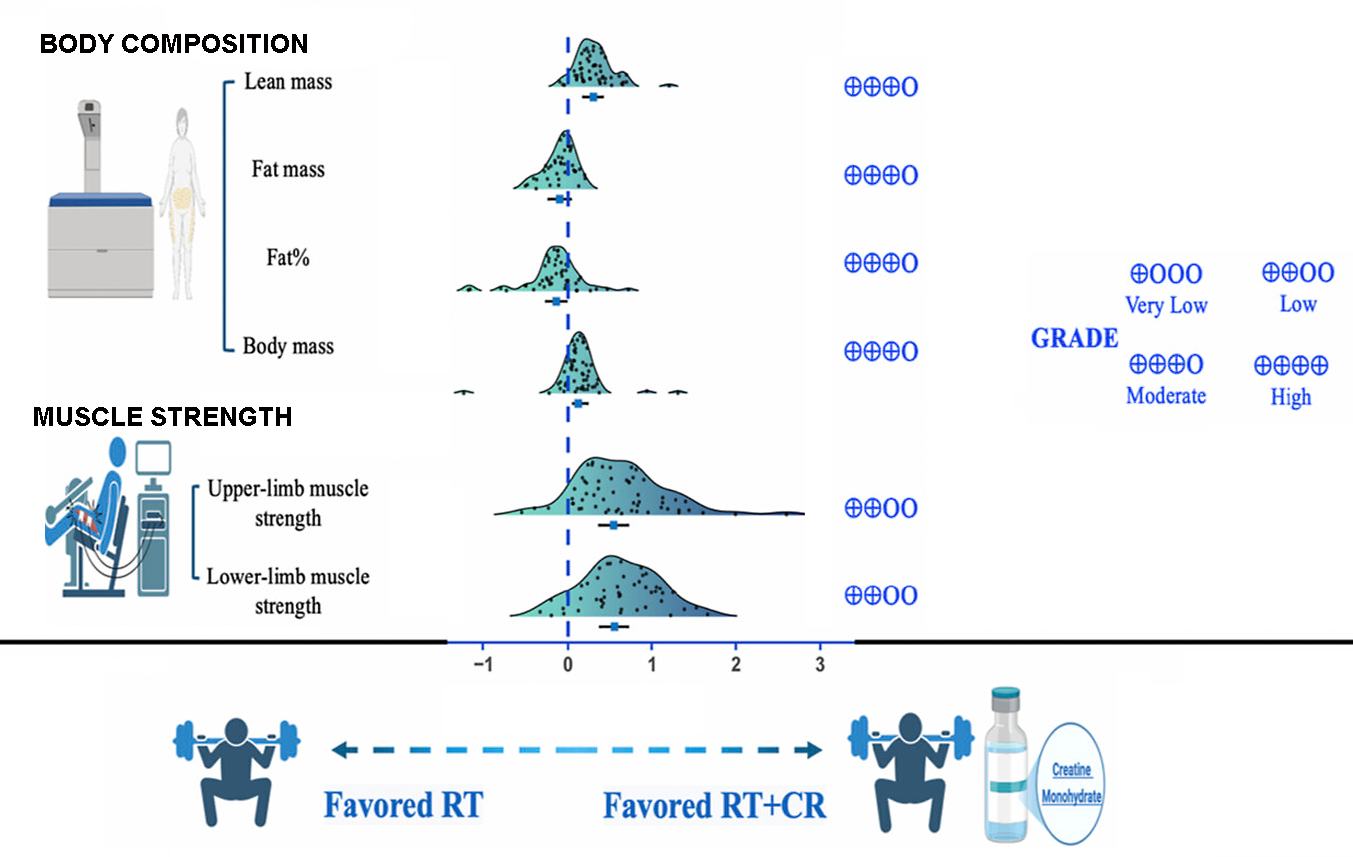
The curved areas are ‘forest plots’ showing the range of findings (from the pooled data) for each outcome investigated. The more the plot lies to the right of the zero line (ie positive), the greater the effect size and therefore greater the benefits of adding creatine supplementation to a resistance training program. We can see that lean mass and upper/lower-body strength all benefit significantly when creatine is taken. The ‘GRADE’ ratings show how confident the researchers were of each finding, with findings based on higher-quality studies boosting confidence ratings for that finding.
Graphic created using data from original study: (www.tandfonline.com/doi/full/10.1080/15502783.2026.2718316) and adapted for use by SPB with AI assistance.
Box 1: Understanding effect sizes in statistics
An effect size like ‘Hedges’ g’ (used in the above study) or ‘Cohen’s d’ measures how big or meaningful a difference or impact is in practical terms, independent of how large the study’s sample size was. To give you a feel, here are some examples of effect sizes from the study above:
*Around 0.14 (very small / trivial): this effect is so small that it is barely noticeable in real-world terms. It may show a slight trend statistically, but it has very little practical impact.
*From 0.20 to 0.49 (small to moderate): this represents a real, noticeable difference or benefit. While it might not drastically change everything, it indicates a consistent and meaningful effect (for example, a modest improvement in muscle strength from a training program).
*From 0.50 to 0.54 (moderate): at the upper end of the range in this study, a 0.50 or higher effect size is considered moderate. This is effects leads to a clearly noticeable, substantial impact that is easily seen in practice.
Practical implications for athletes
What can we make of these new findings and how do they change our understanding of how best to use creatine? The very first thing to say is that the sheer numbers of participants in this meta-analysis makes for robust findings, adding yet more evidence for the benefits of taking supplemental creatine when undertaking a resistance training program, regardless of the program design, the experience and sex of the participant or the way creatine is supplemented. It also helps to clarify what athletes can expect when adding a creatine supplement compared to training without: moderate additional gains in muscle strength and small but significant improvements in lean body mass. What creatine cannot do however is aid in a fat-management or a fat-loss program.
It’s also useful for athletes to know that the way creatine is taken doesn’t seem to affect the benefits delivered; whether you undergo an initial high-dose loading program followed by a small maintenance dose or whether you simply take a daily dose of around five grams per day over an extended period, the results are likely to be the same. However, the analysis found no clear advantage to loading once a daily dose had maintained throughout the training period, which suggests that sustained daily creatine use matters more than sophisticated loading protocols! Note also that nearly every study used in this analysis used simple creatine monohydrate as the supplemental form rather than more exotic (and expensive) forms of creatine, which suggests you should too (and save some pennies!).
Inevitably, some caveats need to be mentioned in our conclusions. Firstly, due to the very diverse natures of the included studies, the confidence levels in the findings ranged from ‘low’ to ‘moderate’. Therefore, some caution is still needed so we can’t regard this new research as absolutely 100% definitive. Secondly, although creatine delivers benefits, the right resistance training and correct daily diet are still crucially important. For optimum gains, athletes should aim to consume 1.5 to 2.0 grams of protein per kilo of bodyweight per day (120g to 160g per day for an 80kg athlete). In terms of training programs, the data showed that creatine’s benefits became apparent when programs lasted four weeks or longer, so if you try creatine out for the first time, don’t expect instant results. Finally, female participants were under-represented in the sample of 1,489 participants, so while they seemed to experience the same benefits from creatine supplementation, we can’t be quite as confident about these benefits as we can with men.
References
1. Cureus. 2023 Sep 15;15(9):e45282
2. Front Nutr. 2026 Sep 4:13:1921827. doi: 10.3389/fnut.2026.1921827
3. Front Nutr. 2026 Apr 8:13:1800546.
4. Eur Rev Aging Phys Act. 2025 Dec 13;22(1):26
5. Curr Protein Pept Sci. 2017;18(12):1273-1287.
6. J Int Soc Sports Nutr. 2025 Dec;22(1):2441760
7. J Int Soc Sports Nutr. 2026 Dec 31;23(sup1):2718316.doi: 10.1080/15502783.2026.2718316. Epub 2026 Sep 21

Latest Issue
Subscribe Today
Newsletter Sign Up
Testimonials
Dr. Alexandra Fandetti-Robin, Back & Body Chiropractic
Elspeth Cowell MSCh DpodM SRCh HCPC reg
William Hunter, Nuffield Health
Subscribe Today



Newsletter Sign Up

Coaches Testimonials
Dr. Alexandra Fandetti-Robin, Back & Body Chiropractic
Elspeth Cowell MSCh DpodM SRCh HCPC reg
William Hunter, Nuffield Health
Subscribe Today
Latest Issue
Keep up with latest sports science research and apply it to maximize performance
Today you have the chance to join a group of athletes, and sports coaches/trainers who all have something special in common...
They use the latest research to improve performance for themselves and their clients - both athletes and sports teams - with help from global specialists in the fields of sports science, sports medicine and sports psychology.
They do this by reading Sports Performance Bulletin, an easy-to-digest but serious-minded journal dedicated to high performance sports. SPB offers a wealth of information and insight into the latest research, in an easily-accessible and understood format, along with a wealth of practical recommendations.
*includes 3 coaching manuals
Get Inspired
All the latest techniques and approaches


Sports Performance Bulletin helps dedicated endurance athletes improve their performance. Sense-checking the latest sports science research, and sourcing evidence and case studies to support findings, Sports Performance Bulletin turns proven insights into easily digestible practical advice. Supporting athletes, coaches and professionals who wish to ensure their guidance and programmes are kept right up to date and based on credible science.
