
 close
close


 LOGIN
LOGINYou are viewing 1 of your 1 free articles. For unlimited access take a risk-free trial
Older athletes: strength solutions for injury rehab
Andrew Sheaf looks at new strength-training research on older athletes, and explains why training the uninjured side could be the answer when injury strikes!


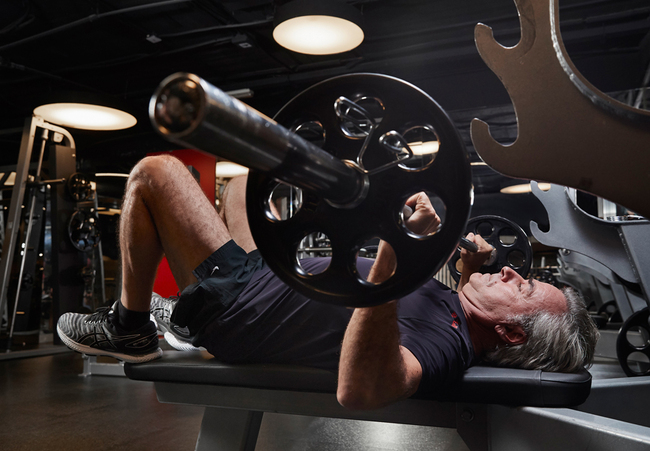
As athletes age, particularly into their senior years, they face two key challenges when striving to maintain performance. Firstly, there’s a need to minimize age-related declines in muscle power. Secondly, it’s increasingly important to avoid injuries that tend to accumulate over the course of a career. These two issues can be related as an injury disrupts the training process, preventing the training necessary to prevent losses in muscle power.
Minimizing injury impacts
Since decreases in muscle power and injury are both challenges likely to be faced by an aging athlete, it’s important to have a strategy to manage this reality. While a ‘don’t get injured in the first place’ is a great approach, injuries can still happen despite the best of intentions. And when they do, having options for minimizing their impact can make all the difference. It’s easy to assume that if an athlete injures their arm or leg and is unable to train it for some period of time, there’s nothing that can be done.
Fortunately, that’s not true. This is due to a phenomenon known as the ‘contralateral effect’, an effect we’ve explored before in previous articles. Training one arm can prevent strength and muscle losses in the other arms, even when that arm is completely immobilized (see here). Meanwhile, training one arm can make the untrained arm more resilient to muscle damage when exposed to future exercise loading (see here). What’s not as clear is whether the contralateral effect can lead to improvements in muscle power in older populations. And as resistance training can be performed using either high loads or low loads, it’s also not clear which type of training is more likely to create the best contralateral effect. Fortunately, the study we’re going to look at here has sought to answer these exact questions.
New research
A group of European researchers recruited 45 subjects to participate in a recent study designed to assess the contralateral effects of power training in older subjects(1). The subjects were all at least 65 years of age and had not been resistance training in the last three years, but were otherwise healthy and showing no signs of frailty or impaired physical function.
The study was set up as a within-person randomized control study. In other words, each subject served as their own control and was randomized into the specific intervention they performed. For all subjects, the study began with an 8-week control period, in which no training was performed. The subjects were tested before and after this control period to determine if any changes took place (ie baseline strength changes unrelated to training). Following the control period, the subjects were split into one of two groups:
· A high-load power training group.
· A low-load power training group.
The subjects trained twice per week on non-consecutive days using a horizontal leg press device. The training was performing unilaterally (ie on one side only) to allow for assessment of contralateral effects on the non-training leg.
The training
In the high-load training group, the subjects performed 6 x sets of six repetitions with a load that was 80% of their maximum 1-rep load. In the low-load training group, the subjects performed 6 x sets of twelve repetitions using a load that was 40% of their 1-rep maximum. By using half the resistance and twice the number of repetitions in the low-load group, the total volume was identical between the groups. This controlled for the amount of work that was done, allowing the researchers to compare the effect of loading intensity rather than the effect of volume. The subjects’ maximal strength was retested every four weeks to ensure the appropriate load was being used throughout the study.
For the repetitions themselves, the subjects were asked to lift the load as fast as possible, regardless of how fast the load actually moved. However, the eccentric phase of each repetition was to be performed in a controlled manner. For the high-load group, the subjects were asked to lower the load over the course of two seconds. In the low load-group, the subjects were asked to lower the load over the course of three seconds. The difference in eccentric duration accounted for the difference in challenge when lower different loads.
Testing
To evaluate the impact of the training interventions, the subjects underwent a series of tests before the control period, after the control period, and after the training period. First the subjects performed an isometric knee extension where they were tested for the maximal force they could generate, as well as how quickly they could generate force during.
The subjects also performed force-velocity testing on the same leg press device that they used during training. They performed a series of repetitions where the load progressed up to their maximum. For each repetition, the subjects tried to lift the weight as fast as possible. The load they lifted and the speed at which they lifted it were recorded. These measurements were then used to calculate several different metrics of power, included the theoretical maximal limb speed, force production, and power production.
Potential changes in muscle mass were measured using ultrasound technology, specifically examining mid-thigh cross sectional area. The larger the area, the bigger the muscle. To determine whether any improvements in strength, speed, or size were related to functional outcomes, the subjects performed three separate tests: a times 5-repetition sit-to-stand, a 3-meter timed stand up and go test, and a 30-meter maximal walking speed test. These tests all represented specific applications of power relevant to everyday life.
For all testing, the subjects used both their trained and untrained leg. The researchers didn’t just want to know if the training improved the trained leg. That wouldn’t be particularly interesting because of course it would! What they really wanted to know is whether that training led to improvements in the non-trained leg. If that’s the case, it would have important ramifications for those who can’t train a limb for an extended period of time.
What they found
Surprisingly, there was little to no impact of training on isometric strength or rate of force development for any of the training groups. However, both groups demonstrated significant improvements in leg press maximal strength of the trained leg. More importantly however, this effect was also demonstrated in the non-trained leg of both groups. The same effects were seen for maximal power, with all groups demonstrating significantly more power, both for the trained and the untrained leg.
When looking at loading, the trained legs of the high- and low-load groups improved their maximal limb speed; in the non-training leg however, this effect was only observed in the high-load group. For all groups, the force-velocity profile improved as well, with the subjects able to create more force at the same limbs speed, again, regardless of whether the leg was trained or not. In terms of muscle hypertrophy (growth), improvements were seen for the high-load and low-load trained leg. But unlike above, an improved muscle size was only observed in the non-training leg of the low-load group - see figure 1. In contrast, the 3-meter up and go time was only improved during the high-load group, with no improvements measured for the other tests.
Figure 1: Changes in mid‐thigh muscle cross‐sectional area
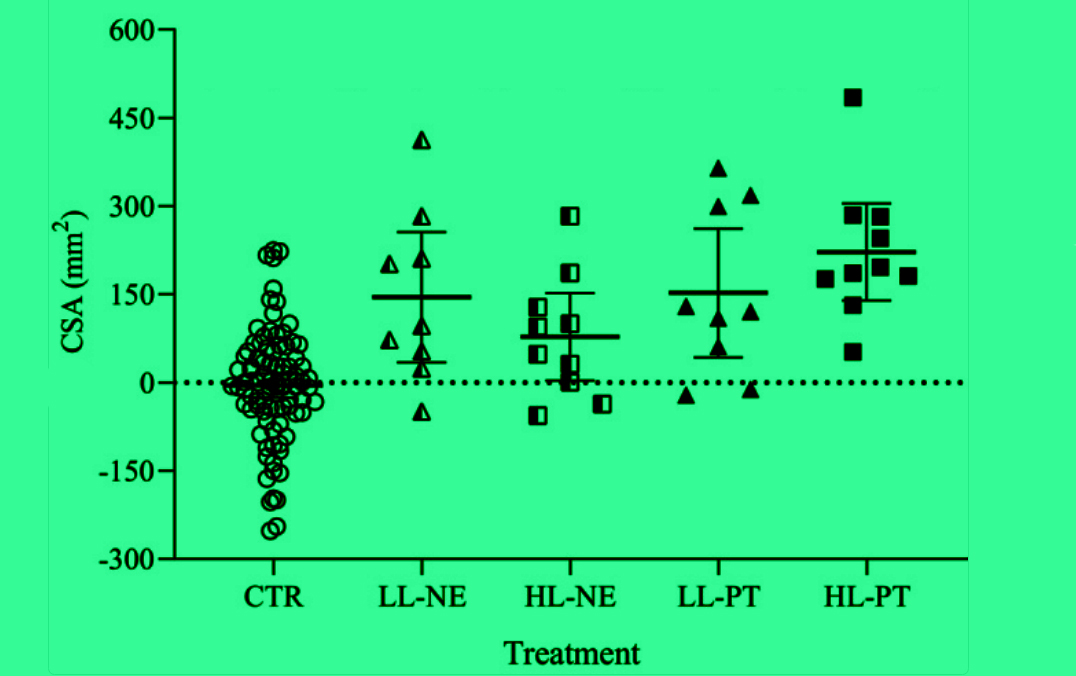
Changes (∆) in mid‐thigh muscle cross‐sectional area assessed by ultrasound after the control (non-exercising) period (CTR; circles), light‐load power training in the contralateral non‐exercised legs (LL‐NE; mid‐filled triangles), heavy‐load power training in the contralateral non‐exercised legs (HL‐NE; mid‐filled squares), light‐load power training in the exercised legs (LL‐PT, filled triangles) and heavy‐load power training in the exercised legs (HL‐PT; filled squares). The contralateral muscle size gains in the non-exercise leg (LL-NE) were greater using low loading than when using high loading (HL-NE). [NB – thick black horizontal line = average result across the participants.]
Implications for older athletes
It’s no surprise that power training improves both strength and power, regardless of whether high-load or low-load training is performed. What is surprising is that these effects can take place in both limbs even when only one limb is trained. It is relevant that these findings are in older adults who are particularly susceptible to losses in muscle power that accompany aging. For older athletes looking to stand up to Father Time, this an important finding, especially if injury makes training a limb impossible.
You may be rightfully wondering how relevant a study using an untrained population is for someone with athletic aspirations. Since these subjects were untrained, it’s much less likely that you’re going to see the same improvements in strength or power. However, there is a strong possibility that training one limb can minimize losses in strength and power in a limb that isn’t being trained for some reason. In a previous article, we already touched on how strength and muscle mass losses can be reduced during immobilization. The same is likely true for power.
Given the difficulty with maintaining muscle power as athletes age, and considering the challenge of keeping injury at bay, it’s important to have every option available to help you optimize performance. If injury strikes and one limb can’t be trained normally, do everything you can to continue to train the non-injured limb. Doing so will maintain more strength and power than doing nothing. If you can minimize any losses in strength and power, making a comeback will be that much easier.
As for whether you should perform low-load or high-load power training, both seem to be effective at improving primary strength and power targets. When it comes to function, measures, such as the 3-meter up and go, high loads may have a slight edge, as do measures of limb speed. By contrast, low-load training may be more effective more maintaining muscle mass. Ultimately, it likely comes down to preference. Regardless of which option you choose, finding ways to continue power training is critical through the aging process, especially in times of injury.
References
1. Scand J Med Sci Sports. 2025 Nov;35(11):e70165. doi: 10.1111/sms.70165.

Latest Issue
Subscribe Today
Newsletter Sign Up
Testimonials
Dr. Alexandra Fandetti-Robin, Back & Body Chiropractic
Elspeth Cowell MSCh DpodM SRCh HCPC reg
William Hunter, Nuffield Health
Subscribe Today

Newsletter Sign Up

Coaches Testimonials
Dr. Alexandra Fandetti-Robin, Back & Body Chiropractic
Elspeth Cowell MSCh DpodM SRCh HCPC reg
William Hunter, Nuffield Health
Subscribe Today
Latest Issue
Keep up with latest sports science research and apply it to maximize performance
Today you have the chance to join a group of athletes, and sports coaches/trainers who all have something special in common...
They use the latest research to improve performance for themselves and their clients - both athletes and sports teams - with help from global specialists in the fields of sports science, sports medicine and sports psychology.
They do this by reading Sports Performance Bulletin, an easy-to-digest but serious-minded journal dedicated to high performance sports. SPB offers a wealth of information and insight into the latest research, in an easily-accessible and understood format, along with a wealth of practical recommendations.
*includes 3 coaching manuals
Get Inspired
All the latest techniques and approaches


Sports Performance Bulletin helps dedicated endurance athletes improve their performance. Sense-checking the latest sports science research, and sourcing evidence and case studies to support findings, Sports Performance Bulletin turns proven insights into easily digestible practical advice. Supporting athletes, coaches and professionals who wish to ensure their guidance and programmes are kept right up to date and based on credible science.
