
 close
close


 LOGIN
LOGINYou are viewing 1 of your 1 free articles. For unlimited access take a risk-free trial
Strength training: new thinking on circuits
SPB looks at new research on how athletes can manipulate the work length in circuit training sessions to target key fitness outcomes


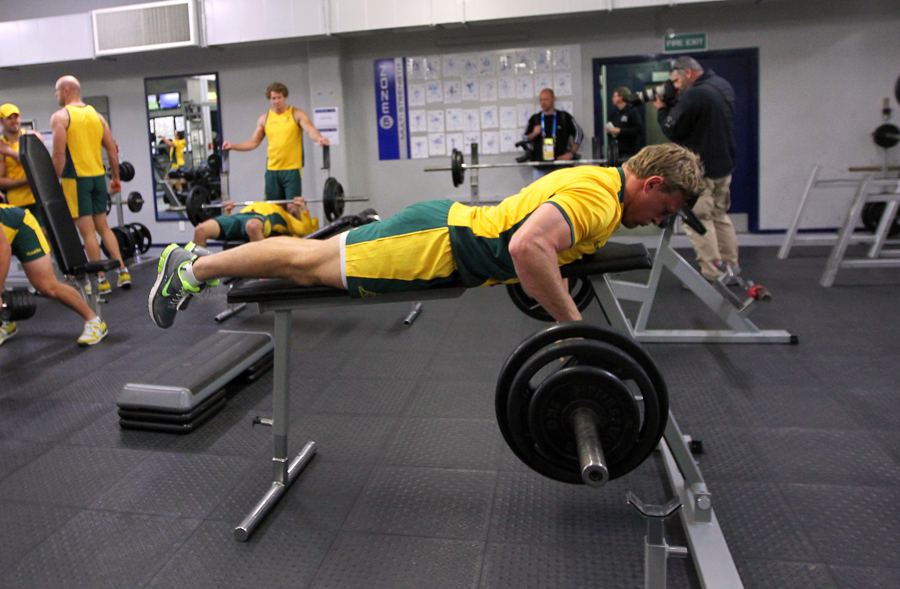
As we’ve reported in so many previous articles, regular strength sessions as part of a training program provides numerous benefits for athletes, regardless of your sport or the level at which you participate. These benefits include improvements in maximal strength and power, sprinting performance, muscle efficiency (making it easier to sustain endurance exercise at sub-maximal pace), body composition and resilience against injury(1-4). However, a commonly reported barrier for athletes seeking to add strength training is lack of time, which can make adherence to strength programs challenging(5). This is particularly the case in amateur and team sports settings, where limitations in infrastructure and equipment complicate the addition of strength training to an existing team sport training practice and conditioning program(6).
The circuit solution
One solution to the ‘no time for strength training’ conundrum is to utilize circuit training instead of conventional resistance training (ie instead of using machine or free weights in a gym). Although there are infinite variations of circuit training, they all share the same theme; participants move quickly through a predefined series of ‘strength stations’, where each exercise is performed consecutively using relatively light weights and short rest intervals (15-30 seconds), with approximately 12–20 reps performed per station(7). This is unlike traditional strength training, which generally involves accomplishing all sets of one exercise (eg 3 x sets of bench press) at a time, employing lengthier rest intervals between sets and using relatively heavy loads.
The very different structure of conventional strength vs. circuit training leads to different physiological responses, one of which is cardiovascular load. While heart rate typically remains at moderate levels during a traditional strength work out, during circuit training it rises significantly higher and in a sustained manner. This is of course what you’d expect and reflects the much more continuous nature of the workload and short inter-exercise rest periods(8,9). The continuously elevated heart rate is also partly caused by the shorter rest intervals, which limit parasympathetic reactivation (the body’s mechanism for ‘switching off’ and returning to base state).
Intense circuits
Traditional circuit training has been regarded as an efficient way to train the cardiovascular system while helping to develop better local muscular endurance. More recently however, high-intensity circuits have become more popular. These use heavier loads, more in line with conventional strength training, and short rest periods. The goal of these intense circuits is to maximize the stimulus for strength development while retaining the cardiovascular benefits. Therefore, the rest periods are still kept relatively short.
How these intense circuits impact training adaptations depends primarily on the ‘work density’ of the session; heavier loadings, more reps/duration of work interval, and shorter rest durations all increase this density. Unsurprisingly, the effect of different work durations in circuit training has been the topic of many previous studies. The general consensus is that when the rest period is held constant:
· Short bouts of work (6–15 seconds) favor the development of neuromuscular power, enabling athlete to focus on speed and explosive strength.
· Medium bouts (30–45 seconds) are considered the middle ground, enabling athletes to simultaneously stimulate muscle growth while also loading the cardiovascular system.
· Longer bouts (60+ seconds) push the emphasis further towards cardiovascular endurance, but with the drawback of reduced power since the accumulated fatigue usually causes a drop in the quality of movement and force production.
Work-to-rest ratio
While there’s been much attention to the duration of work interval in circuit training, this previous research has almost exclusively focussed on a constant rest duration in between stations. Therefore, as the work duration increases, the work-to-rest ratio increases. For example, for rest durations of 30 seconds and work durations of 15, 30 and 60 seconds, this results in a work-to-rest ratio of 1:2, 1:1 and 2:1 respectively (and the results observed above are perhaps entirely expected).
But what happens if the work-to-rest ratio is kept constant while the work duration increases? In other words, what are the effects of varying work duration on its own, without varying the work-to-rest ratio? In circuit training settings, a 1:1 work-to-rest ratio is commonly used, but as you might imagine, performing 10 seconds of work followed by 10 seconds of rest is a very different physiological experience compared to 30 seconds of work followed by 30 seconds of rest, even though both provide the same 1:1 work-to-rest ratio! To answer this question, we can turn to new research by a team of Spanish researchers.
New research
Published in the journal ‘Science Republic’, this study aimed to investigate the physiological responses to circuit strength training performed with three different work-to-rest interval durations: 10 seconds work, 10 seconds rest; 20 seconds work, 20 seconds rest; 30 seconds work, 30 seconds rest(10). To do this, the researchers recruited 34 physically active, trained adults (15 males, 19 females). These participants all had at least six months of consistent strength training experience, which ensured that firstly, they were able to handle the high-intensity demands of the circuit routine and secondly, they were familiar with the strength exercises used. To make the study as rigorous as possible, all the participants had to have been injury-free during the previous six months, and not using any drugs, medications or dietary supplements known to influence physical performance. In addition, the participants were instructed to maintain their regular dietary habits as well as to refrain from performing intense physical activity for 48 hours approximately before each training session.
What they did
Over a period of four weeks, each of the participants underwent three 14-minute circuit training workouts on three separate occasions. Each of these circuit sessions consisted of six multi-joint movements targeting the major muscle groups. These were as follows:
· Leg press
· Bench press
· Single-leg knee extension (right)
· Bilateral row
· Single-leg knee extension (left)
· Seated shoulder press
Each experimental session was divided into two 6-minute blocks with two minutes of active recovery (walking) in between. In each block, participants were asked to perform as many reps as possible as fast as possible while maintaining strict form. To help ensure consistency, verbal encouragement was constantly provided to enhance the participants’ maximal effort. However, these three circuit sessions differed from each other in one crucial way - the work/rest durations:
· 10 seconds work/10 seconds rest
· 20 seconds work/20 seconds rest
· 30 seconds work/30 seconds rest
Each of these protocols retained a 1:1 work-to-rest ratio, but because of the different work durations, the loadings had to be adjusted. This was done via a familiarization session, where each participant performed sets to failure to find their maximum capacity for each duration; in the actual experiment, the researchers then used a very slightly reduced load, ensuring participants could maintain a high intensity for the full duration of each work interval without premature exhaustion!

What they measured
The researchers looked to see how the different work durations would affect the participants’ physiological and performance responses. This involved a number of different measurements:
· Blood lactate - a primary indicator of muscle fatigue caused by the accumulation of lactate during anaerobic exercise, associated with high-intensity work. This was measured via finger-prick blood samples before, during and after each session.
· Heart rate – measured continuously to assess cardiovascular/aerobic demands of the circuit session.
· Countermovement jump performance – a vertical jump test used to measure lower-body power. The greater the drop in jump height following prior exercise, the greater the neuromuscular fatigue.
· 10-meter sprint performance – testing acceleration and speed, thereby giving additional information on the degree of neuromuscular fatigue.
When all the measurements had been gathered in, the researchers then performed a statistical analysis to tease out the differences between each circuit protocol.
What they found
There were several findings, but among these, two particularly stood out:
· Firstly (and perhaps as might be expected) the 30:30 protocol elicited the biggest increase in blood lactate (see figure 1). In the 30:30 group, blood lactate levels reached nearly 16mmol/L compared to an average of just over 12mmol/L the 10:10 protocol. The researchers commented that because the 30-second work intervals were longer, the participants were able to accumulate a higher volume of repetitions in a single bout, which forced them to rely more and more on the lactate energy system as the work interval progressed. The researchers also noted that the countermovement jump height loss tended to be somewhat smaller in the 10:10 protocol and larger in the 30:30 protocol, but that this difference was not quite large enough to reach statistical significance.
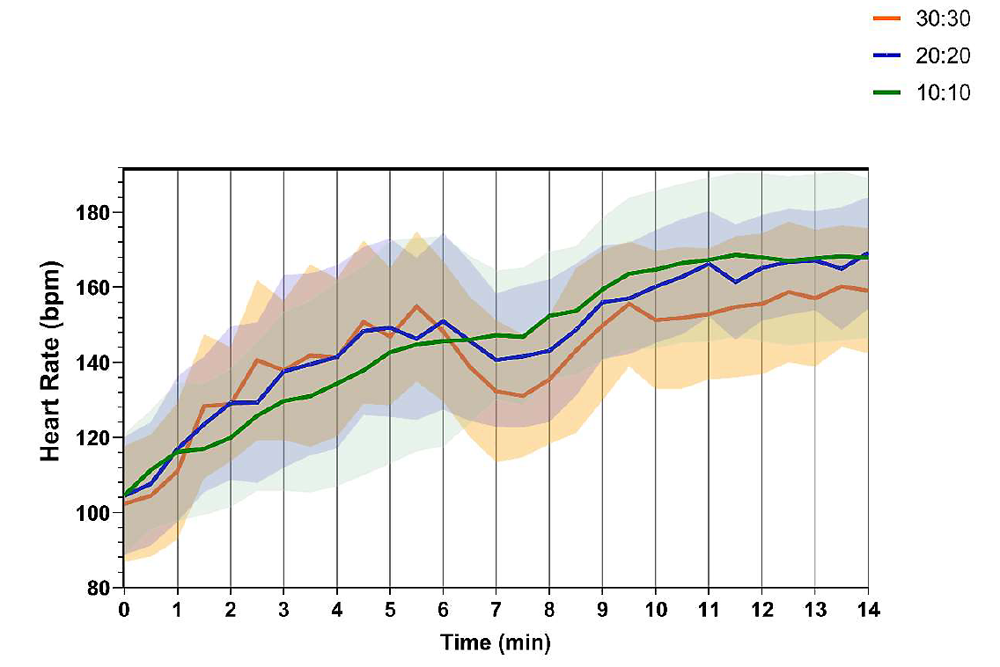
· The second finding was rather more surprising: in the 10:10 protocol, the cardiovascular load was lower than the 30:30 protocol during the first few minutes (again, as you might expect). However, as the 10:10 protocol progressed into the second 6-minute block, it resulted in significantly higher heart rates, which resulted in a greater cardiovascular loading than the 30:30 protocol (not what you’d expect – see figure 2). Here, the researchers noted that this effect was likely because the 10 seconds of rest was not long enough for ‘parasympathetic reactivation’, which meant that the participants’ heart rates stayed elevated and continued to climb, resulting in a very large cardiovascular load by the end of the session.
The researchers summarized their findings by stating that ‘coaches and practitioners may prefer to select a 30:30 protocol when the primary goal is to maximize metabolic stress and neuromuscular fatigue, whereas the 10:10 protocol may be preferred to elicit higher cardiovascular demands with lower lactate accumulation’.
Figure 1: Lactate responses to the different protocols
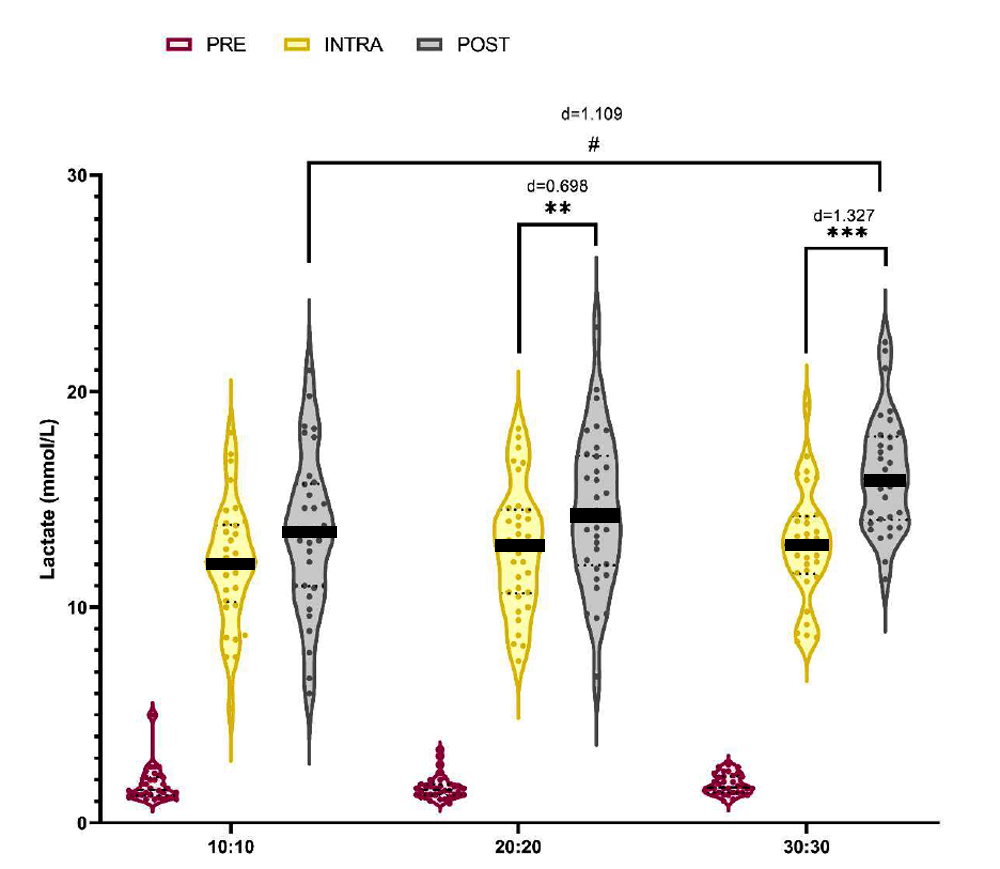
Purple, yellow and gray plots = lactate levels before, during and after each protocol respectively. The width of each plot at different lactate levels represents how common it was in the participants and the thick black line is the average level. The 30:30 protocol elicited much higher lactate levels (and metabolic stress) than the 10:10 protocol.
Figure 2: Heart rates during each protocol
Practical application
A lot of research has been carried out into manipulating work-to-rest ratios when circuit training. But these new findings show that the actual duration of the work and rest periods matter in their own right. Even when the work-to-rest ratio remains constant, the length of the work period strongly influences the training stimulus. It also shows that there is not a ‘one size fits all’ when it comes to circuits!
We can summarize this new research by saying that when it comes to building resilience against muscular fatigue and stimulating muscle growth, the 30:30 protocol is likely superior. By creating more metabolic stress and longer durations of mechanical tension in muscles, more of an anaerobic and muscle growth stimulus will be generated. The downside of course is that the higher levels of lactate and metabolic stress generated means that recovery is longer, which could be a problem if you need to perform in the hours following a circuit session.
By contrast, and somewhat counter-intuitively, the 10:10 protocol appears to be more effective for generating a strong cardiovascular training stimulus. By progressively raising the heart rate to beyond levels seen in the 30:30 protocol, the 10:10 protocol maximizes cardiovascular loading and potentially increases the calorie-burning cost of the session – all with lower levels of metabolic stress. This kind of protocol could therefore be advantageous when more of a focus on cardiovascular conditioning is desired, and when quick recovery is needed (eg during a heavy training block).
And the 20:20 protocol? Well, as the researchers pointed out, this protocol could be considered something of a ‘middle ground’, providing a more even mix of metabolic stress and cardiovascular demand without the extremes of the other two protocols. Another question is whether these same recommendations would apply to different work-to-rest ratios? For example, if you used a 1:2 work-to-rest ratio, would the same pattern be observed in 10:20, 20:40 and 30:60 protocols? Unfortunately, it’s hard to say. It’s likely that the same overall trend would be seen (longer =- more metabolic stress, shorter = more cardiovascular loading), but with more recovery time relative to work, the differences would be less pronounced, especially regarding cardiovascular benefits (due to more recovery time, allowing parasympathetic reactivation to occur). The other factor to consider is that responses to these protocols may vary quite a bit between different athletes, making it difficult to make absolute recommendations. As always, the proof of the pudding is in the eating – try it and see for yourself!
References
1. Br J Sports Med. 2018 Dec;52(24):1557-15
2. J Funct Morphol Kinesiol. 2021 Mar 17;6(1):29
3. J Sports Sci Med. 2025 Jun 1;24(2):406-452
4. Eur. J. Sport Sci 2018. 18, 1199–1207
5. Scandinavian Journal of Medicine & Science in Sports 2020. 30, 1796-1805
6. Biology 2020. 9: 383-383
7. Strength and Conditioning Journal 2011. 33: 16-22
8. Journal of Sports Sciences 1988. 6: 39-48
9. European Journal of Applied Physiology 2007. 100: 1-17
10. Sci Rep. 2026 Jan 8. doi: 10.1038/s41598-025-34940-1. Online ahead of print

Andrew Hamilton

Latest Issue
Subscribe Today
Newsletter Sign Up
Testimonials
Dr. Alexandra Fandetti-Robin, Back & Body Chiropractic
Elspeth Cowell MSCh DpodM SRCh HCPC reg
William Hunter, Nuffield Health
Subscribe Today



Newsletter Sign Up

Coaches Testimonials
Dr. Alexandra Fandetti-Robin, Back & Body Chiropractic
Elspeth Cowell MSCh DpodM SRCh HCPC reg
William Hunter, Nuffield Health
Subscribe Today
Latest Issue

Keep up with latest sports science research and apply it to maximize performance
Today you have the chance to join a group of athletes, and sports coaches/trainers who all have something special in common...
They use the latest research to improve performance for themselves and their clients - both athletes and sports teams - with help from global specialists in the fields of sports science, sports medicine and sports psychology.
They do this by reading Sports Performance Bulletin, an easy-to-digest but serious-minded journal dedicated to high performance sports. SPB offers a wealth of information and insight into the latest research, in an easily-accessible and understood format, along with a wealth of practical recommendations.
*includes 3 coaching manuals
Get Inspired
All the latest techniques and approaches


Sports Performance Bulletin helps dedicated endurance athletes improve their performance. Sense-checking the latest sports science research, and sourcing evidence and case studies to support findings, Sports Performance Bulletin turns proven insights into easily digestible practical advice. Supporting athletes, coaches and professionals who wish to ensure their guidance and programmes are kept right up to date and based on credible science.
