
 close
close


 LOGIN
LOGINYou are viewing 1 of your 1 free articles. For unlimited access take a risk-free trial
Race preparation: numbers vs. feelings for tapering
How should athletes monitor their training reduction during a taper period before racing? SPB looks at new fascinating research comparing objective and subjective monitoring


If you’re preparing for a race or competition, your primary goal is to ensure everything comes together at the right time. When you go to that start line, you want your fitness levels to be as high as possible but to also be as fully rested and fresh as possible. However, an often overlooked fact by athletes is that the physiological benefits of a training session performed one day will not become fully apparent until quite a few days later.
The importance of full recovery
During this intervening time period (also known as recovery!), adaptation takes place, where muscles are refuelled and rehydrated, damaged muscle fibres are repaired and built stronger, and signalling molecules produced during training increases the expression of various genes within muscle cells – genes that alter the biochemistry of the muscle cells so that they can respond to the physical demands placed upon them more efficiently. This takes time with the length of time varying according to an athlete’s biochemical individuality, age, fitness level, nutrition during recovery, and quality of sleep and rest during a recovery period.
However, if your training load has been very high – for example, preparing for an ultramarathon or triathlon – it can take much longer for muscles to become ‘deeply’ rested and fully restored. Some research has showed that ultra-runners completing an ultra-mountain marathon may require as much as 2-4 weeks for all the indices of recovery to return to normal(1). This creates a potential problem; numerous studies on detraining (see this article) have shown that aerobic fitness losses can begin within 5-6 days, which begs the question ‘how can an athlete arrive at the start line deeply rested but fully aerobically fit’? The answer of course is tapering.
The optimal taper
When preparing for a major competition, athletes tend to reduce their training load for a variable period of time. This technique, known as ‘tapering’, can have a major influence on the athlete’s performance, leading to a gain in performance of around 3% compared to no taper(2). However, while training load is reduced significantly, the training intensity is not until the final few days before the event. Also training frequency, while undergoing some reduction, is not reduced markedly. A number of studies on the best way for athletes to taper have been carried out over the past twenty years or so, and their findings can be summarized as follows(3-6):
· Athletes need to have a good endurance base and ‘training volume in the bank’ to fully benefit from tapering.
· The average taper period should be around two weeks but may be as little as four days (for short events) and up to 28 days for long events (eg ultra racing).
· Training frequency should be maintained or reduced slightly but no more than around 20%.
· Training volume should be reduced by 40-90% during the taper, with the biggest reductions in volumes coming in the final week.
· The INTENSITY of the training must be maintained. With lower training volumes, this can be achieved for example by increasing the proportion of interval training.
Despite the science being unequivocal on tapering, many athletes continue to train hard right up to a few days before an event or competition then fail to reach their potential because they’re competing without being 100% recovered from their previous training sessions. In short, training hard until a couple days before your event will mean your physiological peak will occur around 10 days after the event has taken place!
ACWR for monitoring tapering
Whether or not you follow a predefined tapering plan, there’s a need at the very least to monitor your workload, and to ensure that it decreases appropriately in the run up to competing, in order to ensure optimal recovery and freshness. One way of achieving this is by using something called the Acute to Chronic Workload Ratio (ACWR). The use of ACWR was actually pioneered in the field of injury prevention where sport scientists and physiotherapists had long been aware of the association between high training loads and increased injury risk. However, around ten years ago, these scientists began to understand that possibly of even greater importance is the CHANGE in training load.
In a nutshell, The ACWR uses a rolling 4-week average to determine the chronic workload (some use a 3-week average) and the following week’s load (acute load) is compared against the average of the preceding four weeks(7). The workload for each week is calculated by the duration of sessions in that week multiplied by the power output, speed, intensity etc of that session. If the ratio of the acute (what you’ve just done) to chronic (what you’ve done in the four weeks prior to that) workload is greater than 1.3 or less than 0.8, then this may set up the athlete for an injury in the following weeks (see figure 1). However, the same ACWR method of monitoring workload can also be used to ensure that there is a decline in overall workload week by week (during the run up to a competition or series of competitions. A sudden spike in workload would of course not be conducive to an effective taper or general recovery phase before that all-important race!
Figure 1: Risk of injury relating to ACWR
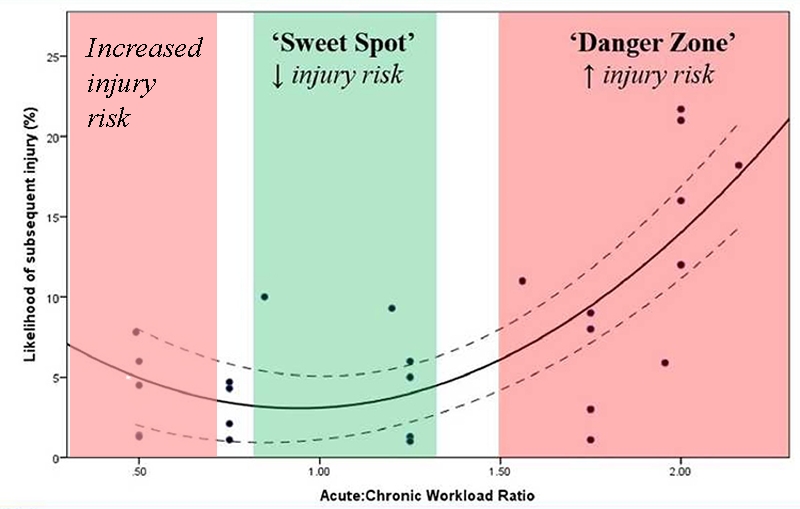
Thick black line shows % risk of subsequent injury. The green zone represents an ACWR of 0.8-1.3. (NB – injury risk may increase when the ACWR drops below 0.8 because although the workload is reduced, too large a drop can result in deconditioning, which may increase injury risk at a later date when workload increases again)
Subjective workload
While ACWR relies on workload measures calculated from miles/metres clocked up and the speeds or power outputs of those workouts, there is an alternative method of monitoring known as Session Rating of Perceived Exertion (sRPE). sRPE focuses not on the external metric but on the internal loading. sRPE is very easy to calculate – the athlete simply rates each session difficulty in terms of subjective feeling on a scale of 1 to 10, and then this number is multiplied by the duration of the session. The key here is that while ACWR calculations focus on external and objective measures, sRPE focuses internally on how hard the athlete’s body felt it was working.
ACWR vs. sRPE for tapering
Although sRPE is much simpler to record and track (hopefully reducing) effort levels in the run up to competition, because it doesn’t measure work intensity objectively but only session duration, the use of ACWR for monitoring total workload over a period of weeks during a taper would seem intuitively to be a more useful and accurate monitoring tool. This explains why many coaches prefer to use mathematical calculations based on hard data rather than subjective feeling to decide when to push and when to res athletes. But are formulas such as ACWR actually the best way to monitor workload and prepare athletes for competition?
New research
To get an answer to this question, we can turn to new research by a team of Spanish scientists who followed seven international-level swimmers (members of the Spanish National Team) over a full 40-week season containing three 13-week competition cycles, but with a particular emphasis in the 7-week run up period to competition in each of these cycles(8). Published in the Journal of Human Kinetics, this study looked the swimmers’ workload accumulated both in the pool and their dry-land training in the gym (strength being an important component of training for elite swimmers).
During the season, the swimmers kept detailed logs of their swim sessions in the pool (type of session, intensity and meters swum) and all the sessions carried out in the gym (exercises, reps and total kilograms lifted per session). This data was used to calculate the ACWR for each swimmer and to track how it changed during each competition cycle. In addition, the swimmers were asked to subjectively rate each session completed in the pool and in the gym, and to record its duration. This enabled the sRPE to be calculated week by week across each cycle. The researchers then compared the ACWR and sRPE scores, focusing on the run-up periods to each competition to see which monitoring method best predicted the performance levels during the week of competition.
What they found
The first finding was that as the researchers has predicted, it was the seven weeks prior to competition that served as the ‘critical zone’ when determined competition outcomes. A good taper (reduced training load) and recovery during these weeks predicted fast swim times. However, what was more surprising was the clear finding that the swimmers’ own subjective feelings of pre-competition workload (sRPE) were a more accurate indicator than ACWR of the performances they actually turned in during the competition periods. In short, when the swimmers felt consistently tired in the seven weeks leading up to a race, their performances suffered, even if the ACWR calculations of their workloads had diminished (suggesting they should have been well rested). Therefore, tapering using ACWR as a workload guideline was not as effective as simply using sRPE.
Another finding was that dry-land training was something of a double-edged sword. Whilst research has unequivocally demonstrated that land-based strength work can help improve swimming performance(9), there was a strong negative correlation between high dry-land training workloads in the final seven weeks and competitive success. Put simply, the more strength sessions performed during the seven weeks in the run up to competition, the slower the swimmers’ race times were. This suggests that full recovery from and adaptation to strength work takes many weeks to benefit swimmers, indicating that they need to back right off dry-land strength sessions during a tapering period.
When the researchers looked at other metrics such as the number of personal bests achieved by the swimmers and the greatest improvements in their World Aquatics points, it was once again a progressive lowering of sRPE that best predicted performance. The swimmers who successfully lowered their total sRPE during the 7-week pre competition window showed attained a significant gain in the number of PBs and World Aquatics points accrued. This compared to swimmers who failed to reduce their perception of effort during these seven weeks and who failed to achieve personal bests.
Practical implications for swimmers and other athletes
This new research is provides another study revealing the potential pitfalls of relying too much on ‘data’ rather than blending that data with your subjective feelings – a topic we’ve covered before in SPB. In fact, let’s go one step further; this study suggests that when it comes to tapering for competition, your subjective feelings about fatigue, energy and recovery are more important than raw data when it comes to your likely performance!
But why did ACWR fail to provide the best indicator of recovery and freshness for competition despite using actual objective training data as opposed to subjective impressions? This is almost certainly because physical training workloads don’t exist in a vacuum. Numerous other factors contribute to determine athletic performance such as sleep amount and quality, nutrition, the mental stress and strains of day-to-day life and naturally occurring biological rhythms that affect all athletes (see this article). While ACWR accurate measures the physical effort put into training sessions, it can’t account for all these other factors.
In practical terms, how can you apply these findings to your next competition taper? The number one priority is to trust your feelings over and above a particular tapering plan and adjust your workload using those feelings. If that ‘expert’ tapering plan is still leaving you feeling tired as you approach your event, it’s still recommending too much workload for you - even though on paper that workload is reducing and looks like it should be okay. So for example, if a session described as ‘easy’ in your plan feels like a 9 out of 10, it’s a hard session regardless of what the plan says.
Secondly, beware of performing strength training sessions during the critical 7-week period in the run up to your event. There’s a good chance that instead of boosting your race performance, those sessions might actually harm it. Instead, focus your strength session for earlier in the season, well away from competition. Finally, remember that while data acquisition can provide valuable insights into performance, it doesn’t give all the answers about how you should be training and recovering. A better approach is to prioritize how you feel first and foremost and then to use data to help shape your training and recovery within that framework.
References
1. Eur J Sport Sci. 2019 Aug;19(7):876-884
2. Int J Sports Med . 1998 Oct;19(7):439-446
3. Eur J Sport Sci. 2020 Mar 14;1-12
4. Med Sci Sports Exerc. 2003 Jul;35(7):1182-7
5. Scand J Med Sci Sports. 2010 Oct;20 Suppl 2:24-31
6. Med Sci Sports Exerc. 2007 Aug;39(8):1358-65
7. Int J Sports Physiol Perform. 2018 Nov 14:1-28
8. J Hum Kinet. 2026 Apr 2;101(Spec Issue):271-284. doi: 10.5114/jhk/218950. eCollection 2026 Feb
9. Sports Med Open. 2022 Jan 31;8(1):19

Andrew Hamilton

Latest Issue

Subscribe Today
Newsletter Sign Up
Testimonials
Dr. Alexandra Fandetti-Robin, Back & Body Chiropractic
Elspeth Cowell MSCh DpodM SRCh HCPC reg
William Hunter, Nuffield Health
Editor's Picks
Subscribe Today

Newsletter Sign Up

Coaches Testimonials
Dr. Alexandra Fandetti-Robin, Back & Body Chiropractic
Elspeth Cowell MSCh DpodM SRCh HCPC reg
William Hunter, Nuffield Health
Subscribe Today
Latest Issue
Keep up with latest sports science research and apply it to maximize performance
Today you have the chance to join a group of athletes, and sports coaches/trainers who all have something special in common...
They use the latest research to improve performance for themselves and their clients - both athletes and sports teams - with help from global specialists in the fields of sports science, sports medicine and sports psychology.
They do this by reading Sports Performance Bulletin, an easy-to-digest but serious-minded journal dedicated to high performance sports. SPB offers a wealth of information and insight into the latest research, in an easily-accessible and understood format, along with a wealth of practical recommendations.
*includes 3 coaching manuals
Get Inspired
All the latest techniques and approaches


Sports Performance Bulletin helps dedicated endurance athletes improve their performance. Sense-checking the latest sports science research, and sourcing evidence and case studies to support findings, Sports Performance Bulletin turns proven insights into easily digestible practical advice. Supporting athletes, coaches and professionals who wish to ensure their guidance and programmes are kept right up to date and based on credible science.
