
 close
close


 LOGIN
LOGINYou are viewing 1 of your 1 free articles. For unlimited access take a risk-free trial
Sprint intervals: can clusters make them better?
Andrew Sheaff investigates new research on splitting traditional sprint intervals into clusters of smaller blocks. Can this enhance their effectiveness and if so, how?


Interval training is a popular training mode across most sports because physiological conditioning is relevant to most sports! Interval training is effective because it allows athletes to experience high levels of physiological stress while working at high power outputs but without excessive accumulation of fatigue. Different types of interval training can be used to accomplish different types of goals, and one popular type of interval training is what’s known as sprint interval training. It consists of very brief periods of very intense work interspersed with short rest periods, leading to improvements in power output, aerobic fitness, as well as anaerobic fitness.
Cluster training
Sprint interval training is both effective and efficient, but coaches, athletes, and researchers are always looking to make training more effective and more efficient - and that’s where cluster training comes in. Cluster training is a strategy used in resistance training where very short breaks are introduced within a set to allow for higher power outputs and better maintenance of performance throughout the set. This strategy has proven successful at sustaining performance during sets, as well as improving training adaptations. Since resistance training and sprint interval training are both focused on challenging athletes with high intensities, could the same strategy be applied to sprint interval training? Fortunately, some smart researchers thought so, and they have put together a study to find out!
New research
A group of international sports scientists sought to discover the impact of cluster training when applied to sprint interval training(1). They wanted to see how clustered sprint interval training on a bike influenced the physiological challenge of a sprint interval session, as well as how clustering the intervals affected power outputs during the sets. The researchers recruited twelve recreationally trained subjects who had a VO2max (maximum oxygen uptake capacity) of around 54.0mls/kg/min. While not highly trained, these were fit individuals with a background of seven years of training, training five times per week, and performing at least two to four endurance training sessions each week.
Study protocol
The subjects visited the laboratory on five occasions. The first visit was a familiarization session during which baseline anthropometric data was taken, and the subjects were fitted to the exercise bike. During the second visit, the subjects performed a graded exercise test to determine their VO2max, the peak power output during the graded exercise test, as well as maximal heart rates. Throughout the testing, gas exchange data and heart rate data were collected. Beyond calculating VO2max, the gas exchange data was used to calculate the respiratory compensation point. This is the point at which there is a significant increase in ventilation (breathing) rate, indicating a much larger contribution of anaerobic metabolism (ie metabolism without oxygen and where lactate begins to accumulate) to power output.
During the last three visits, the subjects performed in a random order three different variations of a sprint interval training protocol:
· Cycling as fast as possible against a resistive load equivalent to 7.5% of body mass. The subjects performed 4 repetitions of 30-second intervals, with a 240-second rest period between intervals.
· The second protocol was the same as above except that instead of a continuous 30-second repetition, they performed 2 x 15-second work intervals with a 15-second break between the 2 x 15-second efforts. Also, rather than a 240-second rest period between intervals, a 225-second break was used to ensure that the total rest interval was the same across all protocols.
· The third protocol involved breaking the 30-second repetition into 3 x 10-second efforts with 10-second breaks, followed by a 220-second break between intervals (again keeping total rest the same).
In summary, all subjects performed 120 seconds of work and 720 seconds of rest during each protocol (see figure 1), with the three above protocols performed in a randomized order. Throughout each interval protocol, the total work and the mechanical power outputs were measured. The researchers determined the highest power output achieved during each work effort, the average power output during each work effort, the minimum power output during each effort, and the fatigue index. The fatigue index was calculated by comparing the maximum power output and the minimum power output, expressed as a percentage.
Figure 1: Experimental protocol
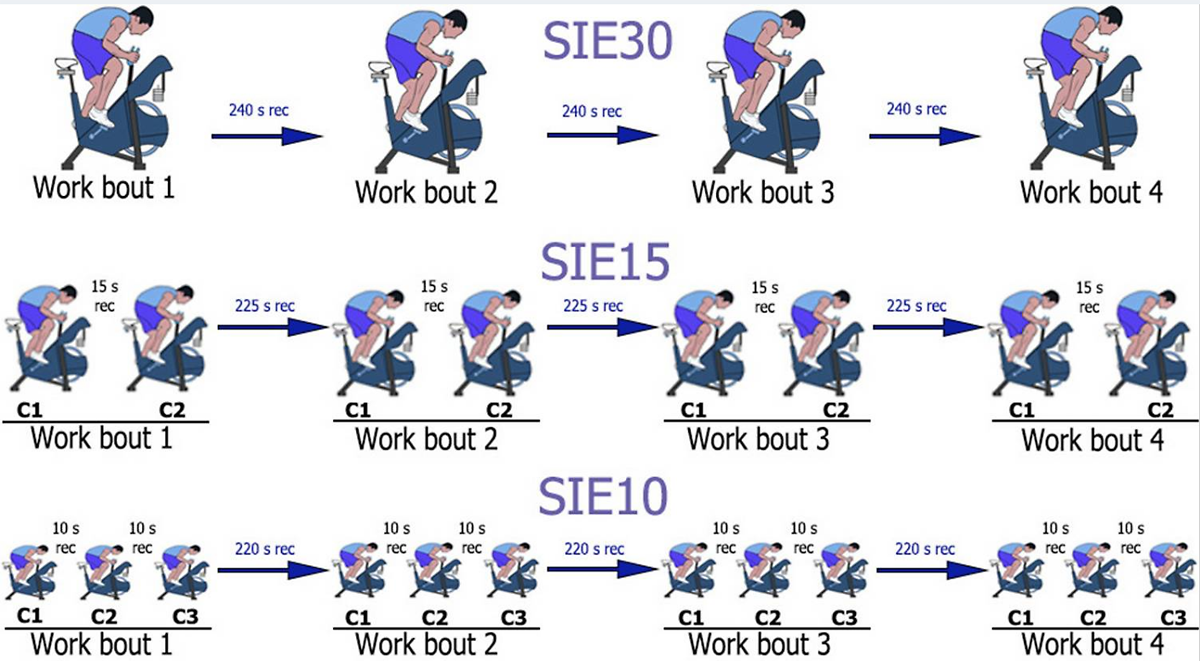
Rec = recovery; SIE30 protocol: 4 × 30-s work bout + 240-s active recovery; SIE15 protocol: 4 × 15-s work bout + 15-s active recovery + 15-s work bout + 225-s active recovery; SIE10 protocol: 4 × 10-s work bout + 10-s active recovery + 10-s work bout + 10-s active recovery + 10-s work bout + 220-s active recovery.
Physiological measurements were taken during sprint interval protocols as well. Pulmonary gases were collected throughout the interval training sessions. The data was used to calculate VO2peak during the work bouts, time spent above the respiratory compensation point, and time spent above 80% VO2max. The latter is considered particularly important as time spent above 80% VO2max has been related to significant improvements in aerobic endurance adaptations(2). Blood lactate levels were measured at the end of each protocol, with measurements taken at 1, 3, and 5 minutes post training. The researchers also asked the subjects for a rating of perceived exertion within 10 seconds of completing the training session.
The findings
When the results were calculated, there were some fascinating findings in terms of how clustered sprint interval training affected the physiological stress generated and the power outputs achieved during training. For oxygen uptake, 86% of maximum (VO2max) was reached during the 30-second intervals, and 96% and 94% of maximum was reached during the 15- and 10-second intervals, respectively. The peak levels of oxygen uptake measured during the recovery periods was also higher for both the 15- and 10-second intervals as compared to the 30-second protocol. Likewise, the key metric of ‘time spent above 80% of VO2max’ and the respiratory compensation point was significantly higher in the clustered interval groups as compared to the transitional intervals.
From an oxygen uptake perspective, clustered intervals were superior at generating high oxygen uptakes despite exercising for the same total time and taking breaks within the intensive intervals. Despite these differences in oxygen uptakes, there were no difference in peak heart rates, peak lactates, or session rating of perceived exertion. These measurements remained the same regardless of whether a traditional or clustered sprint interval protocol was used.
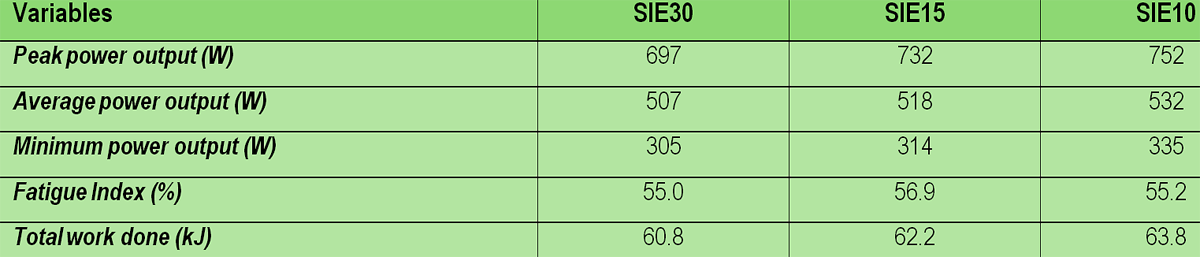
When it came to power outputs and the amount of work done during each sprint protocol, the trend was clear. Taking breaks improved power outputs, and more breaks paired with shorter intervals increased this effect (see table 1). Peak power was higher during the 10-second intervals than it was during the 15-second intervals, which was higher than the traditional intervals. The same effect was seen for the average power output over the course of the repetitions. Similarly, the minimum power output was higher as the clusters became shorter.
Since the work done is directly related to the power output of the activity, and power output was higher during the clustered protocols, so too was the work done across the different intervals. Interestingly, the fatigue index did not different across the protocols, with the subjects losing approximately 55% of their power output across each 30-second block of work. While the clustering the intervals allows for higher performance levels, those performance levels appear to drop by the same degree regardless of repetition length.
Table 1: Average power, total work and fatigue in traditional vs. clustered sprint intervals
Related Files
Implications for athletes
The results of this study are a big win for the concept of cluster training when applied to sprint interval training. The clustered protocols allowed the subjects to spend more time with higher oxygen uptakes, create larger power outputs throughout the training, and do so without increasing lactate levels, heart rates, or rating of perceived exertion. These are valuable outcomes for two key reasons:
1) The time spent at high oxygen uptakes is a key driver of aerobic adaptation. By clustering the intervals, the researchers were able to generate higher oxygen uptakes, and those higher uptakes were maintained for longer periods of time. Importantly, this was without changing the duration of the training or asking the subjects to perform more work. In short, the intervals were more effective and more efficient.
2) Performance is often driven by high power outputs. The more athletes can practice generating higher power outputs, the more they can potentially learn to create and sustain these power outputs. Coaches can take advantage of clustered sprint interval training to enhance power outputs during the same work.
When applying these concepts to your training, consider opportunities where interval repetitions could be clustered to allow for higher performance output, particularly when a large amount of fatigue is likely to be present. This can allow for more high-quality practice, which can stimulate additional improvement over time. Likewise, if you’re using sprint interval training to drive aerobic adaptation as efficiently as possible, clustering the repetitions can help drive higher oxygen uptakes which can lead to enhanced aerobic development.
That’s not to say there isn’t value from performing traditional sprint intervals. Although there is aerobic activation and lower power outputs during the training, there is still a challenge present during extended sprinting, which may be lost when the intervals are broken up. Exercising a high intensity for a longer continuous duration creates a certain stress in the muscular system that is not wholly described just by power output, oxygen uptake, and lactate values. This is particularly true for athletes who need to exert themselves maximally for longer durations – eg runners competing at 200m, swimmers at 50m, track cyclists performing a 1-lap sprint etc. However, this study demonstrates there is additional value in using cluster strategies during some interval training sessions. But it’s not a binary choice that coaches and athletes must make; it’s possible to use both stimuli to keep training fresh, create challenge in novel ways, and stimulate a broader set of adaptations.
References
1. Eur J Appl Physiol.2025 Dec;125(12):3565-3578. doi: 10.1007/s00421-025-05857-4. Epub 2025 Jun 29
2. Front Sports Act Living. 2025 Jan 6:6:1507957
Latest Issue
Subscribe Today
Newsletter Sign Up
Testimonials
Dr. Alexandra Fandetti-Robin, Back & Body Chiropractic
Elspeth Cowell MSCh DpodM SRCh HCPC reg
William Hunter, Nuffield Health
Editor's Picks
Subscribe Today

Newsletter Sign Up

Coaches Testimonials
Dr. Alexandra Fandetti-Robin, Back & Body Chiropractic
Elspeth Cowell MSCh DpodM SRCh HCPC reg
William Hunter, Nuffield Health
Subscribe Today
Latest Issue
Keep up with latest sports science research and apply it to maximize performance
Today you have the chance to join a group of athletes, and sports coaches/trainers who all have something special in common...
They use the latest research to improve performance for themselves and their clients - both athletes and sports teams - with help from global specialists in the fields of sports science, sports medicine and sports psychology.
They do this by reading Sports Performance Bulletin, an easy-to-digest but serious-minded journal dedicated to high performance sports. SPB offers a wealth of information and insight into the latest research, in an easily-accessible and understood format, along with a wealth of practical recommendations.
*includes 3 coaching manuals
Get Inspired
All the latest techniques and approaches


Sports Performance Bulletin helps dedicated endurance athletes improve their performance. Sense-checking the latest sports science research, and sourcing evidence and case studies to support findings, Sports Performance Bulletin turns proven insights into easily digestible practical advice. Supporting athletes, coaches and professionals who wish to ensure their guidance and programmes are kept right up to date and based on credible science.
