
 close
close


 LOGIN
LOGINYou are viewing 1 of your 1 free articles. For unlimited access take a risk-free trial
Protein supplementation: myths vs. reality
What’s the real truth about protein supplementation for athletic performance? Andrew Sheaff looks at definitive new research, and comes up with some surprising answers



Most active people and nearly all athletes understand that protein consumption is associated with muscle growth, sport, and performance outcomes. Understandably then, the popularity of protein supplements has followed suit for both athletes and non-athletes alike, particularly in the last 30 years. However, while the effectiveness of protein supplementation is automatically assumed, the actual research is actually much less clear.
While some positive outcomes have been found, plenty of less positive outcomes have been found as well, and the research is far from conclusive. This can be related to different study designs, types and amounts of protein, as well as different outcomes measured in the studies. This issue is further complicated by the fact that it’s comparatively easy to consume plenty of protein from the diet without resorting to protein supplements. Therefore, if an individual is consuming sufficient protein, more may not be helpful. So does protein supplementation lead to positive outcomes, and if so, what contextual factors are important? Let’s look at some new research and find out.
New research
A group of researchers from China sought to bring clarity to this topic by using meta-analytical techniques. This allowed them to comprehensively evaluate all the relevant protein supplement trials performed to date(1). Rather than performing a very large trial, the authors used statistical techniques to combine the result of many previous trials. Specifically, they were interested in analyzing ‘randomized controlled’ trials, as these studies are the most rigorous, including control and supplemental groups.
To further increase the rigor of the study, only trials involving athletes were included, where one group received supplemental protein and the other did not. In addition, the outcomes of the study were required to be related to athletic performance in some way. In short, all other trials were excluded from the analysis because the researchers wanted to focus on our specific population of interest (athletes) and our outcomes of interest (performance). In total, 75 studies were included for analysis.
What they did
When performing the analysis, the researchers analyzed the potential bias included in the studies. While scientific research aspires to be unbiased, it’s simply not possible to eliminate all bias in designed studies, which can arise due to technological, financial, or logistical challenges. For instance, if there was only so much money or time available for a given study, researchers may have to compromise the design of their study compared to what may have been ideal. While a study is not intentionally biased by the authors of included studies, it is still a factor that must be accounted for, especially when performing meta-analyses.
The authors also tried to account for publication bias. This is a bias towards published studies with positive findings whereas non-positive studies (ie the supplement didn’t work) can go unpublished. This information was used to assess the ‘quality’ of the findings. A study could find a very strong result, but if significant bias is present, the findings become uncertain.
The 75 studies included in the meta-analysis were designed differently, using different supplementation intervention and different outcomes. They used different types of protein and different amounts of protein, both of which could significantly affect the outcomes. Rather than simply asking ‘do protein supplements work?’ the researchers wanted to ask, ‘do certain types of protein supplements delivered in certain ways result in certain types of performance outcomes in certain situations?’ The latter is a much more nuanced question, requiring a more nuanced approach. They achieved this by making the following comparisons during the analysis:
- Athletic performance versus post-exercise recovery outcomes.
- Protein-only versus carbohydrate versus protein and carbohydrate versus placebo.
- Different types of protein (soy, milk, combined, etc).
- The amount of protein given in each supplemental dose.
- Total daily protein intake.
- When protein was ingested (day or night).
- Whether subjects consumed other foods before the supplement.
- If the control group received supplemental calories to match the protein group.
- Whether subjects served as their own control or not.
- Comparing acute versus long-term effects of supplementation.
- Looking only at endurance performance outcomes.
- Looking only at strength outcomes.
- Looking only at glycogen resynthesis outcomes (how much carbohydrate is stored in the muscle).
- Looking only at fatigue as an outcomes.
- Interactions between the above factors
In plain English, it’s not as simple as saying protein supplements ‘work ‘or ‘don’t work’ because whether that’s true or not may depend on all the circumstances above. By changing the interventions and by changing the outcomes, the results could be dramatically different.
What they found
When looking at endurance performance, a net positive effective of protein supplements was found. This was found for both aerobic and anerobic performance, particularly in cyclists. No effect was found for whole-body strength outcomes, although a positive effect was found when lower body strength was evaluated in isolation. As with strength, there was no overall effect found for fatigue-related outcomes, although there was a potential positive effective for ‘fatigue index’, a specific test used in cycling. There was no effect found for glycogen resynthesis.
When protein supplements were compared to a placebo, improvements in both endurance performance and muscle strength were found. When carbohydrate + protein supplements were compared to placebo, only improvements in endurance performance found. When protein supplements were compared to carbohydrate supplements, measures of glycogen synthesis were improved. The inconsistency of findings across different comparisons may therefore potentially weaken performance enhancement claims.
Ten different types of protein sources were evaluated. Only whey protein was found to have a positive effect, and that was for improving both endurance performance and muscle strength outcomes (see figure 1). No other protein sources yielded positive outcomes. Meanwhile, no positive outcomes were found for recovery with any type of protein source.
Protein dosages were grouped into three categories: 0–1 grams/kilogram of body weight, 1–2 grams/kilo, and 2–3 grams/kilo. Interestingly, only the lowest dose - 0–1 grams/kilo - was found to have a positive impact (endurance performance) and fatigue index. Further analysis demonstrated that 1 gram per kilo of supplemental protein improves athletic performance more than 1.5 grams/kilo, and for post-exercise recovery, 0.5 gram/kilo dose was more effective than 1 gram/kilo. The clear implication here therefore is that more protein is not better!
For total daily protein intake, 2 grams/kilo per day led to improved performance and recovery as compared to 1 gram/kilo per day, indicating that total dosage does matter, not just the supplemental dose (see figure 2). When protein was consumed was important as well; daytime supplement consumption seemed to have a positive impact on endurance performance whereas nighttime consumption did not.
When comparing energy-matched intake (supplementing protein but keeping calorie intake constant but reducing calories from carbohydrate and fat intake) to energy-unmatched (giving extra protein calories without cutting back other calories) supplementation, only energy-unmatched supplementation had a positive effect on endurance performance and muscle strength. This finding may indicate that the protein supplements are simply providing more energy rather than nutrients with a particular effect. Protein supplementation also had a positive impact on performance only when subjects consumed the supplements after consuming other food, and not when consuming the supplements in a fasted state.
Endurance performance was improved both acutely and chronically as a result of protein supplementation. This was not true of any other outcome measures. Further analysis indicated 40 to 65 days of increased protein intake is optimal for enhancing athletic performance. Deeper analysis also revealed that if the goal is to promote post-exercise recovery, 40 to 80 days of supplementation may be more appropriate.
Finally, it’s important to assess the reliability of these conclusions, which was determined by the following factors: sample size, meta-analysis results, and quality assessment, including risk of bias and result inconsistency. Due to inconsistency and variation in the findings, the quality was rated ‘low’ for endurance performance. It was rated ‘very low’ for muscle strength and recovery for the same reasons and due to small sample sizes. While positive outcomes were found, they were only found in certain situations, and the findings were not particularly strong. Thus, some caution must be taken in changing behaviors as a result of the study.
Figure 1: Effect of whey protein vs. other proteins
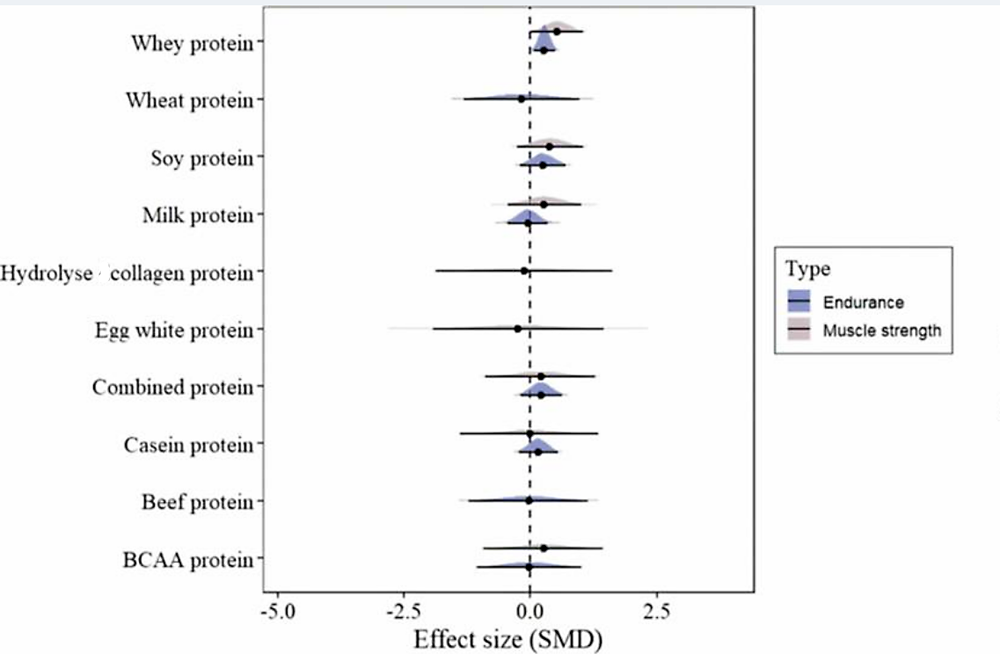
In this forest plot, a statistically significant positive effect from protein is shown when the average result (black dot) for that protein lies to the right of the zero line, and the spread (variation – shown by the shaded curve) also lies completely to the right of the zero line. Only whey protein demonstrated this trend.
Figure 2: Optimum total daily intake of protein
Related Files
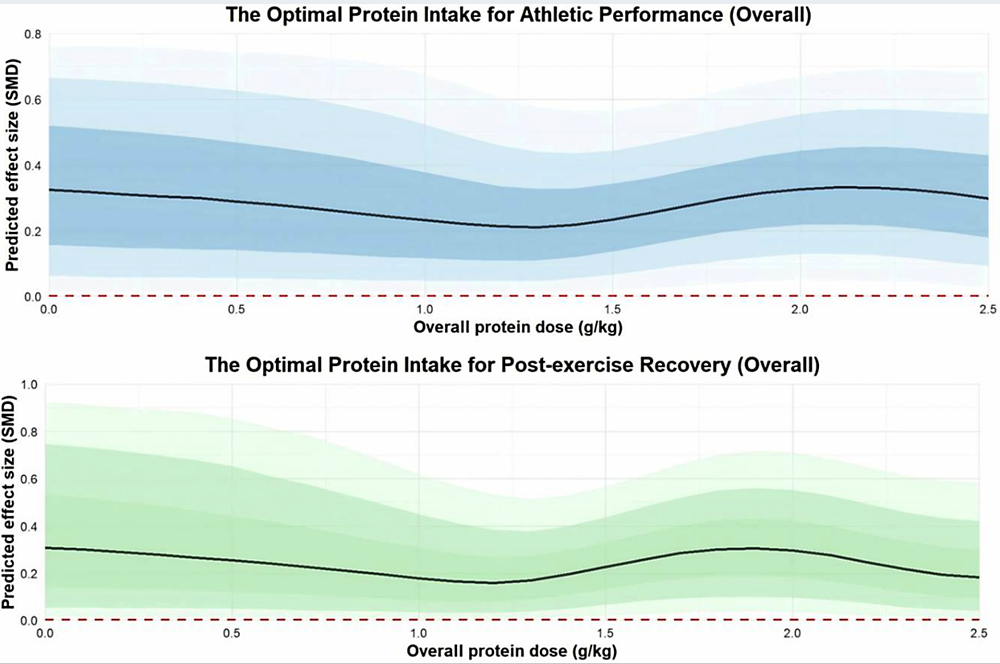
Top = overall performance vs. total (supplemental and dietary) protein intake. Bottom shows total intake vs. recovery. The black line (effect size) and the tightest clustering around the effect size (indicated by the narrower band of darker blue and green) occurs in the region of 2 grams of total protein intake per kilo of bodyweight per day.
Practical implications
If anything, this study clarifies that the outcomes from protein supplementation are not simple and clear cut. Protein supplements may have a positive effective on certain outcomes, but only in certain situations such as endurance performance, with certain types of protein (whey), and in certain dosages (1 g/kg). Because of the low quality of the findings, it may be prudent not to make rash decisions in either direction. If you don’t like taking protein supplements and you meet your daily protein needs through diet, a protein supplement probably isn’t necessary. On the other hand, if you do like taking them, there is a potential upside in doing so.
If you do plan on taking supplemental protein, according to the results of the study, the following guidelines should be followed for optimal effect:
- Protein supplements should be used when targeting endurance performance.
- A dose of up to 1 gram per kilo of bodyweight per day of supplemental protein, leading to a total daily protein intake (diet plus supplemented protein) of 2 grams per kilo per day, is most effective.
- Supplemental protein should be taken in addition to regular food, and taken during the day.
- The protein source should be whey.
One unstated finding of this study was that protein supplements don’t negatively impact performance or recovery. Athletes do have elevated protein needs, and those needs do need to be met. So if you’re struggling to meet your dietary protein needs, consuming a protein supplement can help you do so, and is very unlikely to have any negative effects. Will a protein supplement be beneficial beyond consuming that protein from regular food? It’s hard to tell, but not meeting your protein needs will certainly hurt performance. If a supplement helps you meet those needs, by all means use it. In short, protein supplements may not be necessary, particularly for achieving certain outcomes, but that doesn’t mean they can’t be helpful!
Reference
1. J Int Soc Sports Nutr. 2026 Dec 31;23(1):2605338
Latest Issue
Subscribe Today
Newsletter Sign Up
Testimonials
Dr. Alexandra Fandetti-Robin, Back & Body Chiropractic
Elspeth Cowell MSCh DpodM SRCh HCPC reg
William Hunter, Nuffield Health
Subscribe Today



Newsletter Sign Up

Coaches Testimonials
Dr. Alexandra Fandetti-Robin, Back & Body Chiropractic
Elspeth Cowell MSCh DpodM SRCh HCPC reg
William Hunter, Nuffield Health
Subscribe Today
Latest Issue
Keep up with latest sports science research and apply it to maximize performance
Today you have the chance to join a group of athletes, and sports coaches/trainers who all have something special in common...
They use the latest research to improve performance for themselves and their clients - both athletes and sports teams - with help from global specialists in the fields of sports science, sports medicine and sports psychology.
They do this by reading Sports Performance Bulletin, an easy-to-digest but serious-minded journal dedicated to high performance sports. SPB offers a wealth of information and insight into the latest research, in an easily-accessible and understood format, along with a wealth of practical recommendations.
*includes 3 coaching manuals
Get Inspired
All the latest techniques and approaches


Sports Performance Bulletin helps dedicated endurance athletes improve their performance. Sense-checking the latest sports science research, and sourcing evidence and case studies to support findings, Sports Performance Bulletin turns proven insights into easily digestible practical advice. Supporting athletes, coaches and professionals who wish to ensure their guidance and programmes are kept right up to date and based on credible science.
