
 close
close


 LOGIN
LOGINYou are viewing 1 of your 1 free articles. For unlimited access take a risk-free trial
Treadmill trials: is it time to unplug?
SPB looks at recent research comparing the benefits or otherwise of overground running compared to treadmill running on motorized or non-motorized machines


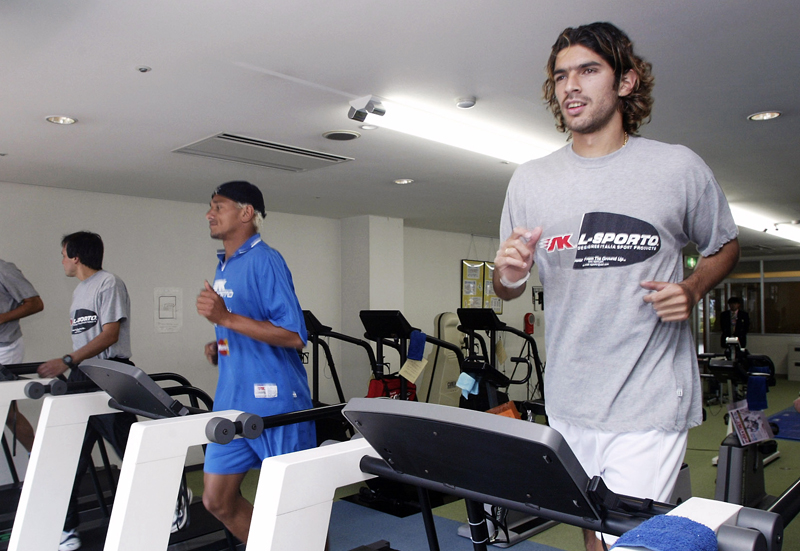
Treadmill training offers a number of potential advantages over outdoors running. No matter the weather or how dark outside, you can always train without the need to modify your sessions because of the conditions outside (eg snow, fog, ice, rain). This is particularly true if you live in a rural area with poor street lighting, or for women who have safety concerns while running alone in ‘less salubrious’ areas. Another factor that makes treadmill training appealing is that you can use gradient controls to generate hill/flat sessions – something that many runners can’t perform if they live in a flat/hilly area. The same is true for interval sessions where traffic lights and road junctions make it difficult (or even dangerous!) to execute a set of carefully structured intervals!
Aside from the training flexibility that treadmills offer, they also have a big plus when it comes to injury prevention. This is because with their well-cushioned running decks, modern treadmills can help lower the impact forces experienced by joints and muscles compared to tarmac roads or sidewalks. That matters because research has definitely determined that higher ground impact forces during footstrike are one of the root causes of running-related injuries such as knee, hip and ankle injuries, and stress fractures(1-3). This injury prevention aspect of treadmill is particularly relevant to novice runners, or those who are carrying extra pounds, and who are more at risk of impact-related running injuries(4).
Can treadmill replicate outdoors running?
Despite their benefits, some runners struggle with treadmill training sessions. Psychologically, running on the spot without any changing scenery to distract you is harder than running in the great outdoors, which is why many runners anecdotally report feeling bored on the treadmill compared to outside training. Of more concern perhaps is the fear that while delivering cardiovascular benefits, a runner’s gait on the treadmill is slightly different to outdoors running. In the longer term, this could reduce the specificity of training sessions, potentially putting runners at a disadvantage if they train on a treadmill then compete outdoors. But is this fear valid?
In a previous SPB article, Andrew Sheaff discussed this very topic. Andrew looked at research to get a better understanding of the extent to which running on a treadmill is similar to outdoors running – and if there are differences, whether runners are able to make any appropriate adjustments to ensure improved performance. Key to this was a recent collaborative study by Turkish and American researchers examining the differences between the two modes of running locomotion(5). Thirteen recreationally active runners ran in a number of different conditions:
- Overground and on a treadmill.
- In both of the above, at different gradients - 0%, 1%, and 2%.
- All the above combinations were conducted two different speeds - 2.92 meters/second and 4.58 meters/second, running for 1 minute in all conditions.
During all the trials, the muscle activity of the knee flexors and knee extensors (hamstrings and quads), plantar flexors and dorsiflexors (key muscles controlling foot pointing/flexing motion) and muscles controlling lateral ankle stability was monitored and compared to determine any differences between treadmill and overground running. The key finding was that muscular activity was similar when running overground and on a treadmill across all conditions, but most similar for the thigh muscles at a gradient of 1% and for the ankle stabilizing muscles at a gradient of 2%. Put simply, if you perform training sessions on treadmills with a gradient set between 1%-2%, you can assured that you are still using your running muscles in a similar manner as when running outdoors!
Ditching the motor
Most of you reading this will probably assume that any decent treadmill will be motor-driven and therefore mains-powered. However, over the past few years, a number of non-motorized treadmills have appeared on the market. On a non-motorised treadmill, only the runner drives the belt – ie there’s no motor moving the belt under the runner’s feet. Once seen as the ‘poor man’s treadmill’, non-motorised treadmills are making something of a comeback, especially those with curved running decks, which many runners report helps to produce a more natural ‘feel’ than a motorized treadmill, being closer to normal outdoors running. But is there any research to support this claim?
Compared to a motorized treadmill, where belt speed is controlled by an external motor, a non-motorized treadmill is participant driven, which means the runner using it can pace themselves more naturally by be able to initiate rapid acceleration and deceleration, and vary step-to-step gait, just as would be the case in overground running. And studies looking into the differences between locomotion on a motorized vs. non-motorized treadmill have indeed concluded that a non-motorized treadmill can indeed provide a closer experience (in terms of what the runner perceives) to overground locomotion(6-8).
Cardiovascular benefits: motorized vs. non-motorized
But what about the physiological differences between using a motorized and a non-motorized treadmill? Do they deliver exactly the same benefits, and if not, how do they differ? For answers, we can turn to research by Aussie scientists, which suggested that non-motorized treadmills are certainly worthy of consideration(9). In this study, fourteen fit, trained male and female runners completed of five x 6-minute bouts of running at progressively higher speeds (females 9-15kmh, males 10.5-16.5kmh), each separated by six minutes of rest. These sessions were completed on three separate occasions using:
- A conventional motorised treadmill set at 1% incline (which as we have seen provides the closest physiological equivalence to running outdoors on flat terrain).
- A curved non-motorised treadmill (Woodway Curve 3).
- Normal overground running on the flat.
For each of the trials, oxygen consumption (VO2max) and heart rates were monitored during the last 2 minutes of each bout and the results compared.
The key finding was that for any given speed, running on the non-motorised treadmill was significantly more physiologically demanding than running on the motorized deck and also when overground running. Averaged across all the running speeds, the runners’ levels of oxygen consumption was around 22% higher when running on the non-motorised treadmill, while heart rates were around 25% higher for any given speed. Because the belt on a non-motorized treadmill is runner driven and carries some resistance, the effect of higher oxygen consumption for any given speed was more noticeable in lighter runners compared to heavier runners. This is because all other things being equal, lighter runners require less oxygen consumption to maintain any given running speed; therefore, the additional energy needed to overcome the fixed belt resistance was proportionately higher for them compared to heavier runners.
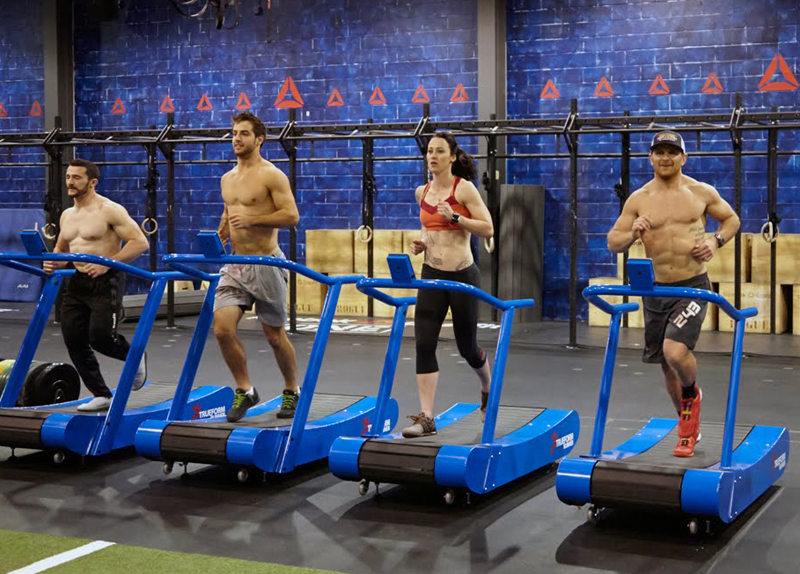
Given that many manufacturers of non-motorized treadmills claim that running on their machines is more challenging than a motorized treadmill and delivers a better workout, these results seemed to vindicate these claims. An increase of 20-25% in cardiovascular demand for a given running speed is certainly more challenging! At this point, you might wonder if this really matters because you can simply adjust the speed upwards on a motorized treadmill to match the oxygen demand of a slower on a non-motorized treadmill.
However, an important aspect of this finding is that being able to place more demand on the cardiovascular system for a given speed is a potentially very useful training tool for runners. This is because not only is it easy to generate high intensities (eg during interval training), it also means that runners can generate their usual training intensities while running at significantly slower running speeds. That’s good news because lower running speeds means less impact loading on the joints and muscles, leader to a ‘gentler’ running gait – something that anecdotal reports from runners using non-motorized treadmills tend to confirm.
Biomechanics of non-motorized treadmills
As mentioned above, Andrew Sheaff’s article presented data that muscular activity when running on a motorized treadmill is largely similar to running overground. However, while largely similar, the muscle kinematics (patterns of movement) are not identical. In a powerful systematic review and meta-analysis study (a study that pools data from a number of previous studies on a topic to come up with more robust conclusions), researchers analyzed 33 studies that compared the kinematics of motorized treadmill running with those of overground running(10).
They concluded that while largely similar, there were some subtle differences. During motorized treadmill running, the degree of knee flexion (bending) from footstrike to push off, the vertical displacement center of mass (bobbing up and down) and peak propulsive force were all lower than overground running. Meanwhile, there was more knee bend at footstrike and more ankle internal joint moment in a lateral direction (side to side) at footstrike than overground running. To emphasize however, these differences were small and many of the parameters measured were largely comparable.
More natural without motors?
The ‘runner-driven’ nature of a non-motorized treadmill is claimed by many runners to feel more ‘natural’ than a motorized treadmill. But does this also mean that running on a non-motorized treadmill can therefore biomechanically replicate overground running better than motorized treadmills? To answer this, we can turn to recent research by a team of Spanish scientists who investigated if curved non-motorized treadmills can reproduce overground running better than motorized treadmills by analysing the differences in joint kinematics (hip, knee, and ankle)(11).
Nineteen recreational runners completed three randomized running tests on both a motorized and a curved non-motorized treadmill. Kinematic data from the hip, knee, and ankle joints were collected and the data analysed in all three dimensions and compared to overground running data to see if/how it differed and if the non-motorized treadmill kinematics were indeed more ‘natural’. The findings were surprising; the analysis showed there were more kinematic differences between curved non-motorized treadmill and overground running than between motorized treadmill and overground running. These differences occurred mainly in knee early and late in the gait cycle and also in the sagittal plane of the ankle.
The authors concluded that running on curved non-motorized treadmills is more biomechanically different compared to overground than motorized treadmills, and that while they deliver a sensation more akin to overground running, there is no advantage in running muscle specificity – indeed there might even be a theoretical disadvantage. However, they also pointed out that non-motorized treadmills could be a useful tool in rehabilitation because the differences in joint kinematics were probably not functionally relevant, and these treadmill types allow runners to generate meaningful workloads with less impact forces.
Implications for runners
Let’s quickly summarize these findings. Firstly, while there are small biomechanical differences between motorized treadmill running and overground running, these shouldn’t be considered as a reason not to train on a treadmill – your running fitness developed on a treadmill will translate to overground running! When it comes to feel however, many runners report that a good non-motorized treadmill feels more natural to run on than a motor-driven treadmill. This is no doubt due to the fact that the runner controls the belt speed, and changes in pace and stride length can be accommodated instantly by applying more or less force during push off – just like in overground running.
However, don’t be misled into believing that this means a non-motorized treadmill is more running-muscle specific than a motorized treadmill because the evidence doesn’t support that – quite the opposite in fact. If you’re going to rack up many miles of training on a treadmill, motorized may be better! But one definite advantage a good non-motorized treadmill can offer is the ability to generate higher cardiovascular loading with lower footstrike impacts, a real plus for runners who need some low-impact training (eg when recovering from or seeking to avoid injury).
One final point concerns build quality. Whether opting to purchase/train on a motorized or non-motorized treadmill, the better the build quality and the engineering, the more it will be able to deliver a stable running platform that enables you to run with a natural gait. Don’t fall into the trap of purchasing a cheap treadmill for home use (motorized or non-motorized) to save money or space because the chances are it won’t deliver; it won’t feel natural and it won’t feel good to use. Always try before you buy!
References
1. J. Sci. Med. Sport 2013. 16, 205–210
2. Med. Sci. sports Exerc 1991. 23, 1008–1015
3. Bone 2017. 94, 22–28
4. J Sci Med Sport. 2018 Dec;21(12):1221-1225
5. Med Sci Sports Exerc. 2023 Mar 1;55(3):517-524
6. J. Strength Cond. Res 2009. 23, 883–890
7. Gait Posture 2015. 41, 141–145
8. Int. J. Sports Med 2015. 36, 705–709
9. Front Physiol. 2017 Nov 14;8:914
10. Sports Med. 2020 Apr;50(4):785-813
11. J Sports Sci. 2023 Nov;41(21):1927-1933

Andrew Hamilton

Latest Issue
Subscribe Today

Newsletter Sign Up
Testimonials
Dr. Alexandra Fandetti-Robin, Back & Body Chiropractic
Elspeth Cowell MSCh DpodM SRCh HCPC reg
William Hunter, Nuffield Health
Subscribe Today


Newsletter Sign Up

Coaches Testimonials
Dr. Alexandra Fandetti-Robin, Back & Body Chiropractic
Elspeth Cowell MSCh DpodM SRCh HCPC reg
William Hunter, Nuffield Health
Subscribe Today
Latest Issue


Keep up with latest sports science research and apply it to maximize performance
Today you have the chance to join a group of athletes, and sports coaches/trainers who all have something special in common...
They use the latest research to improve performance for themselves and their clients - both athletes and sports teams - with help from global specialists in the fields of sports science, sports medicine and sports psychology.
They do this by reading Sports Performance Bulletin, an easy-to-digest but serious-minded journal dedicated to high performance sports. SPB offers a wealth of information and insight into the latest research, in an easily-accessible and understood format, along with a wealth of practical recommendations.
*includes 3 coaching manuals
Get Inspired
All the latest techniques and approaches


Sports Performance Bulletin helps dedicated endurance athletes improve their performance. Sense-checking the latest sports science research, and sourcing evidence and case studies to support findings, Sports Performance Bulletin turns proven insights into easily digestible practical advice. Supporting athletes, coaches and professionals who wish to ensure their guidance and programmes are kept right up to date and based on credible science.
