
 close
close


 LOGIN
LOGINYou are viewing 1 of your 1 free articles. For unlimited access take a risk-free trial
Skill training for athletes: time for some overload
Andrew Sheaff looks at new research on skill acquisition and training for athletes, and explains why you should challenge your skill training with progressive overload!


Most of the available coaching and training information focuses on the development and improvement of various measures of physical fitness. From strength to speed to endurance to mobility - these topics and their sub-categories are covered in great detail, thereby helping to create the potential for better performances. In sport however, what really matters is how any fitness gains are used to produce better skilled movements. In this article, we’re going to explore a framework for improving skills that is not obvious at first, yet extremely intuitive once recognized. Ironically, this framework is borrowed from fitness development principles.
Training overload
One of the foundational principles of effective physical training is the concept of ‘overload’. Overload is necessary for improvements in all physical abilities, from speed, strength, endurance, to range of motion. An overload involves a greater physical challenge to continue to provoke adaptation. That could be more volume, more speed, higher rates of metabolism, more weight lifted, and so on. Without overload, there is no progress.
Yet this same principle is rarely applied to skill development interventions. In many cases, athletes are asked to perform the same task but just ‘better’. They’re provided with instruction, they perform many repetitions, and they’re given consistent feedback. But the activities to develop those skills often remain the same; there is no intentional attempt to create overload, and as a result, skills often fail to improve as much as they otherwise could. Considering the importance of skill in all athletic endeavors, this is problematic.
Skills and balance
As we’ll explore shortly, a group of researchers have recognized this fact and carried out a study applying the overload principle to the acquisition of skills through the use of balance training. While balance training may not directly apply to your sport of choice, that doesn’t mean this new research isn’t relevant to you and your goals; rather than view the study as investigating how to improve balance, view it from the perspective of overloading skills, which is important in all sport.
Beyond the larger framework of improving skills, balance is a critical ability for many athletes, particularly senior athletes who will experience a natural decline balance abilities as they age. This decline can start in one’s 50s, becoming more pronounced after age 65. As with any skills or physical ability, that decline can be prevented or slowed with appropriate training. This speaks to the importance of identifying strategies to facilitate improved balance skills.
New research
As mentioned above, a group of Norwegian scientists has investigated the concept of overload in skill development, using balance training as their intervention (1). They recruited 24 volunteers who had no history of balance training. All subjects were right-footed and performed the balance training on their dominant foot. The balance activity consisted of standing on a wobble board, which is a flat circular disc attached to a hemispherical block. The block was in contact with the ground and the subjects stood on the disc. Their goal was to prevent the edge of the board from touching the ground, and they were not permitted to use the arms to compensate for any loss of balance.
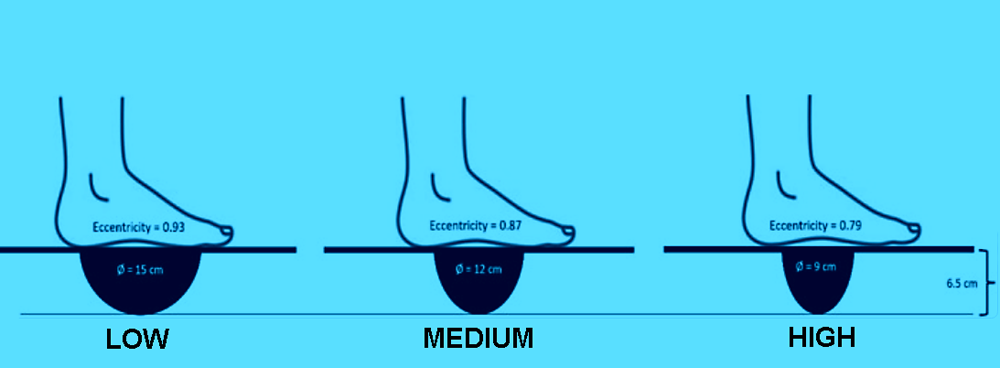
Three different types of wobble boards were used: low-, medium-, and high-difficulty boards. The circular disc the subjects stood on remained the same in all cases, but the profile of the spherical block was different (see figure 1). The low-difficulty sphere was most gently sloped while the high-difficultly sphere was most tightly curved, making it the most difficult to balance on. The subjects were tested on their ability to keep the wobble board level at all three levels of difficulty before training.
Figure 1: Wobble-board design from low- to high-difficulty
During the training intervention, half the subjects were assigned to the low-difficulty group, and the other half were assigned to the high-difficulty group training on both low- difficulty and high-difficulty wobble boards respectively. No training was performed using the medium-difficult board. The subjects performed five training sessions over a 3-week period, with each training session consisting of 25 repetitions of 20 seconds. The repetitions were spaced out to ensure sufficient rest. The initial testing was repeated after the training period.
What they discovered
Once the stats were run, the results were clear. The high-difficulty group improved performance across all three levels of difficulty (see RHS column of figure 2). They improved performance on the high-difficulty board (where some of their training had been performed) and they also improved performance on the medium- and low-difficulty boards. In contrast, while the low-difficulty group improved their performance while using the low-difficulty board, there was no improvement in performance on the medium- and high-difficulty boards (LHS column of figure 2).
Figure 2: Results from low- vs. high-difficulty balance training
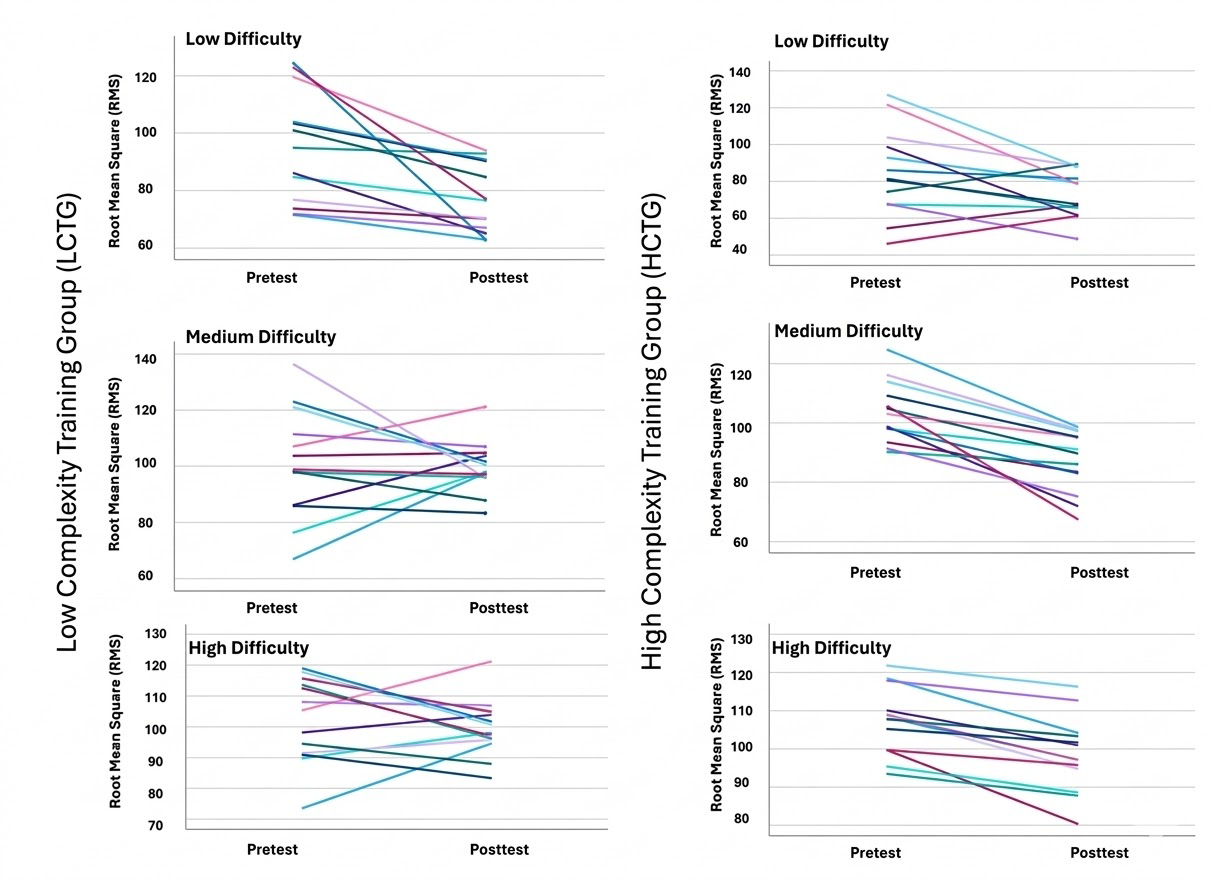
Root mean square (RMS) score on vertical axis = deviation from level balance (lower scores = better balance). Participants who trained at high-difficulty levels improved their scores at all three difficulty levels whereas those who trained at low-difficulty improved only at low difficult challenges and not at medium or high difficulties.
In short, it appears that training at higher difficulty levels allows for performance transfer down the difficulty scale, where performance is also improved in related, but easier tasks. By contrast, the opposite does not appear to be true; the low-difficulty participants were unable to improve performance on even the medium-difficulty wobble board. Since the same basic skill was used in at all three levels of wobble boards, we can conclude that for performance is to improve at higher levels of difficulty, these skills need to be overloaded when training.
Practical implications
The results from this new research are clear. Learning a more difficult version of one task improves performance during an easier version of the same task. However, training with the easier version does not necessarily lead to improved performance in the more difficult version of the same task. Therefore, overloading skills by performing more difficult versions of the same activity is a powerful way to facilitate improvements in skills movement.
I work in swimming, so let’s consider an example from this sport. Swimmers need to be able to create as much propulsion as possible with their arms to go as fast as possible. It requires skill to apply force more than it does strength to create force. We can overload this skill by having swimmers close their hands to encourage use of the whole arm as a paddle, swim against resistance to increase the challenge of moving forward, or both. The goal is to help swimmers improve their ability to create propulsion by overloading this skill.
In all sports, the principle remains the same. It’s a matter of identifying which skills are required for competitive success, determining which skills individual athletes need to improve, and then finding a way to patiently and progressively overload those skills. In many cases, good coaches are already doing so whether they know it or not. By understanding the underlying principle, it’s possible to take those interventions and make them even more effective.
If you’re specifically interested in improving balance qualities, the research is also clear. Ensure that the tasks you carry out to develop balance are challenging - ideally more challenging than what would be expected during whatever competition or activity that you’re training for. As you make progress, ensure that the task difficulty continues to move forward. In the study above, the shape of the ground contact was made progressively more unstable. While that is potentially an avenue for continued increases in difficulty, other options such as adding limb movements can further challenge balance and stability. Just remember the concept: identify what you want to be able to do and then find a way to create a training environment that is more difficult than normal!
Reference
1. Eur J Sport Sci. 2026 Feb 3;26(3):e70130. doi:10.1002/ejsc.70130

Latest Issue
Subscribe Today
Newsletter Sign Up
Testimonials
Dr. Alexandra Fandetti-Robin, Back & Body Chiropractic
Elspeth Cowell MSCh DpodM SRCh HCPC reg
William Hunter, Nuffield Health
Subscribe Today



Newsletter Sign Up

Coaches Testimonials
Dr. Alexandra Fandetti-Robin, Back & Body Chiropractic
Elspeth Cowell MSCh DpodM SRCh HCPC reg
William Hunter, Nuffield Health
Subscribe Today
Latest Issue

Keep up with latest sports science research and apply it to maximize performance
Today you have the chance to join a group of athletes, and sports coaches/trainers who all have something special in common...
They use the latest research to improve performance for themselves and their clients - both athletes and sports teams - with help from global specialists in the fields of sports science, sports medicine and sports psychology.
They do this by reading Sports Performance Bulletin, an easy-to-digest but serious-minded journal dedicated to high performance sports. SPB offers a wealth of information and insight into the latest research, in an easily-accessible and understood format, along with a wealth of practical recommendations.
*includes 3 coaching manuals
Get Inspired
All the latest techniques and approaches


Sports Performance Bulletin helps dedicated endurance athletes improve their performance. Sense-checking the latest sports science research, and sourcing evidence and case studies to support findings, Sports Performance Bulletin turns proven insights into easily digestible practical advice. Supporting athletes, coaches and professionals who wish to ensure their guidance and programmes are kept right up to date and based on credible science.
