
 close
close


 LOGIN
LOGINYou are viewing 1 of your 1 free articles. For unlimited access take a risk-free trial
Injury and mental health: are you in a doom loop?
SPB looks at new and concerning data on the link between injury and mental health – and vice versa. What are the implications for athletes who struggle with either?


As the study of sports science has evolved, one thing that has become increasingly apparent is the role of the brain in regulating physical performance. In recent years, research has identified that physical performance can be strongly influenced by a wide range of factors governed by the way we think or feel, or by exposure to external factors that can impact on brain function and frame of mind. Some examples include:
· The positive impact of music on exercise performance(1,2).
· The negative impact of mental demands, either before(3,4) or during exercise(5).
· The positive or negative effects of mental expectations on exercise performance(6)
· The placebo effect (where beliefs enhance performance) and the nocebo effect (where beliefs harm performance).
Mental health and performance
Given that the brain can play such a role in determining physical performance, it’s hardly surprising that athletes who are struggling with mental health can experience a decline in physical performance. This decline can result from a number of resulting factors, including lack of motivation to train, and disordered eating patterns, social avoidance of group training sessions. You might think that because of their ‘tough personalities’, athletes are less likely to succumb to mental illness, or that athletes who might be prone to mental illness are protected to a degree by their high levels of physical activity [NB: sports or physical activity participation can be a protective factor for mental health, given its associations with improved social outcomes (eg a sense of belonging) and reduced levels of depression, anxiety, and stress](7,8). Unfortunately however, the reality is far less clear.
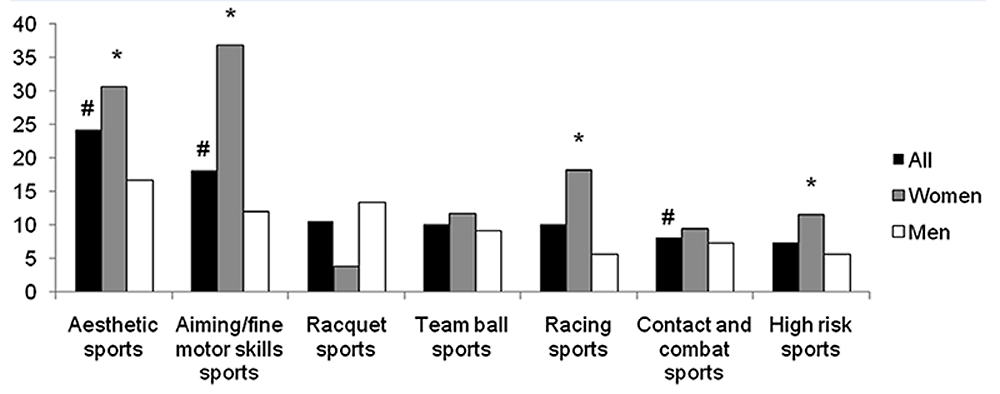
One French study examined the psychological health of more than 2,000 elite athletes(9). In particular, it aimed to identify the principal psychological problems encountered within French elite athletes, and the variations in prevalence according to gender and the sport practiced (see figure 1). The sample used in this study was very comprehensive as it represented 13% of the country’s elite athletes at the time. The main findings were as follows:
· Seventeen percent of the athletes had a current or recent psychopathology (eg anxiety, eating disorders, depression, sleep problems etc) at the time of their evaluation, with generalised anxiety disorder being the most prevalent at 6%.
· Women were a third more likely than men to have a current or recent psychopathology (20.2% of women vs. 15.1% of men).
· Female athletes were 56% more likely than males to have suffered from anxiety disorders over their lifetime.
· Significantly higher rates of anxiety disorders (around four times higher in women and three times higher in men) were found in aesthetic sports such as gymnastics, synchronised swimming and figure skating.
Figure 1: Lifetime prevalence (%) of minor or major depression by type of sport practiced
Injury and mental health
There are many factors that can contribute to the onset of mental health disorders such as eating disorders, depression, and generalized anxiety, including work stress, bereavement, social isolation, money worries, drug use and of course genetic predisposition(10). Naturally, all of these factors can affect athletes too, who are just like everybody else in most respects. However, athletes may face additional challenges/stressors beyond that of the general population in terms of competition pressure and injury. Injury in particular can be very challenging; sport plays a major (even defining) role in many athletes’ lives. Losing the ability to compete in or even train for that sport can result in a great deal of stress and frustration, especially as the injured athlete sees his or her hard-won fitness gains slipping away.
Research has established a clear link between sport injury - defined as ‘any physical condition that prevents an athlete from participating in training/competition’(11) - and poorer mental health. In particular, an injury can be a significant stressor for elite athletes(12) who face an increased risk for injury compared to amateur athletes(13). Moreover, research has highlighted the significant adverse impacts experiencing a sport injury can pose to an athlete’s mental health, including anxiety, depression, and reduced self-esteem(14,15). Indeed, the UK Sports Institute (UKSI) revealed in a 2022 study that four out of ten athletes experienced psychological distress when injured(16). Unfortunately, the exact extent to which injury can lead to mental health problems, which injuries are most problematical, and in which sports athletes are most vulnerable is poorly understood. That’s because there’s a dearth of rigorous longitudinal research that has tracked a large cohort of athletes over time across various sport disciplines with various injury types and the mental ill-health symptoms present.
Mental health and injury
Understanding that suffering an injury (especially a severe injury) can lead to poorer mental health in athletes is easy for most of us. After all, who hasn’t felt thoroughly down in the dumps after succumbing to an injury and having to ditch all training and competition for weeks or even months? What may surprise you however, is that the injury/mental health relationship appears to be a 2-way process – ie that an uninjured athlete whose mental health is suffering (eg through stress, anxiety, low mood etc) is more likely to sustain an injury than would otherwise be the case. Dig a little deeper however and perhaps it not so surprising after all.
It turns out there are well-established theories such as the ‘Model of Stress and Athletic Injury’, which proposes that psychological factors can help precipitate injury in sport, via physiological responses (eg increased muscle tension and poorer attention to surroundings)(17). In this model, several factors related to mental health are identified as being associated with increased injury occurrence including low mood, personality, perceived life stressors, and altered stress responses(18).
However, despite the evidence that psychological factors can increase an athlete’s vulnerability to injury, there is limited understanding on the role of ‘mental ill-health’. One exception was a prospective cohort study (tracking a group of athletes forward in time from a start point), which discovered that athletes who exhibited higher than normal anxiety symptoms prior to the competitive sporting season were nearly twice as likely to experience an injury during that season, compared to athletes with normal anxiety levels(19).
An important question at this point is this: ‘If injury can help precipitate increased stress/anxiety and poorer mental health, and poorer mental health can increase the risk of a subsequent injury, is there a risk that athletes could end up in a doom loop, where frequent episodes of injury and poorer mental health reinforce each other’? It turns out that this potential bi-directional relationship has never been properly tracked in a cohort of elite athletes. But now a team of UK scientists have done exactly that and published their findings in a new study.
New research
Published in the ‘Journal of Medicine and Science in Sport’, the goal of this study was to examine the incidence rates and burden of sport injury and mental ill-health episodes, and also whether there was a bi-directional relationship between sport injury and mental ill-health in an elite UK athlete cohort(20). Led by researchers from the University of Bath and the UK Sports Institute, the study looked back at real-world data from the health records of elite athletes over a period of six years to investigate the relationship between injury and mental health, and vice-versa. Although a retrospective study design (looking backwards in time) is unable to prove cause and effect, it is nevertheless very useful for spotting long-term links, especially when looking at a large number of participants (in this case, athletes).
What they did
The team investigated the records from 1,237 elite athletes engaged in sports such as soccer, rugby, cycling, track athletics, and swimming, and who were registered with the UK Sports Institute. These records spanned the period 2018-2024, and the athletes involved were participating at high levels (either full-time pros or national squad members), training 20 or more hours a week. These records included data from routine medical records, psychological assessments, and the athletes’ own self-reports. Where an injury was mentioned in the records, this was only logged if it was confirmed to be a musculoskeletal issue that had caused more than seven days off training or competition. Injuries were also classed in terms of the number of days lost and whether it was an acute (sudden) injury such as a sprain or an overuse injuries that had come on over time.
Where mental health was mentioned in the records, the athlete’s condition was retrospectively assessed using validated tools such as the ‘General Health Questionnaire-12’ (GHQ-12) for overall distress, the ‘Patient Health Questionnaire-9 (PHQ-9)’ for depression symptoms, and the ‘Generalized Anxiety Disorder-7’ (GAD-7) for anxiety. If a score in any of these assessments was high enough to be clinically significant, this was flagged as a mental (ill) health case’. So they could compare like with like, the researchers also analyzed the data for ‘confounders’ like training load, sleep quality, life stress (eg career pressures), and demographics. This enabled the researchers to eliminate these confounding factors in their comparisons and concentrate only on the relationship between injuries and mental health and vice versa.
To properly analyze the collected data, a statistical analysis technique model known as ‘Cox proportional hazards’ was applied to understand how sustaining an injury predicted a future mental health issue, and vice versa. From this, the researchers were able to calculate the odds of developing depression within six months following an injury, and the reverse – ie how developing a mental health issue predicted the onset of a new injury. Statistical ‘subgroup analyses’ also checked for any differences in the mental health-injury (and vice-versa) relationship by gender, sport type, and injury severity.
What they found
The accumulated data provided an insight gained from over 5,000 athlete-years of follow up, which provided a high degree of scientific robustness. The key findings that emerged were as follows:
· Over the six-year period, 68% (841) of the athletes suffered at least one injury, an average of 1.4 per athlete.
· Mental ‘ill-health’ cases affected 29% of the athletes at the start of the 6-year period, rising to 42% by end of the period. Through the period as a whole, depression affected 18% of the athletes, anxiety 22%, and distress 25%.
· Looking at injury causing mental ill-health, athletes post-injury were more likely to develop depressive symptoms within three months of an injury, with effects strongest for severe injuries of more than 28 days off. Likewise, injury increased the likelihood of anxiety and general distress. Recurrent injuries amplified this trend (see figure 2).
· Looking at the reverse direction of mental ill health causing injury, high overall distress levels at the start of the observation period tripled the athletes’ injury risk in the next three months! High levels of anxiety increased the risk of acute injuries by while depression seemed to drive overuse injuries, increasing them by 2.1-fold.
· There DID seem to be a doom loop in that athletes with both an injury and mental ill health at the start of the observation period were 5.8 times more likely to cycle between injury and mental ill health or mental ill health and injury on a yearly basis.
· There was a greater link between anxiety and injury in team sports, while in individual sports, there was a greater link between depression and overuse injuries.
· Overall, females athletes were slightly more vulnerable to the injury-mental/mental injury link (2.6-fold vs. 2.1-fold for males). The researchers suggested that this was possibly due to greater social pressures or differences in hormonal factors.
Figure 2: Relationship between injury occurrence and risk of mental ill health
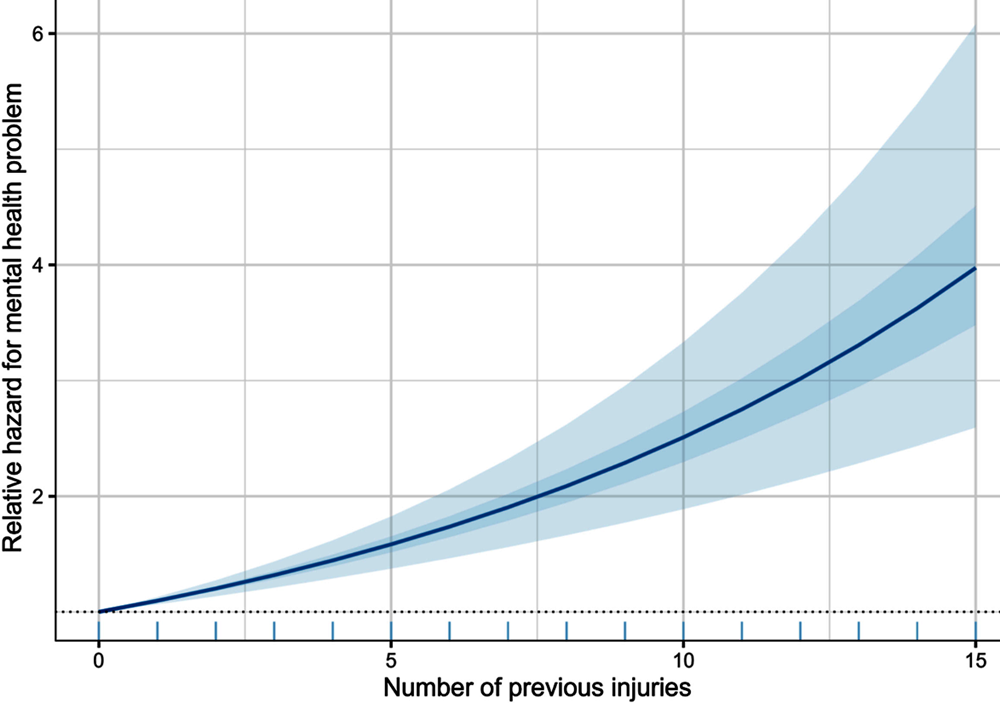
The solid blue trend line shows that with no previous injuries, the risk of developing a mental health problem is 1.0-fold (ie no extra risk). At five injuries, the risk of mental health struggles in the ensuing months around rises to around 2.5—2.5 times higher. For ten injuries, the risk increases to 4-5 times higher. NB – the shaded blue area indicates the statistical uncertainty. It’s narrow at low injury counts (more data there) and widens at high counts (fewer athletes with 10+ injuries).
Practical implications
In their summing up, the researchers emphasized that their results showed that ‘for each injury sustained in the past 12 months, athletes’ risk of experiencing a mental ill-health episode increased by 10%. Furthermore, athletes who had experienced a mental ill-health episode in the last 12 months had an 18% increased risk of injury’. In short, this data shows that there IS a bi-directional relationship between sport injury and mental ill-health in elite athletes – or to put it bluntly, injury and mental ill health can mutually reinforce each other. In other words injuries and mental health woes can feed off each other, which may result in a vicious downwards cycle for some athletes.
In terms of practical application, this data strongly suggests that athletes, coaches and sports medicine professionals need to treat an injured athlete not just in terms of physical rehab, but also in terms of maintaining or improving the athlete’s mental well being. Treating only the injury and not considering the athlete’s mental health could result in the athlete becoming depressed or anxious, thereby increasing the chance of a further injury. Likewise, athletes who are struggling with depression or anxiety are more likely to sustain an injury; it makes sense therefore that coaches seeking to reduce the risk of injury in their athletes monitor athletes’ mental well being on a regular basis. Simple tools like the PHQ-9 screening given to athletes following an injury could flag up an increased depression or anxiety risk, which would enable coaches or even the athlete themselves to use strategies to boost mental health (eg mindfulness practice or counselling).
If you’re an athlete without a coach (as are most recreational athletes), simply being aware of this link can help you navigate your predicament better. If you do sustain an injury that requires a lengthy break from your sport, it’s important to seek support from others – maybe other injured athletes – and to vent your frustration. Engaging in any cross-training activity is likely to help stave off a downwards spiral in your mental well being, especially if you can share it with others. If you’re already in a bad place mentally due to injury, adding in extra core and strength training activities may help make you more resilient to sustaining a further injury and get you back to sport more rapidly. Seeking professional advice from an experienced coach or physiotherapist may also be worthwhile; undertaking a structured rehab program under the watchful eye of an expert will feel much more empowering than struggling along on your own!
References
1. Sport and Exercise Psychology: Topics in Applied Psychology, 109-138, 2008
2. Percept. Mot. Skills. 2010;110:257–264
3. Pediatr. Exerc. Sci 2018. 30, 208–215
4. Front Psychol. 2025 Apr 9:16:1520156
5. Front Psychol. 2020 Dec 23;11:608426.
6. Psychology of Sport and Exercise 2024. Vol 73, 102633
7. Syst Rev. 2023; 12:1-27
8. Br J Sports Med. 2023; 57:1203-1209
9. PLoS ONE 2011; 6(5): e19007
10. BMC Public Health. 2022 Jul 23;22(1):1407
11. Br J Sports Med. 2002; 36:39-44
12. Knee Surg Sports Traumatol Arthrosc. 2016; 24:3934-3942
13. Sports Med. 2018; 48:837-848
14. Br J Sports Med. 2019; 53:722-739
15. Int Rev Sport Exerc Psychol. 2019; 13:231-265
16. J Athlete Dev Exp. 2022; 4:160-172
17. J Sport Exerc Psychol. 1988; 10:294-306
18. Sports Med. 2017; 47:353-365
19. Am J Sports Med. 2017; 45:2148-2155
20. J Sci Med Sport. 2025 Oct 9:S1440-2440(25)00451-7. doi: 10.1016/j.jsams.2025.10.002. Online ahead of print

Andrew Hamilton

Latest Issue
Subscribe Today
Newsletter Sign Up
Testimonials
Dr. Alexandra Fandetti-Robin, Back & Body Chiropractic
Elspeth Cowell MSCh DpodM SRCh HCPC reg
William Hunter, Nuffield Health
Subscribe Today


Newsletter Sign Up

Coaches Testimonials
Dr. Alexandra Fandetti-Robin, Back & Body Chiropractic
Elspeth Cowell MSCh DpodM SRCh HCPC reg
William Hunter, Nuffield Health
Subscribe Today
Latest Issue
Keep up with latest sports science research and apply it to maximize performance
Today you have the chance to join a group of athletes, and sports coaches/trainers who all have something special in common...
They use the latest research to improve performance for themselves and their clients - both athletes and sports teams - with help from global specialists in the fields of sports science, sports medicine and sports psychology.
They do this by reading Sports Performance Bulletin, an easy-to-digest but serious-minded journal dedicated to high performance sports. SPB offers a wealth of information and insight into the latest research, in an easily-accessible and understood format, along with a wealth of practical recommendations.
*includes 3 coaching manuals
Get Inspired
All the latest techniques and approaches


Sports Performance Bulletin helps dedicated endurance athletes improve their performance. Sense-checking the latest sports science research, and sourcing evidence and case studies to support findings, Sports Performance Bulletin turns proven insights into easily digestible practical advice. Supporting athletes, coaches and professionals who wish to ensure their guidance and programmes are kept right up to date and based on credible science.
