
 close
close


 LOGIN
LOGINYou are viewing 1 of your 1 free articles. For unlimited access take a risk-free trial
Hamstring injury: spinning the wheel of fortune
SPB looks at new research on hamstring training to prevent and rehab hamstring injury. Does flywheel strength training offer an advantage over conventional strength training?



If you’re a regular SPB reader, you’ll already be well aware that adding strength training to an athlete’s routine does more than boost strength. It can also help to develop speed and power – an important attribute in many sports – and improve body composition by increasing lean muscle mass. Another key benefit of strength training is an improvement in something called muscle economy, which is how efficiently your muscles use energy to produce motion while exercising(1). This is important for endurance athletes because research has found that when muscles are regularly exposed to heavy loads, for example lifting weights - they become better at turning energy into movement, which means you can run, swim, cycle, or row at the same pace using less energy and oxygen. The result? You feel less tired and have more in the tank for when it really matters—like the final push in a race.
Get going with inertia!
Most athletes are familiar with strength training using weights, gym machines, resistance bands, or even bodyweight exercises. Some might have tried plyometrics (jump-based training) or machines that use air or hydraulics for resistance. But fewer athletes know about a different strength-training method called ‘inertial training’. n this method, resistance comes from a spinning flywheel. When you pull or push against it, the flywheel spins and creates resistance. This training concept is based on a basic law of physics known as ‘conservation of angular momentum’ (see the video clip below for a simple explanation). Flywheel training was first developed in the 1990s to help astronauts maintain strength in space, where they can’t rely on gravity. Since then, many studies have shown how effective it is for improving strength and performance(2–4).
The beauty of angular momentum
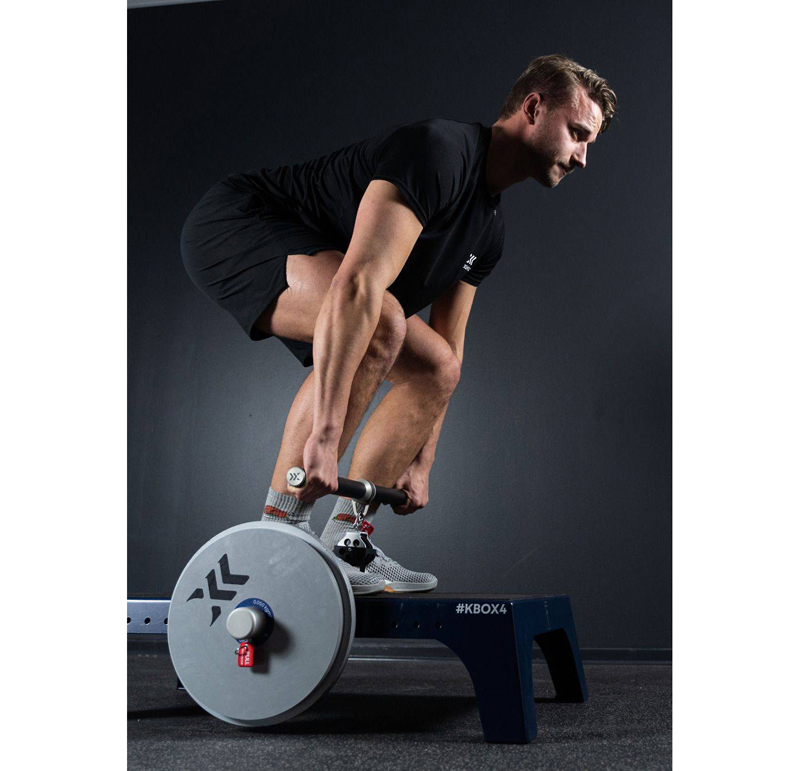
Basically, every spinning object has angular momentum, and doesn’t want to change its velocity or change direction unless an external force is applied. To change angular momentum of a flywheel, YOU have to apply that force. You will have encountered this phenomenon if you’ve ever played with a spinning gyroscope! In flywheel training, the concentric (muscle shortening) action is initiated by pulling the strap connected to the shaft of the device, spinning (accelerating) the flywheel/cone. Once the strap rewinds around the shaft, an eccentric (muscle lengthening) action is performed to decelerate the flywheel/cone rotation. If executed correctly, this enables a greater application of force during the eccentric action, resulting in a mechanical eccentric overload.
Using a spinning flywheel for resistance training might sound an odd approach compared to simply lifting some weights, but it actually some big benefits. First, the resistance to change of angular momentum of the spinning flywheel adjusts automatically; the harder and faster you execute a strength training movement, the more the flywheel pushes back. It also provides resistance in all directions, which means it’s great for training movement patterns used in real sports. Another big advantage of flywheel training is how easily it allows for eccentric training movements, ie when your muscles work while lengthening (akin to lowering a weight slowly). Eccentric training is known to be very effective for building strength, generating larger gains than concentric training movements per unit of energy invested(2). In flywheel training, as you spin the wheel faster during the pushing (or pulling) phase, you also need to control that force during the return, which is what gives your muscles a powerful eccentric workout.
Boosting athletic performance
In recent years, sports scientists have studied how flywheel training can help athletes perform better. One 2017 study looked at national-level swimmers who added just four weeks of flywheel training to their routine(5). They saw a 12.8% boost in muscle force, 14.2% more muscle power, and swam faster - 0.76% faster in freestyle and 1.86% faster in butterfly. A year later, researchers carried out a systematic review of multiple studies on flywheel training and confirmed more benefits in athletes employing this training mode(6). These were as follows:
· Muscle mass gains of 5–13%.
· Strength gains of 21–90%during eccentric movements.
· Muscle power gains of 10–33%.
· Over 15% better jumping performance.
· Increases of 2–10% in top running speeds.
Other sports like soccer(7), rugby(8), and basketball(9) have also shown solid results using inertial flywheel training—especially for improving speed, power, and agility.
Harness the healing power
One big benefit of strength training (and reason that many athletes strength train) is to reduce the risk of injury, or rehab after injury. When it comes to the best type of strength training for injury prevention and rehab, a large body of evidence has accumulated that strength training exercises that emphasize eccentric muscle contraction are particularly effective, especially for recurrent and troublesome injuries like hamstring strains(10-12). It stands to reason therefore that if flywheel strength training is a very efficient of delivering powerful eccentric loadings to muscles, it might be an excellent strength tool for athletes whose main goal is to prevent or recover from injury.
It’s certainly the case that training programs incorporating eccentric-focused resistance exercises have been shown to be very effective at developing eccentric hamstring contraction strength, and improving hamstring muscle fiber length (thereby increasing elasticity in the muscles), and that flywheel training is a good way of developing these attributes(13,14). But can a regular flywheel training program help athletes to develop more resilient muscles and lower the risk of injury, particularly when it comes to reducing the risk of a re-injury following an initial injury?
New research
To answer this question, a new study carried out by a team of Argentinean scientists has investigated whether incorporating flywheel leg curls into a preventive training program leads to greater improvements in muscle structure and function, and a lower reinjury occurrence, compared with conventional leg curls in athletes with a history of hamstring injury(15). Published in the journal ‘Sports Health’ this study looked at the benefits or otherwise of flywheel training in athletes with a history of hamstring injuries sustained within the previous 18 months, and who participated in an 8-week preventive training program using flywheel training. The researcher hypothesized that training the hamstrings with flywheel leg curls would result in greater improvements in eccentric knee flexor strength and biceps femoris long head (BFLH) fascicle length compared with conventional leg curls, thus leading to a reduced occurrence of re-injury.
What they did
Between March 2020 and November 2022, 26 athletes with a history of hamstring injury over the previous 18-month period were assigned to an 8-week preventive training program, performing leg curl exercises on either conventional (control group) or flywheel (intervention group) equipment. The participants were all registered with their relevant sport federation, and were actively involved in their team’s full training routine. All had sustained a hamstring injury within the past 18 months - clinically confirmed by a medical doctor through imaging examinations. All had also undergone physiotherapy (either at their club or privately) and had played at least match after returning to sport.
The athletes were randomly assigned to one of the two groups:
· Flywheel leg curl training group –consisting a twice-weekly training program for eight weeks, consisting of a number of exercises that included leg curls performed using flywheel equipment (Ivolution – see figure 1).
· Control group – performing the exact same program as above with the exception of the leg curls, which in this case were performed on a conventional Cybex leg curl machine (figure 1).
The actual training sessions for both groups began with a warm-up consisting of 10 minutes of treadmill running at 8kmh followed by dynamic flexibility exercises. This was followed by three lumbopelvic stability exercises (lateral bridge, dead bug, and bird dog), resistance exercises targeting the lower limb muscles (leg extension, hip thrust, clamshell, and heel raise), and then conventional or flywheel leg curls (Figure 1). A 30-second self-myofascial release using a foam roller was performed as part of the cool-down. A pictorial description of the exercise routine is shown in figure 1.
Figure 1: Description of the hamstring training program
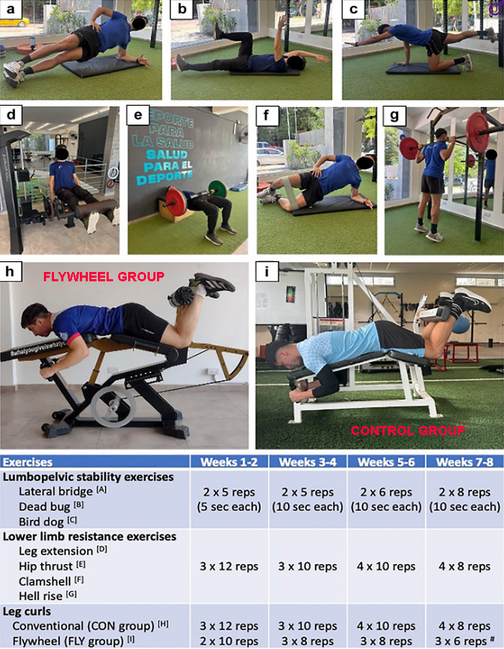
Exercises included in the preventive training program. (a) Lateral bridge. (b) Dead bug. (c) Bird dog. (d) Leg extension. (e) Hip thrust. (f) Clamshell. (g) Hell rise. (h) Conventional leg curl. (i) Flywheel leg curl. The bottom panel shows the training progression over the eight weeks. NB: # = bilateral concentric phase.
Before and after the 8-week intervention, the researchers assessed:
· Hamstring strength and flexibility levels, particularly eccentric strength (because lower levels of hamstring eccentric strength are associated with an increased injury risk).
· Pre- and post-program ‘BFLH fascicle length’. BFLH refers to the length of muscle fascicles (bundles of muscle fibers) in the biceps femoris long head (BFLH), a key muscle in the hamstring group located at the back of the thigh. Fascicle length is typically measured in centimetres or millimetres using imaging techniques like ultrasound or MRI, and is important because shorter fascicle length in the hamstrings is associated with greater injury risk.
· Finally the rate of re-injury was recorded during a 6-month follow-up period. Although important, this was treated as a secondary outcome because there would need to be a large number of re-injuries to generate a statistically robust analysis.
What they found
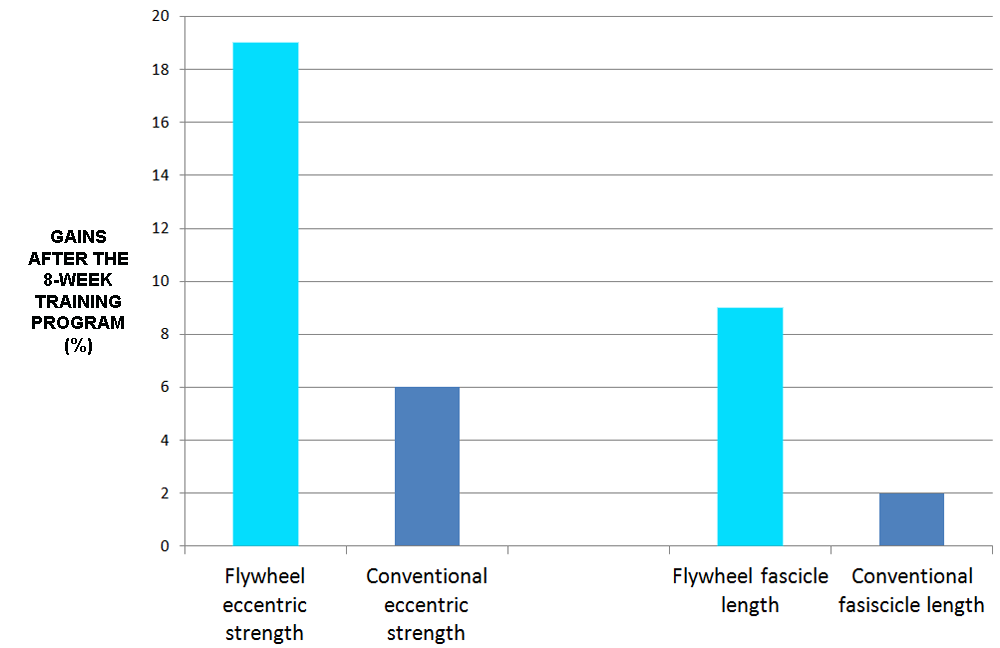
When the data was analyzed and the flywheel-trained athletes were compared with the control athletes, the findings were pretty clear cut (see figure 2). Athletes who performed flywheel leg curls experienced greater improvements in eccentric knee flexor strength (19% vs. 6% in the controls) and BFLH fascicle length (9% vs. 2% in the controls), as well as in other outcomes potentially associated with the risk of hamstring injury, such as isometric strength and hamstring flexibility. In addition, the flywheel-trained athletes presented a lower reinjury occurrence compared with those who trained with conventional leg curls; in the flywheel group, only one athlete sustained a re-injury compared with three athletes in the control group.
Figure 2: Flywheel vs. control leg curls, eccentric hamstring strength and fascicle length
Summary and practical application
For athletes with a history of hamstring injury, or those who want to prevent and/or rehab injury, these findings make for compelling reading. A training technique that is 3 x more effective at developing greater eccentric hamstring strength and fascicle length (both of which are associated with reduced hamstring injury risk) but which takes no more time than conventional training is a no brainer. Even better, the athletes undertaking flywheel leg curls had a subsequent hamstring injury risk that was 66% lower than the athletes using conventional leg curls. It’s true the number of re-injuries was small (3 in the conventional group vs. 1 in the flywheel group), which makes it difficult to obtain statistical significance. However, the much larger gains in eccentric strength and fascicle length in the flywheel-trained group provides a strong rationale for a causal mechanism, and that the lower injury rate in this study was real, rather than just due to a statistical anomaly.
If you are an athlete seeking better hamstring strength, flexibility and resilience against injury, the evidence strongly suggests that using flywheel training for leg curls is a superior option compared to conventional leg curls. If your local gym has an flywheel/inertial training device that allows you to perform leg curls, this is what you should use. If no such facility is available, you might want to consider a home-training inertial/flywheel device. These compact (and often portable) flywheel devices can work most of the major muscle groups while taking up minimal space.
This is in contrast to traditional strength training, which requires at minimum a barbell + stand, plus a range of weight plates and dumbbells. Traditional barbells and dumbbells typically require considerably more space (usually a dedicated home gym facility) and quite a bit of cash outlay. By contrast, an inertial flywheel set up can be had for a 3-figure sum, requiring only 1.5 to 2 metres (5 to 7 feet) of clearance around the athlete to perform exercises. This makes it an ideal set up for anyone setting up a home gym – for example in the garage or garden!
To get an idea of the versatility of inertial/flywheel devices, see the link below to Kynett’s video channel, which is extremely informative. Kynett is a Dutch manufacturer of affordable inertial flywheel training devices and will ship worldwide, but there are many others including Exxentric, Versa Pulley and Proinertial. More expensive devices generally buy you more flexibility with your training positions, and the best also offer precise loading and power measurement and feedback.
References
1. J Funct Morphol Kinesiol. 2021 Mar 17;6(1):29
2. J Sci Med Sport. 2017 Oct; 20(10):943-951
3. Front Physiol. 2017; 8():241
4. J. Strength Cond. Res. 10.1519/JSC.0000000000003005
5. Journal European Journal of Sport Science. Volume 17, 2017 - Issue 4, P369-377
6. Sports Med Open. 2018 Dec; 4: 55
7. Res. Sports Med. 2021; 27 1–21. 10.1080/15438627.2021.1958813
8. Res. Sports Med.2021; 1–14. 10.1080/15438627.2021.1954518
9. Int. J. Environ. Res. Public Health 18 (3), 1181. 10.3390/ijerph18031181
10. J Orthop Sports Phys Ther. 2010 Feb;40(2):67-81
11. Am J Sports Med. 2011 Nov;39(11):2296-303
12. Med Sci Sports Exerc. 2024 Oct 1;56(10):1893-1905
13. Scand J Med Sci Sports. 2003;13(4):244-250
14. J Sci Med Sport. 2020;23(11):1093-1099
15. Sports Health. 2025 Jul 30:19417381251355960. doi: 10.1177/19417381251355960. Online ahead of print

Andrew Hamilton

Latest Issue

Subscribe Today

Newsletter Sign Up
Testimonials
Dr. Alexandra Fandetti-Robin, Back & Body Chiropractic
Elspeth Cowell MSCh DpodM SRCh HCPC reg
William Hunter, Nuffield Health
Subscribe Today



Newsletter Sign Up

Coaches Testimonials
Dr. Alexandra Fandetti-Robin, Back & Body Chiropractic
Elspeth Cowell MSCh DpodM SRCh HCPC reg
William Hunter, Nuffield Health
Subscribe Today
Latest Issue


Keep up with latest sports science research and apply it to maximize performance
Today you have the chance to join a group of athletes, and sports coaches/trainers who all have something special in common...
They use the latest research to improve performance for themselves and their clients - both athletes and sports teams - with help from global specialists in the fields of sports science, sports medicine and sports psychology.
They do this by reading Sports Performance Bulletin, an easy-to-digest but serious-minded journal dedicated to high performance sports. SPB offers a wealth of information and insight into the latest research, in an easily-accessible and understood format, along with a wealth of practical recommendations.
*includes 3 coaching manuals
Get Inspired
All the latest techniques and approaches


Sports Performance Bulletin helps dedicated endurance athletes improve their performance. Sense-checking the latest sports science research, and sourcing evidence and case studies to support findings, Sports Performance Bulletin turns proven insights into easily digestible practical advice. Supporting athletes, coaches and professionals who wish to ensure their guidance and programmes are kept right up to date and based on credible science.
