
 close
close


 LOGIN
LOGINYou are viewing 1 of your 1 free articles. For unlimited access take a risk-free trial
Interval training: taking a more moderate approach
Does interval training for endurance performance always have to be high-intensity in nature? SPB looks at fascinating new research on the use of moderate-intensity interval training, and how it compares with regular training


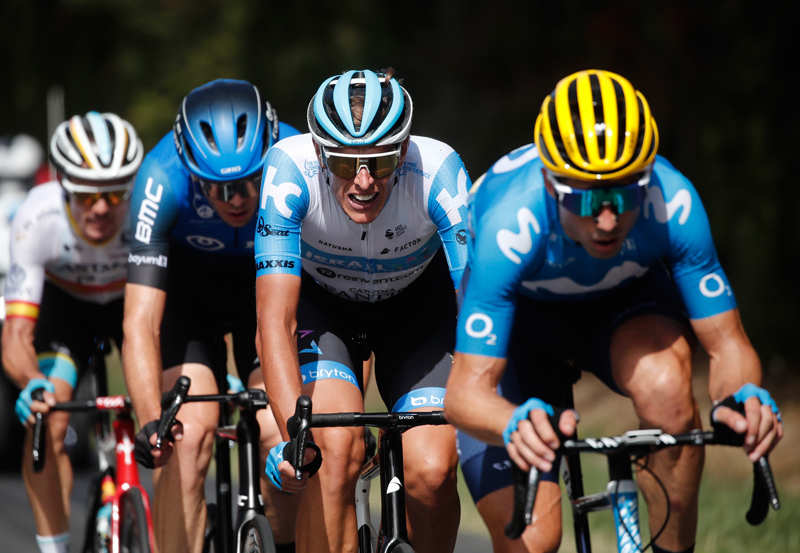
Over the past three decades, a large body of research has confirmed that interval training is an excellent method of improving fitness and that regular sessions of interval training can produce significant fitness gains in less time and with less effort than a higher volume of steady-state endurance training(1-4). Even better, the benefits of interval training can also be realised by amateur and recreational athletes – not just elite athletes. Indeed, recreational athletes who introduce intervals to a training schedule stand to gain even more than more advanced level athletes (who will almost certainly already be utilizing interval training in their training programs)(5).
High intensity intervals
In the early days of the interval training revolution, sessions were typically modelled around interval lengths lasting from 2-10 minutes, with intervals of 3-5 minutes becoming a popular and well-documented method for athletes and fitness enthusiasts seeking to improve aerobic fitness and endurance performance(6). The rationale for using 3-5 minute intervals is that there is a lag between starting a high-intensity effort and the cardiovascular system and muscles ‘catching up’ - a phenomenon that arises from the way the body responds to increase oxygen demand (more technically known as ‘oxygen kinetics’).
However, following landmark research by a Japanese professor called Izumi Tabata of the National Institute of Fitness and Sports in Kanoya, Japan(7), which found that just 8 x repeats of very high-intensity, shorter intervals of 20 seconds’ duration could achieve excellent gains in endurance fitness, the popularity of high-intensity interval training (HIIT) mushroomed! In the years following, subsequent research confirmed that HIIT training using short intervals can be a very effective method of sharpening endurance fitness in athletes(8-10).
A more moderate option
The term ‘HIIT’ when talking about interval training actually covers a range of interval durations and workout structures. The positive findings obtained by sessions of Tabata’s 20-second intervals has been replicated with intervals lengths from 1 minute down to as little as 10 seconds(11)! As a rule of thumb however, most HIIT sessions aim to generate a training intensity that is high enough to accumulate time spent at or close to 90-95% of maximal aerobic capacity. This is because research on this topic has concluded that accumulating time at this intensity is the best way to improve oxygen uptake and endurance performance(12-14).
However, while undoubtedly effective, there are some circumstances where a more moderate approach to interval training intensity is preferred. Although there’s no strict definition, moderate-intensity intervals generally involve performing intervals of between two and four minutes at an intensity of around 70-85% VO2max(15,16). One example of its use is where interval training is combined with blood flow restriction of the active limbs (see this article). The goal here is to use blood flow restriction in combination with moderate-intensity intervals to generate an equivalent training effect to that of HIIT but with less physiological stress, as has been demonstrated in runners and rowers(17). Another example is the use of moderate-intensity interval sessions in sedentary novices those who are obese, or patients with cardiovascular conditions – a training method that is generally better tolerated than HIIT yet still produces significant benefits in these populations(18).
Moderate-intensity intervals and athletes
Because HIIT is a very effective and time-efficient method of training, there’s been very little research into the use of moderate-intensity interval training in athletes. After all, if you can perform continuous moderate-intensity training for an hour or two uninterrupted at 70-85% of VO2max, why would you break that session up by adding add periods of rest? One possible reason is that (as with the blood flow restriction example), a session of moderate-intensity intervals imposes less physiological stress than HIIT sessions, or indeed, continuous steady-state sessions. In theory, this fact could be leveraged to allow athletes to perform a block of higher-volume moderate-intensity interval training without the same accumulation of fatigue that would occur with the same volume of continuous or multiple bouts of HIIT training. But is there any evidence for this theory from real-world studies on already well-trained endurance athletes performing a training program?
New research
To date, no studies have investigated the use of moderate-intensity interval sessions by athletes as part of a training program, but a brand new study on cyclists by a team of Norwegian scientists has provided some definitive answers(19). Published in the prestigious journal ‘Medicine and Science in Sports and Exercise’, this study compared the physiological effects of a moderate-intensity interval training (MIIT) microcycle followed by a 6-day active recovery period, with a time-matched regular training program over the same period during the general preparation phase in well-trained cyclists (see figure 1).
Figure 1: Periodization phases in a cycling season*
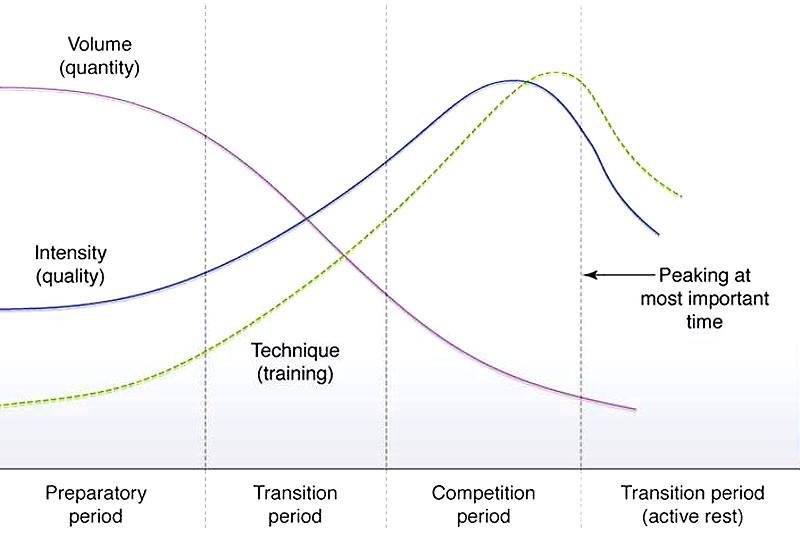
This plot is based on Matveyev’s model of periodization. The preparation period occurs early in the season and emphasizes lower-intensity training with relatively high training volumes in order to build a good ‘aerobic base’. As the competition period approaches, volume is reduced and intensity/quality is emphasized. *NB: adapted from Human Kinetics 2008
In this study, 30 well-trained male cyclists (average maximal oxygen consumption 70.5mL/kg/min – ie very fit!) completed both a 2-week block of MIIT and an equivalent 2-week block of their regular general preparation phase training. The order of these two 2-week blocks was randomized so as not to introduce any bias into the findings. Being a crossover design (ie cyclists who started with the MIIT block first then switched to the general preparation block and vice versa), each cyclists was able to serve as his own control, thus helping to increase the validity of the findings. The two separate 2-week training blocks were structured as follows:
· The MIIT block involved six moderate-intensity interval sessions over seven days, each with five to seven repeats of 10-14 minute work intervals (ie long intervals), performed at a perceived exertion (RPE) of 14-15 on the Borg 6-20 scale (‘somewhat hard’ to ‘hard’ - see table 1). A six-day active recovery period (maintaining recreational activity but no structured training) followed before testing on the 7th day.
· During the regular training block, the cyclists performed their regular preparatory-phase training routine, which primarily involved low-intensity exercise. However, they were also specifically instructed to perform either two MIIT sessions (as described above) per week, or one MIIT session and one high-intensity interval session per week.
Table 1: Borg’s ‘Perceived Rate of Exertion’
|
Scale Number |
Perceived Effort Level |
Approximate Heart Rate |
|
|
|
|
|
6 |
Rest |
60-70 |
|
7-8 |
Very, very light |
80 |
|
9-10 |
Very light |
100 |
|
11-12 |
Fairly light |
115 |
|
13-14 |
Somewhat hard |
130 |
|
15-16 |
Hard |
150 |
|
17-18 |
Very hard |
160-170 |
|
19 |
Very, very hard |
180 |
|
20 |
Total exhaustion |
Maximum heart rate |
Heart rates shown are approximate and will also depend on age.
Before and after both the interventions, measures of endurance performance were made. These included:
· Maximal average power output for 15 minutes (an excellent indicator of maximal aerobic pace).
· Maximal average power output at a blood lactate concentration of 4mmol/L (the approximate point at which lactate starts to rapidly accumulate, breathing becomes laboured and exercise becomes unsustainable.
· Maximum oxygen uptake (VO2max).
· The 1-minute peak power output during the incremental testing to VO2max.
The researchers then compared the before/after results from the two different training blocks to come up with some conclusions.
What they found
Bearing in mind that these cyclists were already well-trained, what the researchers found surprised them. Firstly, they noted that the Training Impulse scores were not significantly different between the two blocks. Training impulse is commonly abbreviated as ‘TRIMP’ (TRaining IMPulse), and assesses the overall cumulative training load over a serious of training sessions based on heart rate, workloads and total durations at each workload)(20). Yet despite the same overall TRIMP scores, the training adaptations that resulted differed significantly:
· When the cyclists performed the MIIT block, their maximum power output at a blood lactate concentration of 4mmol/L rose significantly (by 4.0%), whereas the were no significant gains when performing the regular training block.
· VO2max rose by 2.0% following the MIIT block with no improvement observed in the regular block.
· A similar finding was seen for the maximum power at VO2max, which rose by 2.5% when the cyclists performed the MIIT block but did not improve at all following the regular block.
· The maximum average power over 15 minutes was not significantly different between the two blocks, but there was a trend towards greater gains following MIIT compared to the regular block (a larger study would likely have confirmed this trend as significant).
In the summing up, the authors concluded that “six moderate-intensity interval sessions over seven days, followed by a six-day active recovery period, induces superior improvements in endurance performance compared to a time-matched regular training period in well-trained cyclists”.
Practical advice for athletes
These results surprised the researchers because the cyclists who participated were well trained with an already excellent endurance capacity. In theory, these moderate-intensity intervals shouldn’t have produced much of a significant training effect, especially as the intensity of each interval was modest, corresponding to 66% of power output at VO2max, and 85% of maximal heart rate – ie well out of the 90-95% VO2max zone typically cited as ideal for generating aerobic capacity gains. The MIIT block also outperformed the cyclists’ regular training block, proving its superiority.
How did these gains come about? The researchers didn’t speculate, but one explanation is that the 6-day MIIT block involved 60-90 minutes per day of somewhat hard to hard effort, each day for six days. Although not high intensity per se, it was higher in intensity that the kind of steady-state aerobic base building rides that most cyclists perform in the general preparation phase of the season – and was repeated day after day. On top of that, the MIIT block was followed by a week of light activity during which the cyclists could rest and fully recuperate to reap the benefits of the previous week’s training block. In the regular training block, there was no such recovery and adaptation period, despite the overall workload for each 2-week block being the same.
Either way, what this study reveals is encouraging as it gives endurance athletes yet another tool for maintaining and improving their endurance fitness. In particular, the use of MIIT, which by definition is not high in intensity but moderate intensity, could be of particular value when HIIT is less appropriate – for example, when returning to training after injury or illness (ie where there’s been an enforced break), or early in the season when the muscles haven’t had time to adapt to the higher loadings of HIIT. Another example where it may be suitable is for novice athletes who are feeling their way into interval training and may struggle with the more intense nature of HIIT.
There are downsides to MIIT use however. Firstly, the overall high TRIMP loading in the first week means you will need to take a recovery period afterwards to reap the benefits (ie you couldn’t/shouldn’t perform MIIT week after week). It should be blended in with regular training. Also, compared to HIIT, there’s a lot more time investment involved, which may be difficult for athletes with work and family commitments. Finally, when sharpening up for competition, MIIT is almost certainly less effective and time efficient than incorporating sessions of HIIT. That’s because HIIT sessions combine high intensity with relatively low workload, meaning that you won’t require a long taper before your big day!
References
1. PLoS One. 2014 Apr 15;9(4):e95025
2. Eur J Sport Sci. 2016;16(3):344-9
3. J Sci Med Sport 2007; 10: 27–35
4. Am J Physiol Regul Integr Comp Physiol 2008; 294: R966–R974
5. Scand J Med Sci Sports 2010; 20 Suppl 2: 1–106.
6. Med Sci Sports Exerc. Apr 2007;39(4):665-71
7. Med Sci Sports Exerc 1997; Volume 29(3), pp 390-395
8. Eur J Appl Physiol. 2010 Oct;110(3):597-606
9. Eur J Appl Physiol. 2010 Sep;110(1):153-60
10. Eur J Appl Physiol. 2014 Nov;114(11):2427-36
11. J Sports Sci Med. 2024 Dec 1;23(4):812–821
12. Sports Med. (2013) 43(5):313–38
13. Eur J Appl Physiol. Jul 2019;119(7):1513-1523
14. Physiol Behav. May 15 2018;189:10-15
15. Scientific World Journal. 2015: 639369
16. Biol Sport. 2016 Jun;33(2):145-52
17. J Strength Cond Res. 2024 Jun 1;38(6):e299-e303
18. Biol Sport. 2023 Oct;40(4):1159-1167
19. Med Sci Sports Exerc. 2025 Mar 18. doi: 10.1249/MSS.0000000000003706. Online ahead of print
20. Front Neurosci. 2024 May 23:18:1341972.

Andrew Hamilton

Latest Issue
Subscribe Today
Newsletter Sign Up
Testimonials
Dr. Alexandra Fandetti-Robin, Back & Body Chiropractic
Elspeth Cowell MSCh DpodM SRCh HCPC reg
William Hunter, Nuffield Health
Subscribe Today


Newsletter Sign Up

Coaches Testimonials
Dr. Alexandra Fandetti-Robin, Back & Body Chiropractic
Elspeth Cowell MSCh DpodM SRCh HCPC reg
William Hunter, Nuffield Health
Subscribe Today
Latest Issue
Keep up with latest sports science research and apply it to maximize performance
Today you have the chance to join a group of athletes, and sports coaches/trainers who all have something special in common...
They use the latest research to improve performance for themselves and their clients - both athletes and sports teams - with help from global specialists in the fields of sports science, sports medicine and sports psychology.
They do this by reading Sports Performance Bulletin, an easy-to-digest but serious-minded journal dedicated to high performance sports. SPB offers a wealth of information and insight into the latest research, in an easily-accessible and understood format, along with a wealth of practical recommendations.
*includes 3 coaching manuals
Get Inspired
All the latest techniques and approaches


Sports Performance Bulletin helps dedicated endurance athletes improve their performance. Sense-checking the latest sports science research, and sourcing evidence and case studies to support findings, Sports Performance Bulletin turns proven insights into easily digestible practical advice. Supporting athletes, coaches and professionals who wish to ensure their guidance and programmes are kept right up to date and based on credible science.
