
 close


 LOGIN
Strength and BFR training: good for all?
One of the most important goals in any training program is to stay healthy. Training is effective when it’s consistent, but it’s much more difficult to remain consistent with training when injured. When injuries do occur, it’s critical to find ways to create a training effect that doesn’t re-aggravate the injury or delay healing in any way. It’s critical to have training options that allow for training continuity.
Strength training is a key component of any effective training program as it can lead to increases in strength, hypertrophy (muscle size), and power. This is particularly true of heavy resistance training, which is a particularly potent stimulus for facilitating these training adaptations. However, heavy strength training is also one of the most stressful types of training an athlete can perform. And when an athlete is injured, it becomes very difficult to continue to strength training effectively when certain areas of the body are compromised.
The BFR alternative
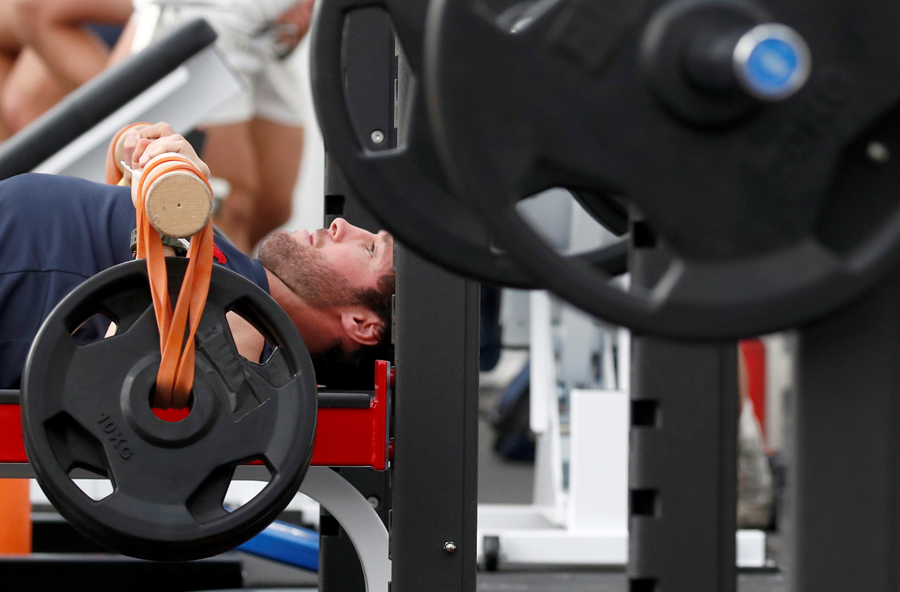
Fortunately, there may be an alternative during times of injury. Blood flow restriction is a type of resistance training that uses much lower loads - as little as 30% of maximal strength. By placing carefully designed devices on the limbs, it’s possible to limit the blood flow out of but not into the targeted limbs. When combined with high repetitions and short rest periods, it’s possible to create a physiological effect that is quite similar to that produced by heavy strength training, which leads to improvements in strength, hypertrophy, and power. This can allow otherwise injured athletes to strength train with lower loads, making it possible to continue to make progress despite their injuries. Let’s take a look at a recent study that directly compares blood flow restriction training and heavy resistance training.
New research
A group of Chinese researchers sought to investigate the impact of high-load resistance training versus low-load blood flow restriction training on strength, hypertrophy, and symmetry(1). The premise of the study was simple: a group of subjects would resistance train for six weeks using the Bulgarian split squat. This exercise involves squatting straight down with one leg as the other leg is extended behind the body with the top of the foot resting on a bench. With one leg, the subjects would perform heavy resistance training and on the other leg they would perform low-load blood flow restriction training. The researchers wanted to see whether training adaptations were different between the two protocols, and if so, how.
The researchers recruited 24 subjects who had been resistance training for at least two years, performing at least two resistance training sessions per week. All subjects were required to be able to back squat at least 1.5 times their own bodyweight, be uninjured, and be free from any potential issues that would make blood flow restriction training dangerous. The subjects were randomly assigned to perform blood flow restriction training on either the dominant or non-dominant leg.
What they tested
The subjects were tested twice during the study, both before and after the training intervention. The subjects were tested for one repetition maximum in the Bulgarian split squat, muscle thickness of the vastus lateralis (outer frontal thigh), and single-leg countermovement jump. Testing was performed on both sides of the body. Training was performed for six weeks, with three sessions per week for a total of 18 training sessions. In the blood flow restriction training group, a load of 30% of maximum loading for one rep (1-RM) was used. The subjects performed 4 x sets of 30-15-15-15 repetitions, taking 30 seconds of rest between sets. Blood flow was restriction implemented with a KAATSU device, and the pressure used was set at 80% of the pressure predicted to occlude the artery (this calculation was made for each individual). By contrast, the heavy resistance training group performed 4 x sets of 10 repetitions using 80% of 1-RM repetition, with 120 seconds rest between sets. Sets were terminated prior to achieving the targeted repetitions if subjects were no longer able to perform the reps successfully.
The findings
The results of the study were straightforward: muscle thickness of the vastus lateralis was significantly increased in both the heavy resistance and blood flow restriction training legs (see figure 1). Importantly, there were no significant differences between legs. Similarly, improvements in single-leg countermovement jump were seen on both legs, again without significant differences between the two legs. The same result was found for peak power during the jump (figure 2). Finally, maximal squatting strength was improved on both legs, with no significant differences between the legs.
Figure 1: Vastus lateralis muscle thickness – BFR vs. heavy-weight training
You need to be logged in to continue reading.
Please register for limited access or take a 30-day risk-free trial of Sports Performance Bulletin to experience the full benefits of a subscription. TAKE A RISK-FREE TRIAL
Latest Issue
Subscribe Today
Newsletter Sign Up
Testimonials
Dr. Alexandra Fandetti-Robin, Back & Body Chiropractic
Elspeth Cowell MSCh DpodM SRCh HCPC reg
William Hunter, Nuffield Health
Subscribe Today


Newsletter Sign Up

Coaches Testimonials
Dr. Alexandra Fandetti-Robin, Back & Body Chiropractic
Elspeth Cowell MSCh DpodM SRCh HCPC reg
William Hunter, Nuffield Health
Subscribe Today
Latest Issue
Keep up with latest sports science research and apply it to maximize performance
Today you have the chance to join a group of athletes, and sports coaches/trainers who all have something special in common...
They use the latest research to improve performance for themselves and their clients - both athletes and sports teams - with help from global specialists in the fields of sports science, sports medicine and sports psychology.
They do this by reading Sports Performance Bulletin, an easy-to-digest but serious-minded journal dedicated to high performance sports. SPB offers a wealth of information and insight into the latest research, in an easily-accessible and understood format, along with a wealth of practical recommendations.
*includes 3 coaching manuals
Get Inspired
All the latest techniques and approaches


Sports Performance Bulletin helps dedicated endurance athletes improve their performance. Sense-checking the latest sports science research, and sourcing evidence and case studies to support findings, Sports Performance Bulletin turns proven insights into easily digestible practical advice. Supporting athletes, coaches and professionals who wish to ensure their guidance and programmes are kept right up to date and based on credible science.
