
 close
close


 LOGIN
LOGINYou are viewing 1 of your 1 free articles. For unlimited access take a risk-free trial
Athlete health: time for tea
SPB looks at recent research on black and green tea, and asks what these teas can do for health and performance



Originating from China around 2000 years ago, tea is the world’s most widely consumed beverage after water. It’s hardly surprising therefore that tea has been extensively studied for its health-giving properties. Much of the early speculation was based on purely anecdotal reports but recent research indicates that tea really does seem to provide health and potential performance benefits too.
All tea is made from the leaves of a plant called ‘Camellia Sinensis’, which is an evergreen, tropical plant with green, shiny pointed leaves that look quite similar to privet hedges seen in here in Britain. Although most of the tea consumed in the UK is black tea, there are actually two main types, depending on the manufacturing process used:
● Fermented or black tea, which undergoes a full post-harvest fermentation stage before drying and steaming. Black tea is what most people mean by ‘tea’.
● Non-fermented or green tea, produced by immediate drying and steaming the fresh leaves, which inactivates the fermenting enzymes.
Health benefits
A number of scientific studies have looked at the health and performance effects of compounds in tea called ‘catechins’. These compounds are powerful antioxidants, which are believed to help reduce the damage to cells in the body at the molecular level, thus protecting against a number of degenerative and metabolic diseases. Catechins are found in both green and black tea, although green tea is a richer source. This explains why many (though not all) of the studies into the health and performance benefits have used green tea.
For example, research on humans suggests that 1-6 cups of green tea per day can reduce damage to cell walls and DNA, while animal studies show that green tea inhibits the formation of cancers of the skin, lung, mouth, esophagus, stomach, liver, kidney and prostate. Studies on black tea are also encouraging and suggest that regular black tea consumption can help(1):
· Reduce the risk of skin, ovarian and lung cancer.
· Reduce the risk of rheumatoid arthritis.
· Improve blood sugar metabolism, thereby reducing the risk of type II diabetes.
· Improve aspects of metabolism associated with cardiovascular health, reducing the risk of stroke and heart attack.
Scientists have also investigated the possible benefits of tea consumption (especially green tea) for weight management. A number of animal studies have shown that green tea extract (rich in the catechin called EGCG) can dramatically enhance fat burning, weight loss and endurance exercise performance in mice. But can we also reap these benefits? Although some human studies on green tea consumption and weight loss have produced some positive effects, others have failed to find any significant benefit. However, the most recent research continues to indicate that regular intake of green tea and/or green tea extracts provides an ‘anti-obesity’ effect, and that high intakes of green tea catechins CAN produce a modest increase in fat oxidation(2).
Definitive research
For example, a study, published just over a year ago the Journal of the International Society of Sports Nutrition investigated whether supplementing exercise with green tea catechins provides an extra weight loss effect compared to exercise alone(3). The researchers also looked at the effect of green tea consumption on key markers of metabolic health. Given that the previous research on green tea efficacy had been inconsistent prior to this study, the researchers sought to specifically determine the weight loss benefits of green tea when combined with structured exercise programs. In order to arrive at a definitive conclusion, they conducted a systematic review and meta-analysis of all the previous studies on this topic. This type of study is considered ‘gold standard’; by pooling the data from all the previous studies on a topic that meet strict inclusion criteria, it’s possible to draw far more robust conclusions that it is possible from one study alone.
To do this, the researchers initially identified 1,000 studies, out of which, ten studies met the strict inclusion criteria for meta-analysis. [NB: data can only be successfully combined in a meta analysis if the studies from which that data is drawn are consistent in methodology and scientific rigour.] In total, these studies involved a total of 476 participants, who consumed green tea dosages ranging from approximately 100mg to 1,500mg per day. In addition to weight loss outcomes, the researchers also looked for outcomes on body weight, BMI, body fat percentage, fat mass and blood lipid profiles - triglycerides, LDL cholesterol, HDL cholesterol, and total cholesterol.
What they found
When the pooled data was statistically analyzed, it was apparent that those who exercised and consumed green tea experienced a small but consistent additional BMI and weight/fat loss compared to those who exercised but did not consume green tea (see figure 1 below). In other words, while the additional weight loss benefits are likely modest, regularly consuming green tea when combined with an exercise regimen does help as part of a weight management plan. Importantly, any side effects from green tea consumption were uncommon, meaning that most people can take it without any adverse outcomes.
When it came to markers of metabolic health however, there was no clear benefit from green tea consumption plus exercise compared to exercise alone. The researchers postulated that because the metabolic improvements seen in an exercise program are so significant anyway, the signal for additional improvement with green tea consumption was likely swamped by that from exercise. In other words, the cardiovascular benefits traditionally associated with green tea may not be amplified by exercise because exercise itself is already such a powerful driver of lipid marker improvements. In addition, the researchers also noted that the individual responses to green tea consumption were quite variable, making a harder to discern a clear trend.
Figure 1: Body composition improvements with green tea plus exercise vs. exercise alone
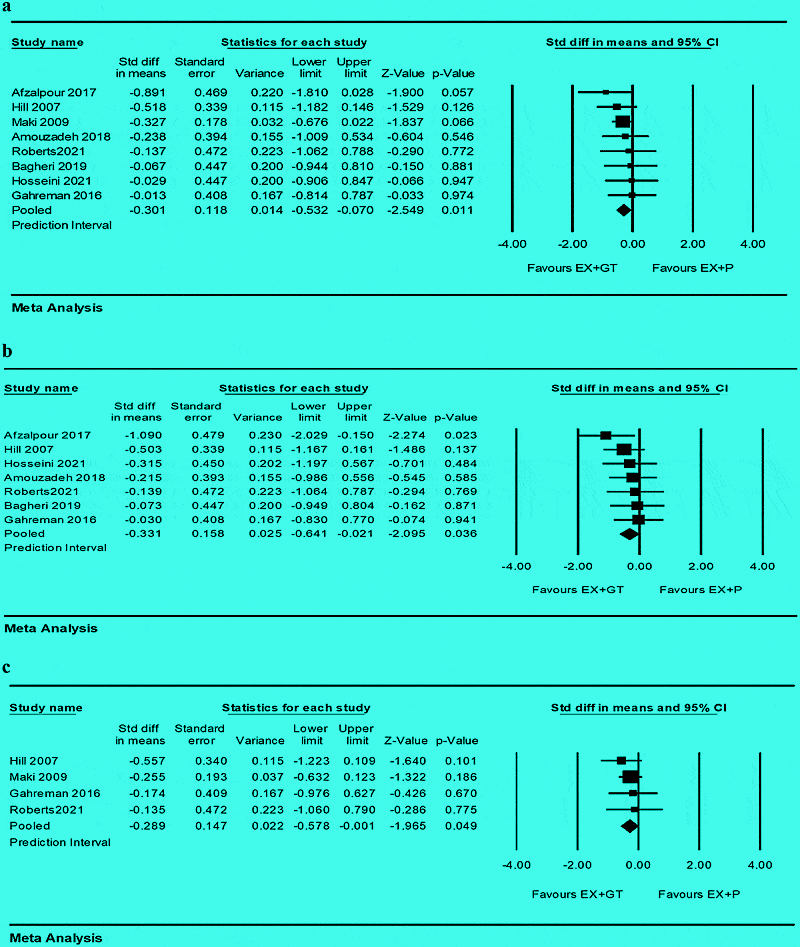
In this forest plot, each square represents an individual study and each diamond, the average finding for the group above. The diamonds for (a) weight, (b) BMI and (c) fat mass average outcomes all lie wholly to the left of the zero line, indicating a benefit from green tea plus exercise vs. exercise alone.
In summary, the researchers concluded that while green tea is a useful addition to an exercise program in terms of weight loss, it’ not a magic bullet - the focus still needs to be on exercise as the main driver However, it is a safe supplement that can deliver extra weight-loss benefits, and is worthy of consideration when weight management/loss is a priority. Remember too that both black and green tea provide 20-50mgs of caffeine per cup; given that caffeine is now known to be one of the best ergogenic aids there is for enhancing endurance performance, it’s easy to understand why consuming green and/or black tea before and during exercise could be a wise move!
Using tea in practice
Much as you may be tempted, it’s simply not practical to stop and brew up in the middle of a long workout or race! The good news is that you can easily make your own tasty tea-based sport drink to both hydrate and energize on the move. Even better, it’s cheap and quick to make. Try this recipe:
Ingredients
• 3 bags of your favourite tea blend (black or green)
• 500mls of water
• 500mls of apple/apple & mango/pineapple juice
• ¼ teaspoon of salt
Directions
• Place the 500mls of water into a small saucepan and bring to the boil
• Add the teabags and allow to simmer gently for 4 minutes
• After 4 minutes, remove the teabags and allow the tea to cool
• Once cool, pour the tea into a 1 litre container then add the salt and juice of your choice
• Shake well and place in the fridge to chill
• Pour into your drinks bottle(s) just before commencing your workout (you will have enough for 2 x 500ml bottles)
Each 500ml bottle will deliver around 26g of carbohydrate (just over 100kcals), 300mgs of sodium and 60mgs of caffeine. For a slightly sweeter taste and higher carbohydrate content, you can add 1 or 2 dessertspoons of honey to the tea while still hot in the saucepan.
References
1. Curr Pharm Des. 2013 ; 19(34): 6141–6147
2. J Nutr Biochem. 2016 Nov 2;43:1-10
3. J Int Soc Sports Nutr. 2024 Dec;21(1):2411029

Andrew Hamilton

Latest Issue
Subscribe Today
Newsletter Sign Up
Testimonials
Dr. Alexandra Fandetti-Robin, Back & Body Chiropractic
Elspeth Cowell MSCh DpodM SRCh HCPC reg
William Hunter, Nuffield Health
Subscribe Today

Newsletter Sign Up

Coaches Testimonials
Dr. Alexandra Fandetti-Robin, Back & Body Chiropractic
Elspeth Cowell MSCh DpodM SRCh HCPC reg
William Hunter, Nuffield Health
Subscribe Today
Latest Issue

Keep up with latest sports science research and apply it to maximize performance
Today you have the chance to join a group of athletes, and sports coaches/trainers who all have something special in common...
They use the latest research to improve performance for themselves and their clients - both athletes and sports teams - with help from global specialists in the fields of sports science, sports medicine and sports psychology.
They do this by reading Sports Performance Bulletin, an easy-to-digest but serious-minded journal dedicated to high performance sports. SPB offers a wealth of information and insight into the latest research, in an easily-accessible and understood format, along with a wealth of practical recommendations.
*includes 3 coaching manuals
Get Inspired
All the latest techniques and approaches


Sports Performance Bulletin helps dedicated endurance athletes improve their performance. Sense-checking the latest sports science research, and sourcing evidence and case studies to support findings, Sports Performance Bulletin turns proven insights into easily digestible practical advice. Supporting athletes, coaches and professionals who wish to ensure their guidance and programmes are kept right up to date and based on credible science.
