
 close
close


 LOGIN
LOGINYou are viewing 1 of your 1 free articles. For unlimited access take a risk-free trial
New world record: the first ever official sub 2-hour marathon!
In 2018, SPB highlighted new research predicting the first ever official sub 2-hour marathon in 2026. On April 26th 2026, it happened!



Back in 2018, I wrote about some fascinating new research published by a group of international scientists from Brazil, Switzerland and Greece [Open Access J Sports Med. 2018; 9: 139–145]. Basically, the scientists involved summarized the key factors known to be essential when trying to improve marathon performance, and then performed a mathematical analysis to predict when the first sub-2-hour marathon would be run by a male runner.
Predicting the future
To do this, the researchers collated the best official marathon race times from males and females. This included data from the 1999–2018 (up to April 2018) World Championships and the Olympics (the best official Olympic Marathon race times since 1920 for males and 1984 for females, which was the year when the marathon running distance was standardized and involved females, respectively).They also included the times of the fastest marathons run in a given year for both males and females.
These times were then subject to a ‘regression analysis’, which is a mathematical technique to model a set of points lying on a curve from data already collected, and to predict where the curve is heading – in this case, how long it should take to hit the 2-hour time barrier. The equation that best fitted the data was as follows:
Y =0.045X2–15.12X +3194
This yielded a predicted date of 2027 for the first sub-2-hour marathon.
When the Kipchoge’s 2017 record using Nike’s Zoom VaporFly Elite shoes was included, the regression equation was slightly different:
Y =0.0417X2–14.18X +3128
This equation yielded a predicted date of 2026.
The future is here!
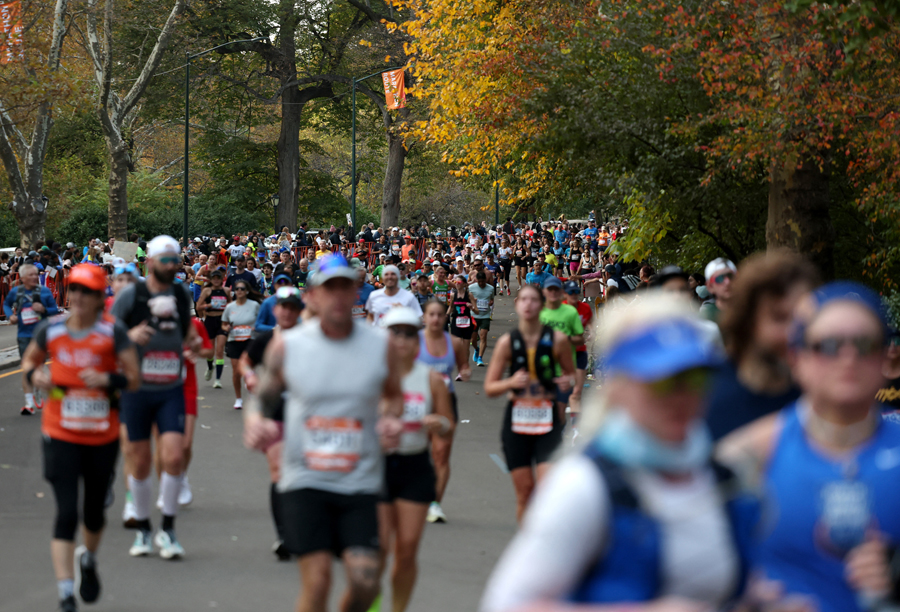
Yesterday, the future arrived at the 2026 London Marathon when Kenyan runner Sabastian Sawe made history at the London Marathon by becoming the first man to officially break two hours for the distance, winning the World Athletics Platinum Label road race in a world record* of 1:59:30. He didn’t just break the 2-hour barrier - he smashed right through it! Spare a thought for the remarkable performance of Ethiopian Yomif Kejelcha, who finished second in 1:59:41 – the second-fastest time in history and the fastest marathon debut ever. It must have been something of a bittersweet experience to break through the 2-hour barrier and the previous world record, but only place second. Let’s not forget too the superb performance by Ethiopian Tigst Assefa in the women’s race, who successfully defended her title with an improvement on her own women-only world record of 2:15:41.
Understanding how to run faster
We cannot but marvel at these performances, but are there any lessons that the rest of us can learn about how to run faster? How much of the performance gain needed to break through the 2-hour barrier was due to better endurance training techniques, and how much was due to other factors such as better conditioning and superior shoe technology? These are the questions we have answered, and which you can find in this article.
Here at SPB, our job is to present the latest findings to you from the world of sports science to help you (literally) keep ahead of the pack. As you can see from our article published eight years ago, we are doing just that! So if performance really matters to you - regardless of whether you’re a recreational, amateur or elite athletes - make sure you subscribe to SPB and STAY ahead of the pack!

Andrew Hamilton

Latest Issue
Subscribe Today
Newsletter Sign Up
Testimonials
Dr. Alexandra Fandetti-Robin, Back & Body Chiropractic
Elspeth Cowell MSCh DpodM SRCh HCPC reg
William Hunter, Nuffield Health
Subscribe Today


Newsletter Sign Up

Coaches Testimonials
Dr. Alexandra Fandetti-Robin, Back & Body Chiropractic
Elspeth Cowell MSCh DpodM SRCh HCPC reg
William Hunter, Nuffield Health
Subscribe Today
Latest Issue
Keep up with latest sports science research and apply it to maximize performance
Today you have the chance to join a group of athletes, and sports coaches/trainers who all have something special in common...
They use the latest research to improve performance for themselves and their clients - both athletes and sports teams - with help from global specialists in the fields of sports science, sports medicine and sports psychology.
They do this by reading Sports Performance Bulletin, an easy-to-digest but serious-minded journal dedicated to high performance sports. SPB offers a wealth of information and insight into the latest research, in an easily-accessible and understood format, along with a wealth of practical recommendations.
*includes 3 coaching manuals
Get Inspired
All the latest techniques and approaches


Sports Performance Bulletin helps dedicated endurance athletes improve their performance. Sense-checking the latest sports science research, and sourcing evidence and case studies to support findings, Sports Performance Bulletin turns proven insights into easily digestible practical advice. Supporting athletes, coaches and professionals who wish to ensure their guidance and programmes are kept right up to date and based on credible science.
